Chinese Stele Rubbing: The Feng Shui Meaning of Ink, Stone, and Contact
A stele rubbing is one of the quietest objects in Chinese culture. No glaze, no carving, no gemstone colour invites argument. There is only paper, a black field of ink, and characters that stay white because the stone beneath them was cut away. Yet for a thousand years these sheets were handled like original paintings, carried between provinces and hidden during wars. Everything a rubbing means is decided in the twenty minutes of contact between paper and stone.
What a Stele Rubbing Actually Is
A stele is a standing slab of limestone or sandstone, carved with a text and raised at a temple, tomb, bridge, or mountain pass. The carving is intaglio: the calligrapher’s brushstrokes are cut into the surface, so the characters sit below the plane of the stone. A rubbing records that recess. Paper is laid over the face, wetted, pressed into every groove, then tapped with an ink pad so ink touches only the raised field. The characters, being lower, take no ink and stay the colour of paper. What results is not a photograph but a physical impression, taken at one moment by one pair of hands.
Why the Image Arrives Reversed
A rubbing reads backwards. Paper pressed onto a carved surface takes the carving in mirror image, as a fingerprint does. Steles were cut so that the finished sheet reads correctly, which means the mason carved every character in reverse, planning the outcome rather than the act. This carries most of the object’s weight. The stone is the source, the paper the receiver, and the source only becomes legible after it has passed through another body. In feng shui terms this is a yang text in a yin medium, and the reversal is the mechanism, not a flaw.
Paper, Ink Pad, and the Pressure of a Hand
The technique is simple to describe and hard to do well: a poor rubbing is blotchy or torn, a good one evenly dark with crisp edges.
- Clean the face. Dust and lichen are brushed from the recesses; anything left inside prints as a white speck.
- Wet and seat the paper. Thin absorbent paper is misted on and worked down with a stiff brush until it sinks into every cut.
- Drive out the air. A felt pad is struck over the sheet until the paper sits tight and the characters show as shallow hollows.
- Tap the ink. A cloth pad loaded with light ink is dabbed, never wiped, building tone in thin layers.
- Lift while barely damp. Peeled too wet the sheet stretches; peeled too dry it tears at the edges of a stroke.
Every step is a hand judgement, which is why two rubbings of one stele taken a year apart can look like different works.
Black Ground, White Characters
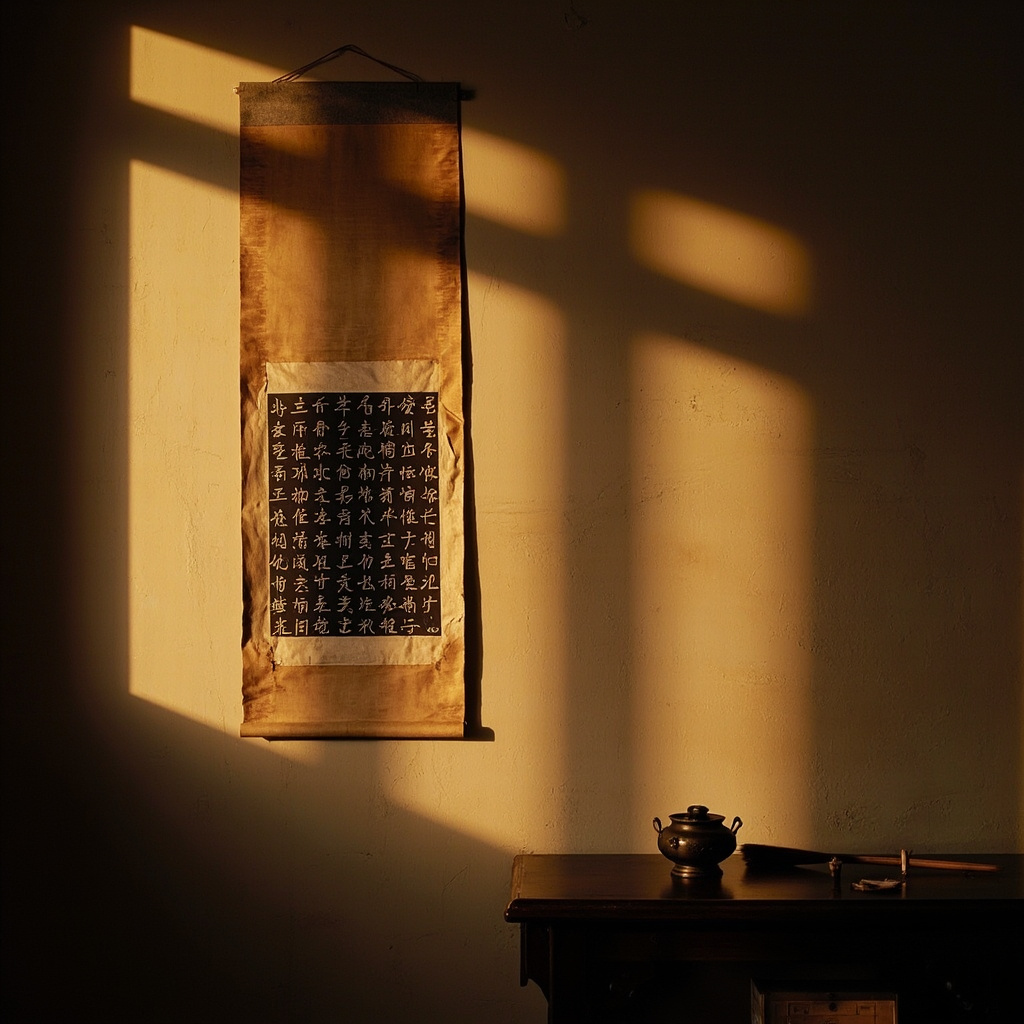
The finished sheet is almost entirely black, with narrow white strokes floating in it. Here the field is filled and the text is void, inverting the usual order of dark strokes on a light ground. Practitioners read it as a picture of how a space works: the broad dark area is the container, still and receptive; the white strokes are the moving line. On a wall the sheet behaves like a window cut into a solid surface, drawing the eye to light rather than mass. That is the opposite of most framed art, and it is why a rubbing calms a busy room without adding another pattern.
The Stone as a Clock
Rubbings are dated and ranked by age, and the ranking is not sentimental. Each impression lifts a trace of the stone with it: ink pad pressure rounds the lip of a carved stroke, damp paper loosens a grain of surface, weather does the rest. A stele crisp in the Tang dynasty may be a ghost today, its strokes softened into troughs. So an early rubbing can preserve a text no longer legible on the stone itself. Collectors call these sheets the shadow the stone cast when it was young, and a temple boxes a good rubbing because the stele outdoors is dying.
Why Collectors Treat Rubbings as Originals
In the West a print is a reproduction. In the Chinese tradition a rubbing is closer to a relic. It was never a picture of a monument for people who could not travel; it was the monument, transferred. Scholars wrote colophons in the margins, added their own seals, and bound them into albums that became objects in their own right. A sheet carrying three centuries of seals is a document of attention: each mark records someone handling it and thinking it worth passing on. That accumulated handling is what the culture means by qi in its practical sense. The object has been used, and the use is visible.
Where a Rubbing Belongs in a House
Mounted as a scroll or framed flat, a rubbing asks for a particular wall. It reads best at close range, because the point is the text. Its black field is heavy and still, so it steadies a wall that would otherwise be restless:
- The study or home office. Its traditional home, and still the best. Hang it beside the desk at seated eye level, as background rather than subject.
- The entry hallway. One deep, quiet field steadies a short corridor. Keep it on a side wall, not facing the door.
- A stair landing. Passing glances suit a tall scroll, provided the bottom edge clears head height.
- A reading corner. Hung lower than a painting, so a seated reader can follow the characters.
What to Avoid
Three placements undo the object. Do not hang a rubbing directly above a bed: the sheet carries the authority of a formal public text, the wrong register for sleep. Do not face one at a mirror, where the reflection doubles a dense black field and turns a still wall busy. Do not put one on a damp exterior wall or in a bathroom, where paper cockles and foxing spreads within a season. Interior walls, away from moisture and glare, are the whole rule.
Living With a Rubbing Over Time
The object changes as it is kept. Paper resting in a dry room for decades acquires a soft, even tone, and the ink settles into a matt black. Keep it out of direct sun, dust it with a soft brush, and handle the mounting by the wooden rollers only, never the paper. If framed, use UV-filtering glass and a mat that keeps the sheet off the surface. Aired yearly and reboxed, a scroll stays supple; paper never unrolled grows brittle.
A Record Made by Touch
What makes the stele rubbing unusual among feng shui objects is that its power lies neither in its material nor its placement, but in the event that produced it: one surface pressed against another until a transfer occurred. Every later reading repeats that event at a smaller scale, the eye crossing a black field to find the white text the stone gave up. Hung well and kept dry, it turns a wall into a record of contact.