Chinese Guqin Feng Shui Meaning: The Scholar’s Seven-String Zither
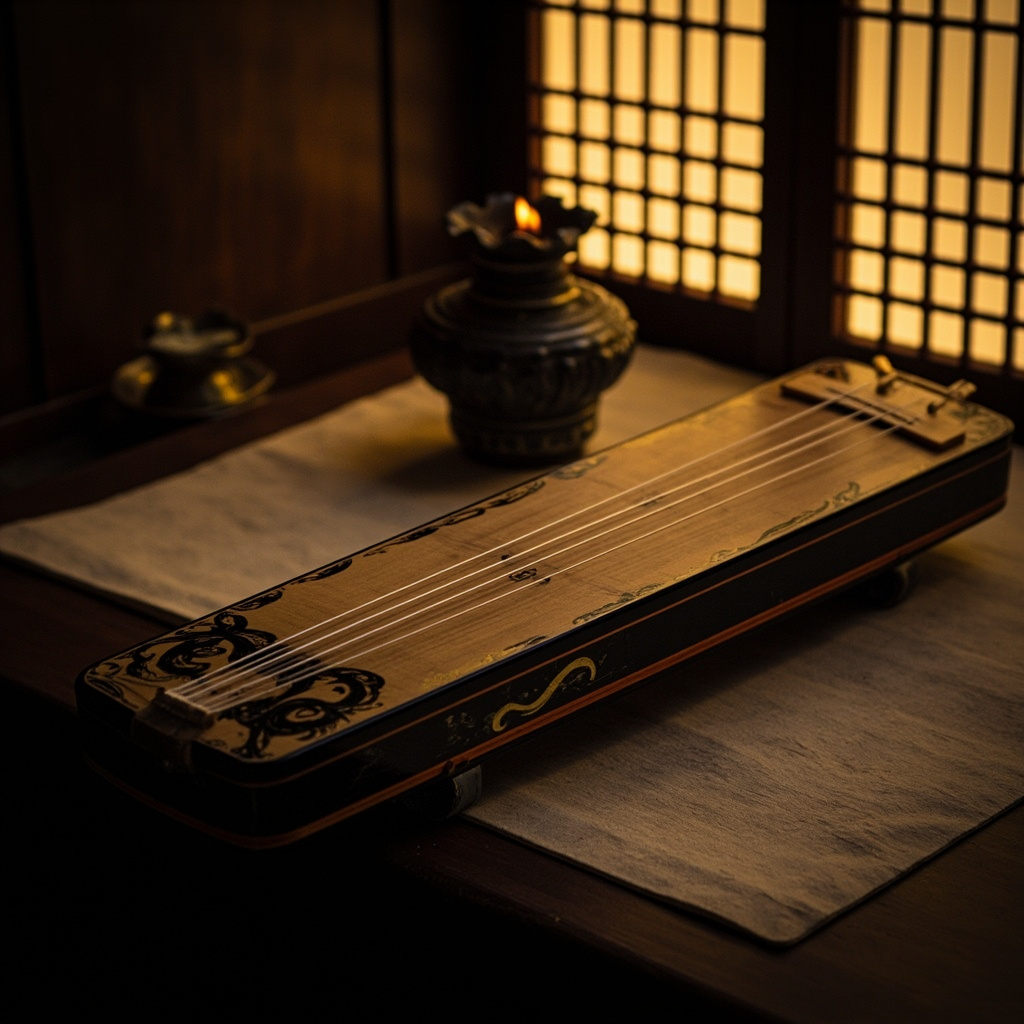
The guqin is the most quietly authoritative instrument in the Chinese repertoire, and the one most often misread by outsiders. It is a seven-stringed zither played with the hands alone on a flat lacquered soundboard, and it carried a status no other instrument matched: first of the Four Arts, ranked above chess, calligraphy and painting, and played alone rather than to an audience. What that history means for feng shui is not that a guqin is a lucky object, but that it changes what a room is for.
The Scholar’s Instrument and Its Standing
Classical texts treat the qin as a test of character rather than entertainment. Confucius is recorded in the Analects as judging a man’s moral condition from the way he played, and later commentators built a vocabulary around the idea that tone reveals its producer. The Four Arts an educated man mastered were the zither, the game of go, the brush and the painting, and the zither came first because it trained judgement rather than displaying it. A guqin was owned slowly, studied for years, and played for oneself, often at night, in a room kept deliberately clean. It was also in practice the most solitary of the arts: an instrument without a conductor, without a pit and without an audience.
The Instrument Itself: Seven Strings and Seven Stars
Modern readers tend to picture the guqin as a guitar with more strings and an oriental finish. The instrument has no frets and no separate neck. Two boards, traditionally paulownia, are joined into a hollow resonant body finished in many layers of lacquer, each polished and hardened before the next. Seven strings run over a broad fixed bridge, each tuned by twisting a peg on the head. Silk was the standard string material for most of its history.
The seven strings were also aligned with the seven stars of the Big Dipper, and the thirteen marked positions along the soundboard with the months of the year. This is why a guqin in a room was treated as more than a musical instrument: it gave the room a small working model of the sky, and required the player to hold an orientation with respect to the year rather than simply produce a tune.
The Sound of the Guqin
The guqin’s voice is unlike that of any plucked instrument most listeners know. The attack is dry and slightly percussive, almost the sound of a fingernail, and then the note sustains a very long time, filling with overtones that gradually thin out. Because the sound is quiet, the player sits close and the listener leans in; before amplification, the exchange happened at the distance of a conversation. Classical descriptions prized what was clear, even and restrained, and the absence of showiness. The character is short attack and long decay: it fills a room without raising anyone’s voice.
Where the Guqin Sits in the Five Elements
Several classical taxonomies that rank objects, arts and occupations place the qin under the metal phase, and therefore to the west, to autumn, and to the season of harvest and judgement. This old classification is the reason the guqin occupies such a specific place in a feng shui analysis. Read through the five phases, the instrument carries the qualities assigned to metal: precision, refinement, boundary and the capacity to clarify. A metal-phase object in the west sector of a home is read as a request for order and focus rather than expansion.
The Guqin and the Scholar’s Studio
The guqin’s real address is the study. In a traditional Chinese house the study held the family’s books, writing implements and accounts, and it was the room where the family’s attention was supposed to be disciplined. Classical guidance describes it as quiet, lit from one side and free of clutter, and the guqin sat in it as the object that required all three. A guqin on a stand or against the wall becomes the room’s centre of gravity, not because it is valuable but because it is demanding.
Placement: Light, Height, and Avoidance
Placement follows from the reading, and for the guqin the instructions are unusually concrete.
- Place it in the study or office, or in the room where you work alone.
- Give it light from one side, ideally from a window, but keep direct afternoon sun off the lacquer.
- Set it at a height that allows it to be played rather than stored.
- Keep it clear of standing water beneath it, including a water feature in the same room.
- Do not bury it under papers, boxes or other stacked objects.
- One instrument is enough; a second in the same room adds nothing.
The rule about water is the old one and it is not decorative. A lacquered wooden body above moving water reads as leakage in the classical vocabulary, because metal and water stand in a direct generating-and-overcoming relationship in the five phases system.
The Player’s Discipline and the Flow of Qi
Tone matters more than display, and the teaching literature is firm about it. The ideal is described as harmonious, balanced and free of showiness, and the technique is built to produce that rather than to project power. The left hand stays relaxed, the right wrist loose, and the sound is allowed to decay rather than cut off. The discipline models self-command, and it decorates a room only if the person in that room is also willing to be quiet and exact.
In the interpretive layer of feng shui practice, the guqin is often discussed as a means of settling the qi of a room, and it is worth stating plainly what that claim is not. It is not a medical claim and does not rest on measurable acoustics. Its working assumption is that a room occupied by someone listening carefully has already changed, which is defensible inside a tradition that treats sustained attention as a form of energy.
Choosing a Guqin for a Modern Home
Practical realities are worth stating plainly. The variable that matters most is the wood, since the body produces the tone. Paulownia is the traditional choice, and old-growth tonewoods are expensive and scarce, which is why much of the affordable market is laminate. A second instrument of any quality is a luxury rather than an improvement, since the tradition treats the instrument as a lifetime relationship rather than a collection. And if a guqin will sit in a room rather than be played, the deciding factor may simply be that room’s light and its noise.
Taken together, the guqin is a position rather than a decoration. It says: this is the room where attention is trained, this is metal and the west, this is a sound that fills the space without filling the air. Read that way, a guqin becomes an instrument of orientation, a reminder of which quality a room is meant to hold.