Chinese Wild Goose Feng Shui Meaning: The Hongyan and the Message That Arrives
No bird carries one meaning in Chinese culture so consistently as the wild goose. It arrives. A single goose crossing a wide sky has meant for two thousand years that news is coming, and that someone far away is still part of the family. In feng shui practice the reading is practical rather than decorative. The wild goose is the household messenger: it stands for communication across distance and for the right timing of a journey held too long.
The Bird That Carries Letters
Chinese poetry uses the goose as a literal courier. Because geese migrate, a bird flying in a given direction suggests something travels that way. The old tale of the envoy Su Wu, held far in the north for many years, made the goose a symbol of endurance: the bird arrives, the message lands, and the separated household learns it still exists. Geese also pair for life and return to the same wintering grounds each year, and Chinese readers took both as statements about human obligation. A marriage that keeps its shape through difficulty was described in the language of the returning bird, which is why the goose is often given to families separated by distance.
The Geese on Flat Sand: Eight Views of Xiaoxiang
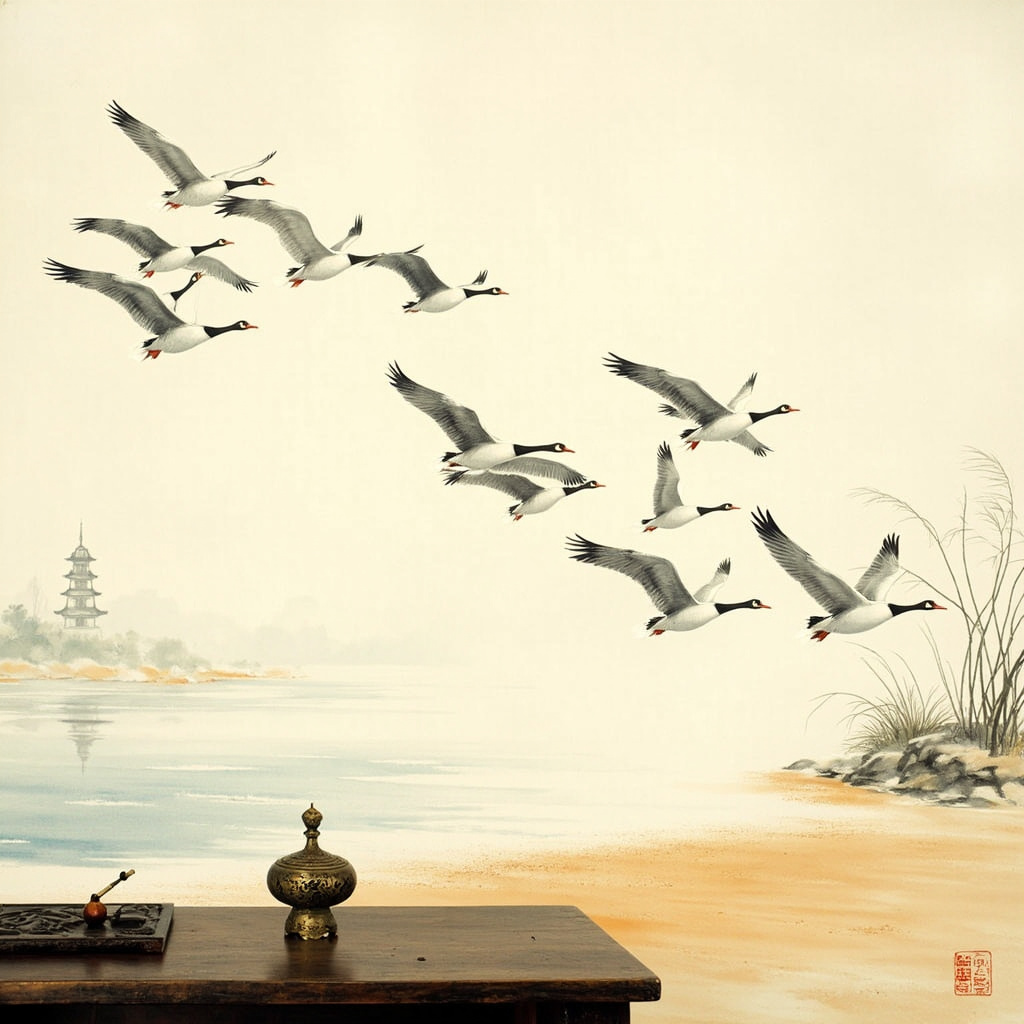
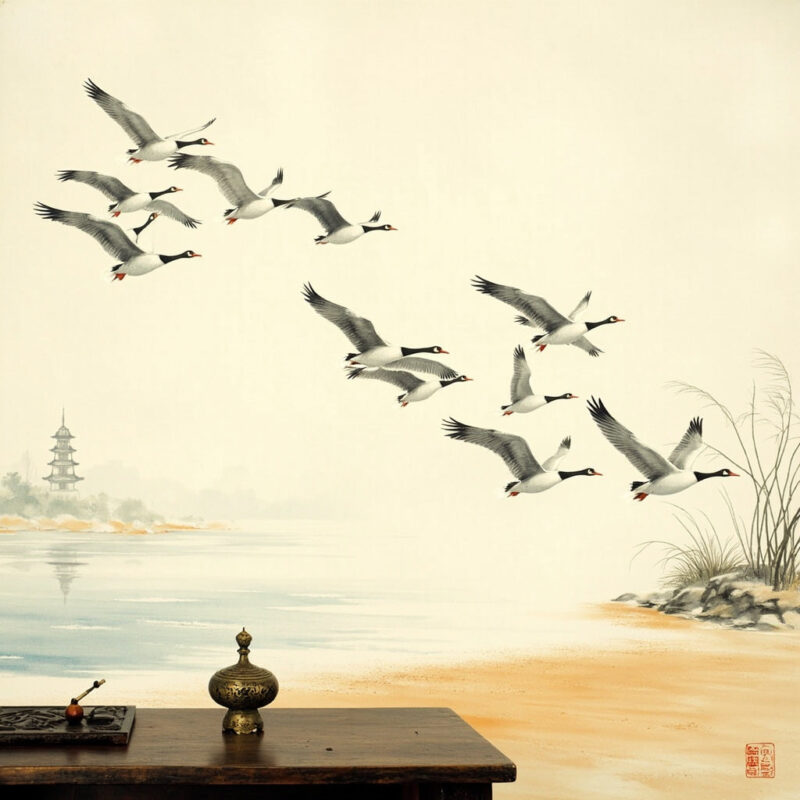
One of the most influential subjects in Chinese landscape painting is a set of eight scenes called the Eight Views of Xiaoxiang, first painted by the Northern Song official Song Di in the eleventh century. The views cover the lake and river country of Hunan, and each names a condition of light, weather and season rather than a place. The first view in most arrangements is the geese descending onto a flat sandbar: the birds fall out of the open sky and settle on level ground. For a feng shui reader it is a painted diagram of qi arriving and coming to rest.
Why the Pagoda Bears the Bird’s Name
The Great Wild Goose Pagoda in Xi’an was raised in 652 to hold the Sanskrit scriptures the monk Xuanzang carried back from India. The tower has been repaired many times, and its present brick exterior largely reflects Ming dynasty work, but the name never changed. One legend says a goose fell wounded and became the temple’s foundation; another says a goose fell while the monastery was short of meat, prompting the monks to abandon flesh. A tower built to hold translated scripture and named for a bird that carries words is a compact image of knowledge travelling.
Formation: What a Line of Geese Teaches
Wild geese fly in formation: a lead bird at the point, two lines sweeping back, each bird holding a place and taking its turn at the front. The formation is a working system built on cooperation and a shared burden that rotates so no single bird carries the whole effort. It is one of the clearest pictures of how qi moves through a space: not one forceful push, but a current in which effort is distributed and the whole gains what the leader gains.
- Direction: the formation sets the line of travel, and a room needs one clear direction.
- Distribution: the load is shared, the argument for balancing a space instead of loading one corner.
- Return: the same route is flown every evening, which is why the roost is a stable centre.
Descent and the Settling of Energy
The verb inside the view’s name is the important part. The geese do not merely fly; they descend, and then they alight. Almost everything feng shui calls useful is described the same way, as something that comes down from above and settles. Water does it, light does it, and a person crossing a threshold does it. The flat sandbar matters too. Level open ground is the simplest surface for arrival, with nothing on it to block the movement, so the first Xiaoxiang view shows the ideal landing place.
Metal Phase, Autumn and the West
Wild geese arrive in autumn, and autumn belongs to the metal phase in the five-phase system. Metal is the phase of refinement and harvest, the closing of a cycle and the gathering of what has been grown, and the goose carries that autumnal character. It marks the end of a long season and the moment things are taken in. Metal also governs the west, so a goose motif placed toward that side of a home asks for the harvest character of a cycle rather than the heat of summer, which is why the goose balances a home that has become too hot or too scattered.
Where to Place a Wild Goose in Your Home
Placement follows the function, and the function is always a connection crossing a distance. For correspondence, business partnership or news from elsewhere, the north and the water direction are natural positions, because the north is the water direction and the goose is the travelling bird. For a home where family members are far apart, put the goose in the living room rather than a private study, since the message belongs to everyone. A scroll hung to catch the first morning light has long been read as an invitation to arrive early. If you choose the pagoda form, treat it as a vertical accent: stand it on a shelf with clear space above, never wedged into a corner. Above all, do not crowd the bird. The flat sand in the view is the condition of the whole image.
Choosing an Object That Carries the Meaning
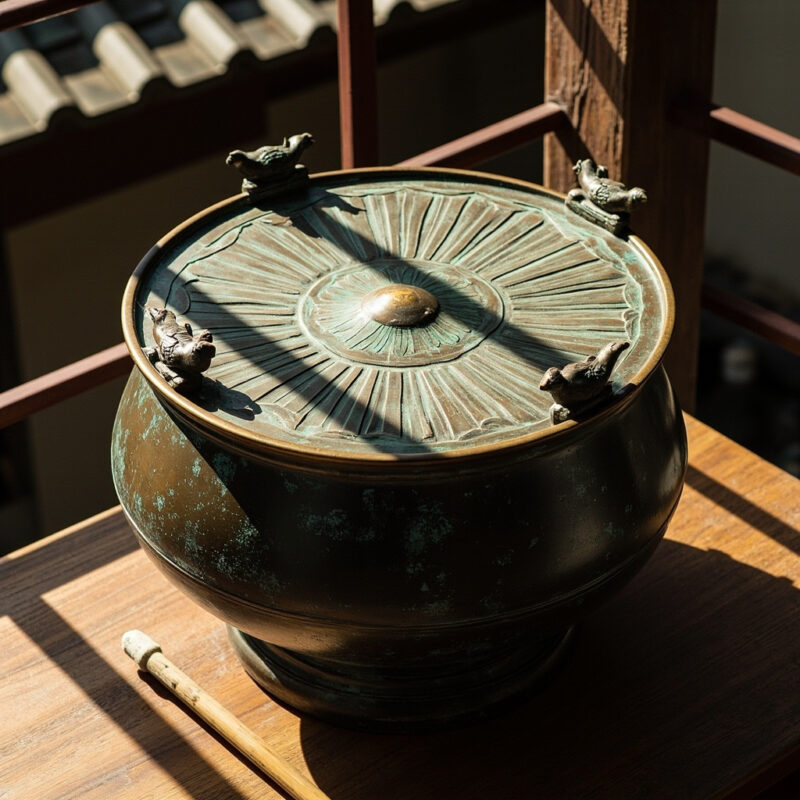
Most households meet the wild goose as an image rather than a possession, and the image must be judged. Look for birds in a formation that still reads at a distance, and for open sky with level ground below, a sandbar or still river, rather than a crowded composition. A scroll in the ink-wash manner of the Xiaoxiang views does the work best, because the mist and the empty space are part of the meaning. Metalwork and cloisonne carrying a goose motif hold the same symbolism at smaller scale, and a carved panel or a ceramic brush washer with a goose in low relief suits a study. Resist the purely decorative version: a bird with no ground beneath it and no open sky above has lost the two things the scene is about.
Reading the Symbol in Daily Practice
None of this asks you to accept anything supernatural. It asks you to notice a pattern Chinese culture has repeated for a long time and then use it deliberately. The goose arrives, it carries words, it comes home. When you want a household to communicate more honestly, place an image of a returning bird where people pass every day. When you want a career to move forward, keep the pagoda form clear and uncramped, and set it where the light falls early. When you want a cycle to close cleanly, remember that the geese come in autumn, when the harvest is already in. The wild goose is a modest object, and that is its strength: it asks for a clear direction, an open surface and the willingness to let a message arrive.