Chinese Bronze Drum Feng Shui Meaning: The Tonggu and the Thunder of the South
The bronze drum of southern China is not a musical instrument in the way a guqin or a pipa is. A guqin is played alone, a pipa before guests, but a bronze drum is not played for an audience at all. It is played to the sky. It stands on a tower outside, struck with a wooden mallet, and the sound is meant to travel across fields, over water, and upward. That fact decides how feng shui reads it. A drum does not decorate a room. It announces that this place has a voice, and it marks the hour.
What the Bronze Drum Is
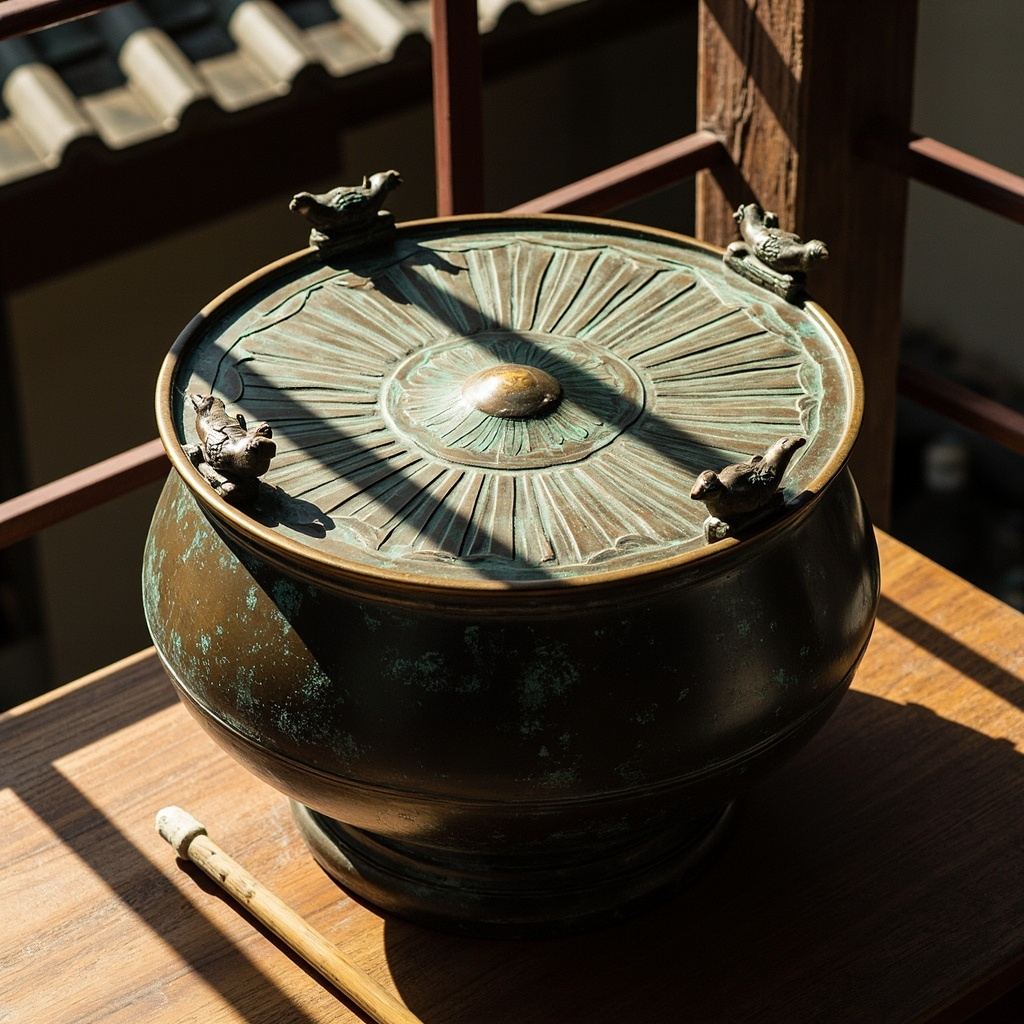
The bronze drum, tonggu in Mandarin, belongs to the indigenous peoples of the Guangxi, Guizhou and Yunnan highlands and to northern Vietnam, where it survives as a living ceremonial object rather than a museum piece. The classic form is a squat cast cylinder: a flat solid top, a shoulder that flares outward, and a hollow body tapering to an open base. It is cast rather than turned, in a sectional mould, and the surface carries raised relief. Several hundred such drums survive, and the culture built around them is now documented as a World Heritage practice.
The Twelve Rays and the Frog
Two features identify the drum at a glance. The centre of the top face carries a radiating sun or star, and the oldest type bears twelve rays, a number tied to the months and to the seasonal cycle. Around the rim squat small frogs, modelled in the same bronze, one with a tongue that appears to project into the drum. The frog is the rain-bringer and the thunder figure, and its presence on the crown is what makes the drum a rain object and not only a musical one.
A Drum That Calls Rain
Its oldest job was agricultural. Before the monsoon arrives, the village beats the drum in a rain ceremony, and the bronze frogs on the crown are struck first, because a frog’s croak is the sound the sky is expected to answer. The drum was also used to summon an assembly, announce a wedding or a death, and open a festival. In every one of these it acts on distance, making a message reach the far end of a valley, which is why it was always hung high and struck hard.
Thunder and the Wood Phase
Every sounding object in the Chinese tradition is read through the trigram that governs it, and the drum belongs to Zhen, thunder, the trigram of the east, of spring, of wood and of sudden beginnings. Interpretive feng shui practice accordingly places the drum with growth rather than consolidation: a drum asks a room or a site to wake up, to move, to start something. A bronze drum is a request for beginning. It belongs to the season of the sprouting grain, not the harvest.
Metal Body, Wood Sound
Here the object is genuinely interesting, because the body contradicts the sound. Bronze is metal phase, and metal restrains wood, while a drum’s voice is wood phase, and wood is what metal overcomes. The classical reading is not that this is a flaw. A drum’s job is to take an incipient movement, the sound of a thing beginning, and give it a form that can be carried: measure, beat, order. The metal vessel disciplines the wood-phase impulse. A drum asks for energetic movement that is nonetheless structured, and will not tolerate a merely restless space.
Bell Tower and Drum Tower
In a Buddhist monastery the bell and the drum divide the day. A bell marks the limits of the hours, and a drum marks the moments of action, so the saying morning bell and evening drum describes a rhythm, not a pair of ornaments. The villages of the Guangxi highlands built the same pairing in wood, and the drum tower, with its large drum hung in the upper storey, became the visual centre of the settlement. Feng shui reading keeps the distinction: the bell closes, the drum opens.
Placing a Bronze Drum in a Home
No household is going to hang a ceremonial drum on a tower, but the placement rules carry over to the smaller drums and drum motifs that are actually bought and displayed.
- Keep the drum out of the bedroom. A drum is a public, outdoor sound and it wakes things.
- Face it toward the east or the south, the directions of wood and fire, where its growth reading is wanted.
- Place it high if you can, on a shelf or a bracket, since a drum on the floor reads as stored rather than sounding.
- Do not put it under running water or a water feature. A drum that calls rain asks for rain, not for a leak.
- Give it a partner only if you intend a pair. A single drum reads as a statement, two as a matched set.
- Avoid placing it opposite the main door, where its noise works against the quiet a threshold should hold.
The rule about water is the old one. A drum already carries the request for rain, and adding a water feature on top of that doubles a claim the room should make only once.
Metal, Patina, and Craft
The bronze is a leaded alloy of copper and tin, and the lead is what gives the drum its short, hard, carrying tone rather than a long ring. The decorated bands were cast in relief rather than chased afterwards. After two thousand years the surface carries a patina, green and blue in the recesses, rust orange on the ridges. That patina is not damage. A clean bright bronze drum is a modern reproduction; a genuine old drum has a surface that looks as though it has already done its job.
Choosing a Drum You Can Live With
Most drums sold for home use are reproductions in the style of the Guangxi type, cast in modern bronze or in resin, and the practical questions are about proportion and sound rather than antiquity. Weight matters more than diameter, because a drum that cannot be lifted will not be struck. A twelve-ray sun motif on the top face is the marker to look for, with the frogs around the rim. Genuine old drums are collection objects, are valuable, and are not home furnishings.
The Drum as a Statement
Read this way the bronze drum is neither a wealth charm nor a luck object. It asks for a place with a voice and for the right hour to act in. A drum lying on the floor says nothing; a drum raised and struck says that this settlement, this household, has something to announce and intends to be heard. That is a very different request from the pipa, which asks for company, or the bell, which asks for closure. The drum asks for beginning, in a voice made of metal, carrying the wood phase of thunder out over the fields.