Chinese Phoenix Feng Shui Meaning: The Vermilion Bird of the South
The phoenix is the one Chinese mythical creature that Western readers already half know, and the one they most often understand backwards. In Chinese tradition the phoenix is not a bird that rises from fire; it is one of four directional guardians, the bird that holds the south. It is female, it governs fire and summer, and it stands opposite the winter-bounded Black Tortoise at the far end of the compass. Once the four symbols are understood, the phoenix stops being decoration and becomes a directional instrument.
The Four Symbols and the Guardian of the South
Classical Chinese cosmology organises space into four seasons, four colours, four elements, four directions and four animals. The Azure Dragon holds the east and the spring and the wood element. The White Tiger holds the west, the autumn and metal. The Black Tortoise holds the north, the winter and water, and it carries a snake. The Vermilion Bird holds what remains: the south, the summer, fire, and the colour red. Each animal is a complete statement about the character of a direction rather than a mascot for it. The phoenix is therefore not simply a rare bird but the southern quarter of the year made visible.
What the Vermilion Bird Actually Looks Like
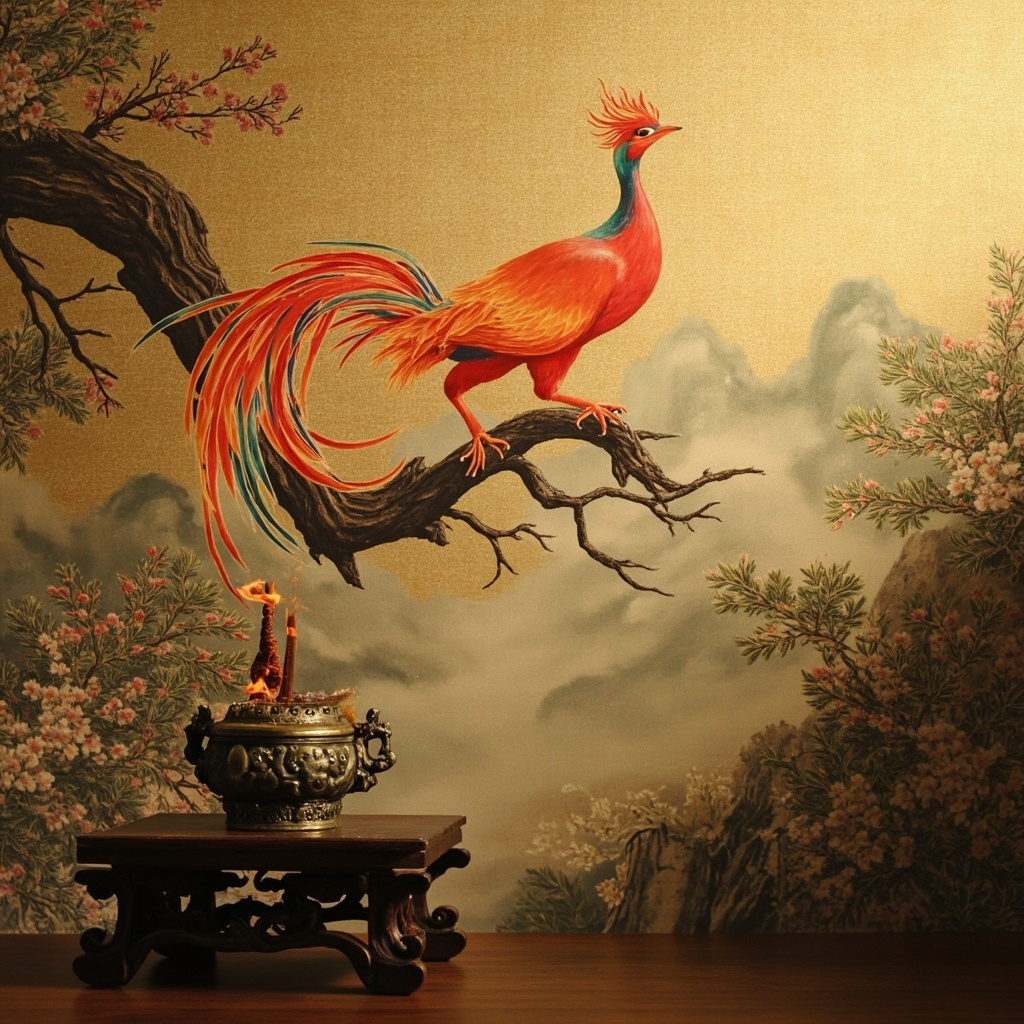
Descriptions across the classical texts converge on an unusual set of features. The bird is female in the oldest sources, which surprised Western readers for centuries. It has a crested head, a long neck and a slender body, and above all an extravagant tail: some accounts give five long curling tail feathers, others give twelve. Early accounts also speak of its markings breaking into the five colours, one reason the phoenix came to stand for the five phases and for the virtue of a ruler who governed them in harmony. The Chinese bird is not a bird of fire, and it does not burn.
The South, Fire, and the Height of Summer
South is the brightest direction in the Chinese compass, and that is where it sits in a diagram. It corresponds to fire, to summer, to the full strength of the sun and to red. In a house, the southern position is traditionally associated with fame, visibility and reputation, the direction where a person’s work is seen. Classical advice for a dwelling placed with the south facing front concentrates on light, ventilation and openness there, since the southern sector is where accumulated heat must be handled. The phoenix, as the emblem of that sector, therefore reads less as a warning than as an encouragement: the south wants brightness, movement and air.
The Phoenix Is Not the Western Bird
The resurrection story is the one most often imported from Europe, and it is worth separating the two traditions rather than assuming they are the same. The Western phoenix is defined by death and renewal; it burns and is born again, and that cycle is the point. The Chinese phoenix has no such biography in the classical sources. It is tied to the south and to the season of greatest heat, and the link to fire is calendrical rather than sacrificial. Readers who meet the European story for the first time often assume the Chinese bird is the same animal under another name. Treating them as distinct is not pedantry; it keeps the domestic use of each image accurate.
The Female Bird and the Classical Canon
Chinese tradition describes the phoenix as female and the dragon as male, a pairing that runs against the Western dragon entirely. The female reading is not a later correction but the older one, and it is why the phoenix appears in wedding and betrothal imagery, in phoenix coronets, in embroidered bridal robes and in carved marriage plaques. The Book of Songs contains a famous description of the bird’s arrival, marking a ruler’s virtue by the way the fenghuang flies and settles, and the ritual manuals treat its appearance as an omen of ordered government rather than of personal luck. By the Song dynasty the phoenix was one of the most frequently depicted creatures in decorative art, on lacquerware, ceramics, carved screens, textiles and jewellery.
What the Phoenix Governs in a Home
Read as a directional and seasonal emblem, the phoenix covers three areas of ordinary life. The first is reputation and standing: the south is where a household’s work becomes visible, so the bird suits a person whose work must be seen and judged by others. The second is the inner life of the house, since fire in classical thought governs clarity, visibility and the warming of what is otherwise cold and dim. The third is care of temperament: the phoenix is composed, exacting and calm, and it is one of the few Chinese animals chosen as much for conduct as for function. A room holding one is asking for clarity and self-command.
Where to Place a Phoenix Image
Placement follows from the reading. The phoenix belongs in the southern sector of a dwelling, and the most useful modern version of that instruction is simply the part of the house that receives the most light and the most visitors, which in a typical northern-hemisphere plan is the front and the sun-facing side. It suits a wall or a hanging panel rather than a low surface, and it should not be crowded by clutter or darkened by heavy shadow.
- Hang or set it in the sunlit, south-facing part of the room.
- Choose a wall or a high shelf rather than a low table, so the bird reads as presiding.
- Keep it clear of shadowed corners, where fire symbolism is weakest.
- Avoid pairing it with a large water feature in the same sector.
- One bird is enough; a single phoenix is dignified, a crowd is not.
Reading the Bird in a Personal Chart
For an individual, the phoenix is consulted when the question concerns visibility, standing and the public face of a life. In the practice of Tian Xing feng shui, the direction a person occupies in relation to the movement of the stars is read together with the direction of their own working life, and the southern sector is treated as the register of reputation and outward recognition. A practitioner working with a birth chart will look at the southern placement of the person’s period, and a consultation room carrying the bird will often be arranged with it on the southern wall.
Taken together, the phoenix is a position rather than a personality. It says: this is the south, this is fire, this is summer, this is where the house is seen. Read that way, a phoenix image stops being an ornament and becomes a piece of orientation, a reminder of which quarter of life a room is answerable for, and of the calm, exact quality the Chinese tradition expects to find there.