Chinese Longevity Peach Feng Shui Meaning: The Shou Tao Peach of Immortality
Few symbols carry as much meaning with so little explanation as the peach. Western readers meet it through the Greek story of the golden apple and assume the Chinese peach is the same object renamed. It is not. The peach has its own origin and use: in Chinese cosmology it stands for long life, for the rare moments when a life is granted more time than it might expect. That is what the shou tao, the longevity peach, carries into a birthday, an altar and a house.
The Shou Tao: Longevity You Can Eat
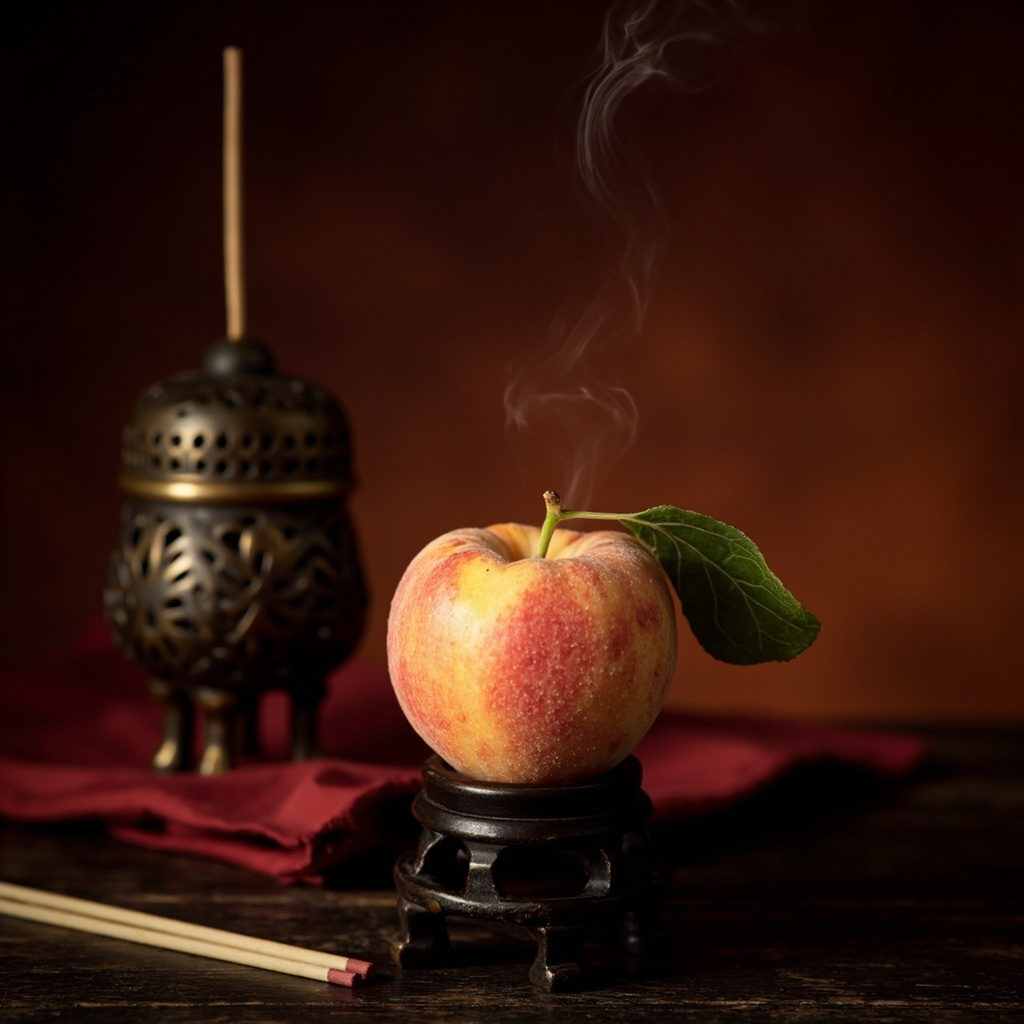
The longevity peach, shou tao, is the form most meet first: a peach-shaped bun or cake, usually pink or red, offered to an elder and eaten at a birthday table. The shape does the work. A rounded fruit with a cleft and one leaf, modelled in dough or sugar, so the wish for long life becomes edible rather than merely spoken. In the south it is a soft pink bun; in the north a steamed cake in the same profile. Either way it is placed before the person being honoured and eaten, with a deadline rather than kept as a souvenir.
The Queen Mother of the West and Her Immortal Orchard
Behind the birthday bun stands a much older tree. In classical mythology the Queen Mother of the West, Xi Wangmu, presides over an orchard of peaches on the Kunlun mountains, and the fruit she keeps is the peach of immortality itself. She is the most considerable female deity in the tradition, and the peach is her attribute as much as a gift. Han-dynasty bronze mirrors show her seated with a phoenix and a peach in hand, fixing the iconography for two millennia.
The peaches of Kunlun ripen once in three thousand years, so her feast for the gods is irregular and unrepeatable. This is the key to the symbol. An ordinary fruit signifies health; one that ripens almost never signifies what is scarce and what is granted. The Han court sent envoys west in search of the tree. The story of an immortal who received a peach at the banquet and left with a longer life fixed the fruit as the sign of a lifespan extended beyond the natural span, and every later tradition carries that mixture of rarity and favour.
The Blossom and the Fruit Are Not the Same Symbol
Here is where most imported readings go wrong. One tree produces both blossom and fruit, and in everyday Chinese the names follow the season: the flower is the peach blossom, the fruit simply the peach. English has one word for both, and readers collapse them. They do opposite work. The blossom, short-lived and fragile, governs attraction and the meeting of lovers, the basis of the peach blossom luck now marketed in the West. The fruit, which takes a full season to arrive, governs duration and the completion of a life. A branch in blossom promises a moment; a ripe peach states a span.
Peach Wood and the Eighteen Talismans
The peach’s protective reputation comes from its wood rather than its fruit. Peach branches were used for centuries as ritual warding objects, and the practice survives in the name given to the earliest Daoist charms: the Eighteen Taos, eighteen peach-wood tablets carrying inscribed protective script. The word itself is Chinese wordplay, the character for peach being built from the marks for eight and ten-eight. The objects made from it were specific: the peach-wood sword carried by a door guardian, the comb and the whip. The peach answers two questions: the fruit, how long a life may run; the wood, what may be kept out of the house.
The Birthday Table: Where the Peach Actually Belongs
Placing a longevity peach is a precise matter, and the popular instruction is often confused. The peach belongs at the table, before the person whose birthday it is, set down with the leaf turned toward them and accompanied by longevity noodles left unbroken. It is eaten by the person it was made for, before the family, and not displayed afterwards.
- Set the peach before the person being honoured, leaf turned toward them.
- Serve longevity noodles unbroken, and eat the peach at the table.
- Never keep a birthday peach on an altar; an uneaten offering has lost its function.
- For a permanent motif, choose a carved or painted peach rather than food.
The Longevity God and the Southern Star
Behind the birthday peach stands a deity, the Shou Xing, the god of longevity, invariably shown as an aged man with a high domed forehead carrying a peach. In Chinese astronomy the same figure is associated with the Southern Polar Star, a star that never sets, long treated as guarantor of an unbroken line of rulers. This is where the peach touches the celestial system that Tian Xing feng shui works with. Longevity here is not a private sentiment but a position in the heavens, an unbroken chain of light from a fixed star, the fruit in the god’s hand its visible form. In the classical order of feng shui aspirations, long life comes first, above wealth and rank.
The Peach in a Home and in a Personal Chart
If the food offering belongs at the table, the peach motif has a wider domestic life in objects. Chinese painters place the fruiting peach branch on its own, bending, with the fruit split to show the pale flesh and a single leaf; ripe and split together they are read as a wish for long life completed rather than merely wished for. It appears in embroidered panels and carved screens, and in the scholar’s studio it is standard because the peach carries classical meaning without explanation. For domestic use the advice is restrained: one piece, well made, where the light reaches it. A single mature peach reads as realised time; many small ones read as decoration.
For an individual, the peach is consulted when the question concerns health, duration and the care of a body through the years rather than a particular decision. A practitioner working from a birth chart will examine the life palace and the periods that stress it, and a household keeping a peach branch in view states the same priority. Longevity is the ground on which everything else in a life is built, and the peach is the object that names it. Where it appears, it names it as fact rather than wish, which is why the fruit is eaten rather than kept.
Read with that care, the longevity peach is one of the most economical symbols in the Chinese tradition. It is a fruit, a gift, a star, a deity and a piece of furniture, holding all those meanings without strain because they are one meaning at different scales. The blossom secures a meeting. The fruit secures a life. The wood secures a house. The peach of immortality is not a fantasy of escape but a piece of ordinary practice: a modelled bun, a carved branch, a birthday table set with a bowl of unbroken noodles, offered to somebody older than last year.