Chinese Pipa Feng Shui Meaning: The Four-String Lute of the Tang Court
The pipa is the most public of the Chinese plucked instruments, and it stands at the opposite pole from the guqin. The guqin was played alone, late at night, for oneself; the pipa was played in a hall, before guests, at the height of the Tang court banquet. That difference in use is what a feng shui reading is actually about. A guqin in a room disciplines the person who enters it. A pipa in a room changes what the room is for, because it was built to be heard by other people.
From the Western Regions to the Tang Court
The pipa arrived in China as a pear-shaped lute from Central Asia, probably by way of the Silk Road, during the Sui and Tang periods, and Chinese makers reshaped it into the instrument that survives: four strings, a fretted neck, a wooden body with a skin soundboard. It was taken up at once as court music, and the eighth and ninth centuries were its golden age. Tang poetry treats the sound of the pipa as something that changes what a room feels like. Bai Juyi, writing in the year 816, left the fullest statement of that in a poem read more often than any other.
The Instrument Itself
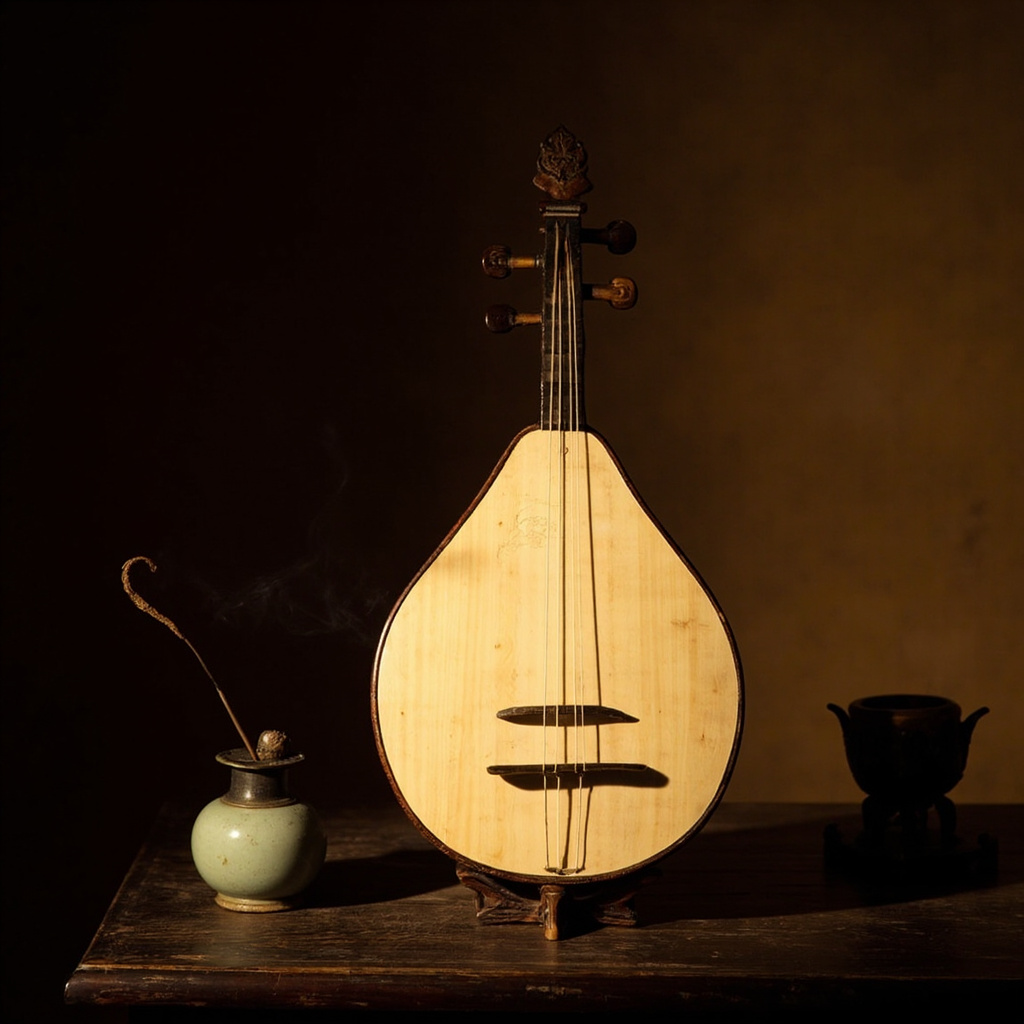
The modern pipa has four strings and a pear-shaped body with a flat front and a rounded wooden back, quite unlike the arched bowl of a European lute. The soundboard is a pale panel of python skin set into the wooden face within a broad border, and the back is carved from a single piece of hardwood with the traditional cloud head and phoenix tail motifs at the ends of the bow. On the neck, a fretted fingerboard carries bamboo frets in the classical instrument, and four pegs in the head hold the strings. A small wooden plaque on the face lets the player press the strings down against the frets.
The Sound of the Pipa
Classical descriptions of the pipa’s voice dwell on the attack. The plectrum strikes hard, the note appears almost at once, and the tone is carrying rather than transparent. Bai Juyi gives the standard account: the musician tightens the strings, turns the pegs, plucks two or three times, and before any tune is formed there is already feeling in the sound. He compares one of the four strings to tearing silk, and closes the poem on a paradox the tradition has never stopped arguing about: in the silence at the end, the playing says more than speech.
Four Strings, Four Seasons
Because the pipa has four strings, and the year runs through four seasons, the instrument was read against the calendar. The four strings were matched to the four seasonal phases, the frets to the months, and the fret under the left hand told the player where in the year the piece belonged. A pipa is therefore not a decoration. It is a device that keeps a year in the hand, and it asks the player to hold an orientation with respect to time rather than merely to produce a tune.
Where the Pipa Sits in the Five Elements
Classifications that rank objects by phase generally place a wooden-bodied instrument under wood, and the pipa is read with the east, with spring, with growth and with the colour green. Read that way the request it makes is developmental rather than consolidating, and it is the opposite of what a metal-phase object asks for. The classification is worth stating plainly because it decides the sector: a pipa in the east-facing room of a house is asking for expansion in that direction, and a pipa in a cold northern corner is asking in the wrong place.
Placing a Pipa in the Home
Placement follows from the reading, and for the pipa the instructions are unusually practical.
- Put it in the music room, the living room, or the garden pavilion, anywhere people gather.
- Hang it on an east or south wall, at about seated head height or a little above, so it can be taken down and played.
- Keep it out of the bedroom. The pipa’s attack is penetrating, and the tradition treats it as a public sound rather than a settling one.
- Leave it clear of damp, standing water and any water feature in the same room.
- Do not bury it under boxes, papers or other stacked objects; give the wall around it space.
- One pipa is enough. Several crowded together read as storage rather than as an instrument.
The rule about water is the old one and it is not decorative. A wooden body above moving water reads as damp and decline in the classical vocabulary, because wood and water stand in a direct overcoming relationship in the five phases system.
Music, Gathering, and the Flow of Qi
Interpretive feng shui practice often links the pipa’s character to how a household gathers. The instrument was made for a hall, so it is read as an object that asks for company, conversation and hospitality rather than for solitude. Its claim on the qi of a room is not a medical claim and does not rest on measurable acoustics. Its working assumption is that a room in which music is played regularly is a room that people use differently, which is defensible inside a tradition that treats shared attention as a form of energy.
The Player and the Repertoire
The pipa’s technique asks for one thing the guqin does not: accuracy before sound. It must be tuned properly before it can be played at all, the plectrum must be light and even, and the left hand has to press the strings firmly enough to sound a fret cleanly. It is also an instrument people learn for company rather than for mastery alone. The classical repertoire splits into the quiet literati suites and the fast, percussive banquet pieces, and a home instrument is almost always the first of the two.
Choosing a Pipa for a Modern Home
Practical points deserve plain statement. Beginners’ instruments are simpler than concert pipas: cheaper woods, simpler frets, and usually a synthetic skin rather than python. The python skin soundboard is the classical construction, and the species is governed by international trade rules, so a synthetic face has become the common choice for beginners and for anyone who travels. A second instrument is rarely an improvement in the way it might be for a Western stringed instrument, because the pipa rewards time rather than collection.
The Instrument as a Statement
Read this way, the pipa is not a charm. It does not ask a house for luck. It asks for a room with people in it, and for a year that somebody is keeping track of. Four strings, a fret under the finger, a pear-shaped body turned toward the east: that is a compact statement about hospitality, about time, and about what a room is for.