Chinese Bi Disc Feng Shui Meaning: The Jade Ring With a Hole at Its Center
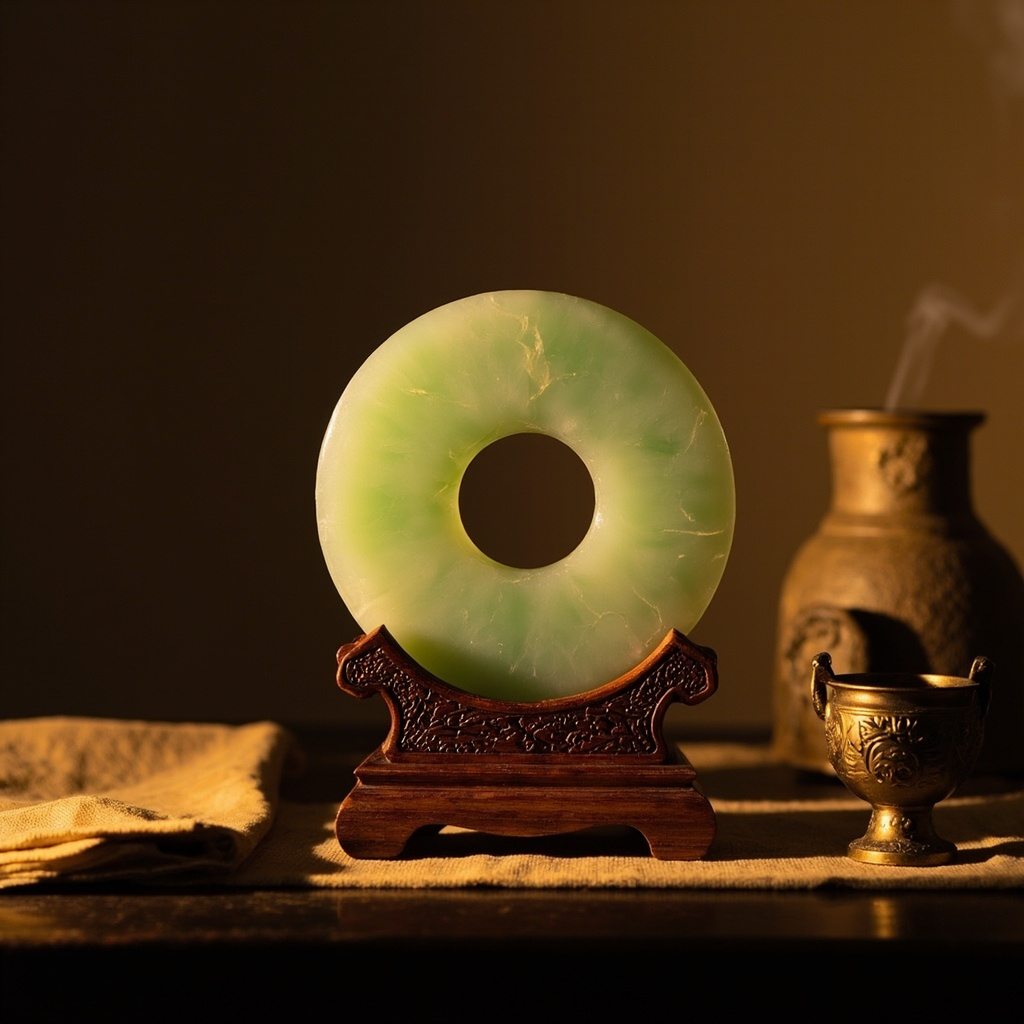
In a museum case it looks almost like a mistake: a flat disc of pale green stone with a clean circular hole bored through the middle, no carving, no inscription, no figure. Visitors walk past it because there seems to be nothing to look at. Yet the bi disc is one of the oldest and most deliberate objects in Chinese material culture, and its power comes from exactly what those visitors dismiss. Everything about it is decided by the size of the emptiness at its centre.
What a Bi Disc Actually Is
A bi is a flat, circular jade object with a circular hole in the middle. Both faces are smooth and parallel, the outer edge is a true circle, and the inner hole is centred with considerable precision. Surviving examples range from pieces small enough to sit in a palm to discs wider than a dinner plate. It is not a bangle, because the hole is far too small for a wrist. It is not a plate, because it stands on its edge rather than lying flat. The defining feature is the ratio between the width of the stone and the width of the opening.
The Hole Is the Point
Classical Chinese connoisseurship measured bi discs by that ratio. When the band of stone was wide relative to the opening, the piece was read one way; when the band narrowed and the hole widened, it was read another. The object was graded by how much had been removed. This is unusual in the history of ornament, where value normally attaches to what is present. A bi disc asks you to value an absence. Seen in a room, the same logic still operates: the eye is pulled through the opening rather than across the face, so the piece behaves as a frame, not a surface.
Heaven Round, Earth Square
Ancient ritual texts paired the bi with another jade form, the squared tube. The circle was assigned to heaven and the square to earth, and the two were used together in ceremonies addressed to both. The pairing explains why the bi so often appears in burials arranged around the body, laid on the chest, or set near the hands. It was not jewellery placed for beauty but a statement of position within a cosmos. The circle above, the square below, the person between them: a complete diagram, assembled in stone.
From Tomb to Living Room
That ritual life ended long ago, and the object moved. Today a bi disc in a home is usually a modern carving in nephrite or jadeite, or a reproduction in stone, resin or glass. The change of setting matters. A burial deposit asserts a fixed order; a displayed disc asserts a chosen one. What survives the move is the geometry and the habit of reading it. A household that hangs a ring of stone on a wall is quietly restating a very old argument about the shape of the world and the place of a person inside it.
Reading the Stone
Judging a bi disc is mostly a matter of looking at the material rather than the form, because the form is fixed. Hold it to a light source and see whether the stone glows at the thinner sections. Look for even grain, a consistent polish, and an outer edge that is a genuine circle rather than a slightly flattened one. In older pieces, a soft surface sheen and fine surface wear along the inner rim are expected. A perfectly uniform, glassy finish on a stone sold as antique is a reason for caution, not excitement.
Where a Bi Disc Belongs in a House
The disc is a closing device. In a home it finishes a line of sight or gives a back something solid to sit against, which suits rooms that feel open-ended. Three placements work well:
- At the end of a corridor. A long passage delivers energy in a rush. A ring on the far wall receives it and closes the run.
- Behind a desk or chair. A seat with open space behind it reads as exposed. A disc behind supplies the missing mountain.
- On a shelf with air around it. The hole needs light and background. Bury the piece between books and the circle stops working.
Two rules follow. Display it upright on a stand or flat to the wall, never face down on a surface. And never cover the opening with a mirror, clock or photograph, because the opening carries the meaning.
What a Bi Disc Is Not
Confusion here is common, and it changes how the object is used. A bi disc is not a bagua mirror: it has no reflective face and deflects nothing, so it should not be hung outside a door to turn away hostile energy. It is not an ancient coin, because coinage has a square hole and carries wealth through trade rather than through cosmology. It is not a peace buckle, the small round jade charm worn on a cord for safe travel, though the outlines match. And it is not a good-luck charm activated by wordplay, since its name offers no pun on fortune.
Choosing One for a Modern Home
Scale decides more than price. A disc of twenty to thirty centimetres suits a corridor end or a wall behind a desk; a palm-sized piece belongs on a shelf or in a study. Practical points, in order:
- Measure the wall first, then choose a diameter that leaves generous margin on every side.
- Decide between a carved display stand and a hidden wall mount before buying.
- Check at arm’s length that the hole is centred, not only by the measurements given.
- Prefer one well-proportioned piece to a cluster of small ones.
A single disc with space around it makes a stronger statement than a group of five competing for the same wall.
Caring for Jade Without Harming It
Jade is tougher than it looks and still easy to mistreat. Dust with a dry, soft cloth rather than washing, since water trapped behind a mount encourages staining. Keep the piece out of prolonged direct sun, which can dull a polished surface over years. Avoid household cleaners, acids and ultrasonic baths. Handle by the outer edge with clean hands, because oils from skin collect in the recess where the inner rim meets the face. A disc displayed this way will keep its sheen for decades with almost no attention.
A Circle With Nothing in the Middle
The bi disc is a rare thing in feng shui: an object whose purpose is not to add, block or redirect, but to complete. It marks a boundary and leaves the centre open. Placed with care at the end of a passage or behind a seat, it does quietly what the oldest examples were made to do, holding a circle around an emptiness and letting the rest of the room arrange itself around that fact.