Moon Gate Feng Shui: The Circular Opening That Frames a Garden
Most boundaries in a Chinese garden are built to stop you: the wall, the screen, the locked door. A moon gate is the one boundary built to let you pass, and it does so deliberately. It is a circular opening cut clean through a garden wall, open at every hour, with no leaf, no hinge, and no latch. What makes it a feng shui object rather than ornament is not the shape alone, but what the shape does to the person walking toward it.
What a Moon Gate Actually Is
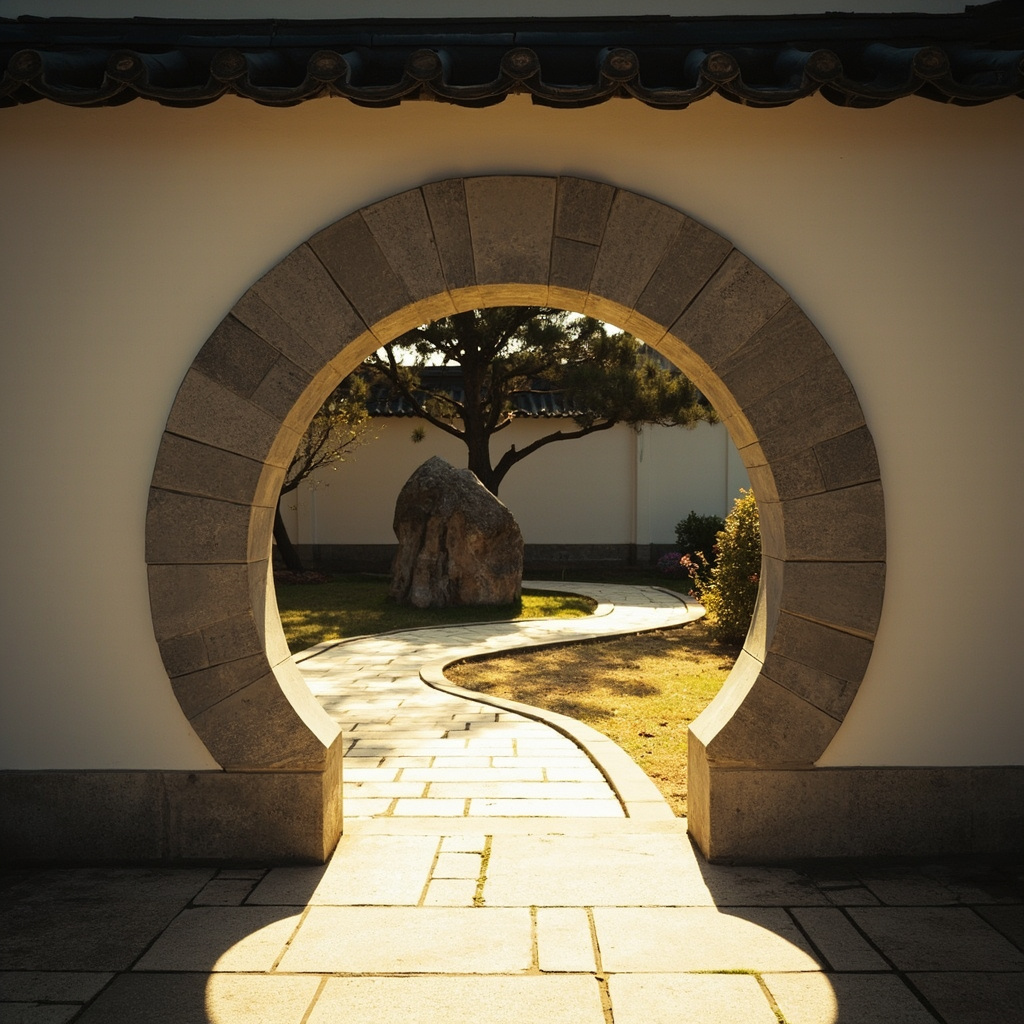
A moon gate is an opening cut through a garden wall into a full circle or a near circle, wide enough for two to pass abreast. In the classical gardens of the Jiangnan region, walls divided a property into connected courts, and a round opening was the standard way from one court to the next. The name comes from the form: a complete circle, like the moon at its fullest. Many are cut with a flat base and rounded head, because a pure circle taken to the paving reads as a wheel.
The distinction matters: a gate with no leaf never shuts, so it reads as a standing invitation rather than controlled access, and everything that follows is about where it points.
Why the Opening Is Round, Not Square
The old formula is round heaven and square earth. A circle has no corner, and a corner is where moving air slows, pools, and turns stale. The same reasoning that puts a plant before a sharp interior angle applies to a wall opening: a circular rim gives the air nowhere to catch, so what passes through keeps its momentum instead of dumping against the jambs.
A second reason: a square opening reads as a door, and a door is administrative, a thing that admits by permission. A circle reads as an aperture, closer to a window someone decided to walk through, and carries the old association with fullness and reunion.
The Gate as a Frame: Borrowed Scenery
The wall supplies the frame and the garden supplies the picture. From the near side it behaves like a hanging scroll: it crops one view, a branch, a standing rock, a far roof, and by cropping it makes that view feel owned. The technique is called borrowed scenery, and this gate is its cheapest form, a hole in a wall that turns a distant hill into a painting.
That is why the gate is judged by what sits behind it, not its own cut. A circle aimed at an empty yard is a picture of nothing; the same circle aimed at one dark pine against a white wall is worth the whole wall.
The Threshold That Slows You Down
The practical heart of the object is timing. A moon gate changes tempo, not direction. You cannot cross at your usual pace: the rim narrows the visual field, the sill takes a deliberate step, the frame asks you to look before you commit. The breath shortens, the shoulders turn slightly, the far view registers.
That pause is the correction. Feng shui is largely a study of the sequence in which a person meets a space, and a gate that inserts a pause breaks a rushed arrival. Chi that would run straight from street to bed is asked to slow, look, then continue.
Getting the Proportions Right
- Diameter: two people wide, roughly 1.8 to 2.4 metres in a domestic garden. A smaller gate becomes a peephole, and a tight rim pushes air through in a jet.
- Sill: a low raised sill of ten to fifteen centimetres defines the threshold and sheds water. Anything above the knee reads as refusal.
- Height: the top of the circle should sit below the wall coping, so the wall still reads as a wall with an opening, not a doorway with a wall attached.
Where a Moon Gate Belongs, and Where It Does Not
It belongs between two garden courts, where it connects a busy area to a quiet one. It belongs in a side court glimpsed from a living room window, where it works as a picture even when nobody walks through.
It does not belong on an outer boundary facing the street, where an opening that never closes invites strangers. Nor in a bedroom wall, opposite a bed, or between a kitchen and a bathroom. And it should never sit on one unbroken axis with the front door, which builds a straight channel from road to private room.
What the Gate Should Open Onto
The far side is the content of the picture, so it deserves the same care as the cut. Put something vertical beyond the rim to stop the eye: a specimen tree, a standing stone, a white wall with one shadow on it. Never open it onto another opening: two circles in a row cancel and the eye runs straight through the property.
Let the path curve within a few steps of the sill and change material, stone to gravel, so the foot knows it has crossed something. A bench just beyond the gate gives a reason to enter rather than only to look.
Light, Shadow, and the Moon on the Ground
On a clear afternoon a moon gate casts a circle of light onto the paving, a full moon at noon. At night, with one lamp behind it, the same circle glows from within the wall. This is the object explaining itself: the shadow repeats the symbol without doctrine.
Keep the wall face pale, lime plaster or whitewash, so the shadow has something to land on, and keep plants off the immediate face. A gate facing east or west, raked by low sun, throws the strongest ring; in shade it keeps the shape but loses the light.
Materials, Planting, and Upkeep
Grey brick, lime plaster, a stone base, and a tiled coping are the traditional assembly. A vine over the coping is welcome as long as it never closes the circle, and moss on the sill shows the gate is holding damp and slowing the foot. Avoid thorns at the threshold, and plants that bleed milky sap beside the opening.
Upkeep is simple: clear the rim of branches and cobwebs each season, repaint the wall face when it greys, check the sill for water damage. A moon gate works because the wall around it is quiet, so anything crowding the wall weakens the gate.
Common Mistakes and a Closing Thought
- Cutting the circle so small it feels like a service hatch.
- Leaving the view behind it empty, which turns a frame into a hole.
- Hanging a heavy lantern at the top of the circle, breaking the moon.
- Bolting a metal arch to the rim, which turns the moon into a hoop.
A moon gate is not a lucky object and needs no charging. It is an instruction about how to move: the wall says stop, the circle says look, then come in. A household that walks that sentence daily keeps a habit no ornament can supply.