Chinese Chess Feng Shui Meaning: The Xiangqi Board and the River Between
Xiangqi, the Chinese game of generals and chariots, is not a decorative object and was never meant as a talisman. Yet it rewards reading with the same attention feng shui asks of a room. Its board is a small, strict model of how power behaves when it is given a centre, a threshold and a set of boundaries. Four rules do most of the work, and each of them translates into something a household can learn from a game kept on a table.
What the Board Shows
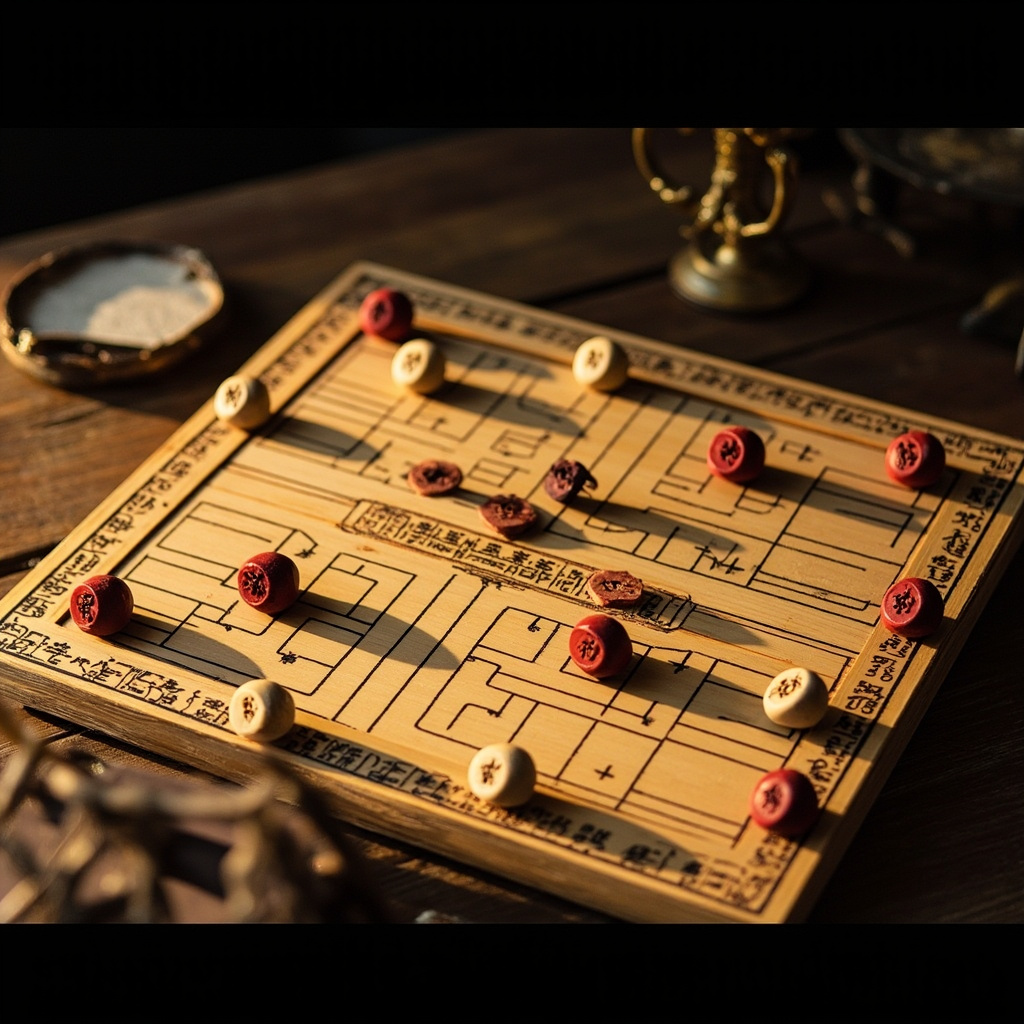
The xiangqi board is a grid of nine vertical files crossed by ten horizontal ranks, ninety points in all, divided in the middle by a wide channel called the river. At each end sits the palace, a three-by-three square of nine points marked with diagonals. Two armies of sixteen face each other across that channel: a general, two advisors, two elephants, two horses, two chariots, two cannons and five soldiers. On the boards in use today the river carries four characters naming the Chu River and the Han Border, so the object itself keeps its own history in view.
The Palace Is a Centre That Cannot Leave
The general is the strongest piece on the board and it is confined to nine points. It moves one step in a straight line and it may never cross the palace boundary, which is why a Chinese player speaks of a threat to the head rather than a threat to the king. The structure is the point: the seat of command is bound to its own room. In feng shui terms the palace is a bound centre, and its nine points correspond to the nine-palace grid that organises the eight trigrams in classical Chinese spatial practice. The highest authority does not wander the field; it holds one square, and everything else arranges itself around it.
The River Is a Decisive Threshold
A soldier that has not yet crossed the river may move straight forward only. The moment it reaches the far bank it may also move sideways, and it may never step backward. One crossing changes what the piece can do, permanently and without ceremony. This is the cleanest lesson the game offers a home: a threshold does not merely divide two spaces, it alters the behaviour of whatever passes through it. The channel in the middle of the board is the only place where the two armies touch, and games are usually decided in that narrow strip rather than in either rear.
The Horse That Needs a Knee, the Cannon That Needs a Screen
Two pieces depend on something outside themselves. The horse moves one step in a straight line and then one step at an angle, and if a piece occupies the square at the bend, the horse is stopped; players call it hobbling the horse’s knee. The cannon moves like a chariot when it is not capturing, but to capture it must leap exactly one intervening piece, the screen, and land on the piece beyond. Both are read the same way: neither works in isolation. A horse without a clear knee is a statue, and a cannon with nothing between it and its target is only a heavy block. Power here is a relationship between two things standing in a line.
Facing Generals
One rule forbids a whole class of position: the two generals may not stand on the same file with nothing between them. Bring them face to face and the position is illegal, because the rule treats the two commanders as a single line of force that nothing is permitted to interrupt. Much of Chinese practical philosophy turns on the same intuition, that two very strong presences aligned without a buffer between them is a dangerous configuration rather than a fortunate one. In a house the parallel is the open sightline. What matters is not only what stands in a room but what stands directly opposite what.
Where the Game Came From
The board is usually read as a map of the Chu and Han contest of the third century BCE, and the characters inscribed along the river keep that reading in plain view. The game appears in the written records of the Song period, by which time professional players worked the entertainment quarters of the great cities, setting up boards in the street for money. The strongest of them were called jianghu, river men, a title borrowed from the very feature that divides the board. Successive Ming governments found the game troublesome and banned it more than once on the ground that it taught ordinary people the art of war.
Seven Roles and a Vocabulary of Response
Read the pieces as a set of responses rather than a ladder of strength, and the set turns out to be seven distinct answers to the question of how power behaves when it meets resistance. A household that takes this seriously stops asking which object is strongest and starts asking which object is placed so that it can answer the right question.
In short:
- The chariot is reach and nothing else.
- The cannon is reach with a condition attached.
- The horse is precision that can be blocked from outside.
- The elephant is blocked by a single stone at the midpoint of its path.
- The advisor covers one diagonal step of the palace.
- The soldier is the only piece that gains as the game goes on.
- The general is the piece that must never leave its room.
Where to Keep a Xiangqi Board in the Home
Placement is where the object earns its keep, and a board is a demanding guest. It wants a low table in a study or a living room that people cross, not a bedroom, because the pieces are opponents and a game of adversaries does not belong beside a marital bed. Leave it where the light falls from one side so the carved characters stay legible, and let it stay still, since a board moved every evening stops being a map and becomes furniture. Its river should face the open side of the room, and it should never be set down in a doorway, where the traffic of a household would disturb the one position the pieces are meant to hold.
A Grammar of Constrained Response
Taken together, xiangqi is a grammar of constrained response. The strongest piece is confined, the weakest piece grows as it advances, the two swiftest depend on a clear line and something to stand behind, and the two camps are separated by a strip no wider than a hand. None of that is decoration. It is a working model of the idea that a well-placed object does more than a powerful one, and of the older conviction that limit is what makes a form legible. Keep the board where the household can read it, and it will keep reminding you that arrangement, not inventory, is what carries a room.