Chinese Roof Ridge Beasts: Feng Shui Meaning of the Chiwen and Roof Guardians
Walk through any old Chinese town and look up. Above the doors you have been studying, above the windows and painted beams, the roofline carries a row of small clay figures nobody photographs. They are roof ridge beasts, and they are the only guardians in Chinese architecture placed where no visitor will ever meet them.
That single fact is the key to reading them. A guardian at a gate works on people. A guardian on a ridge works on the building itself, on the sky above it, and on the line where the two meet.
What a Roof Ridge Beast Actually Is
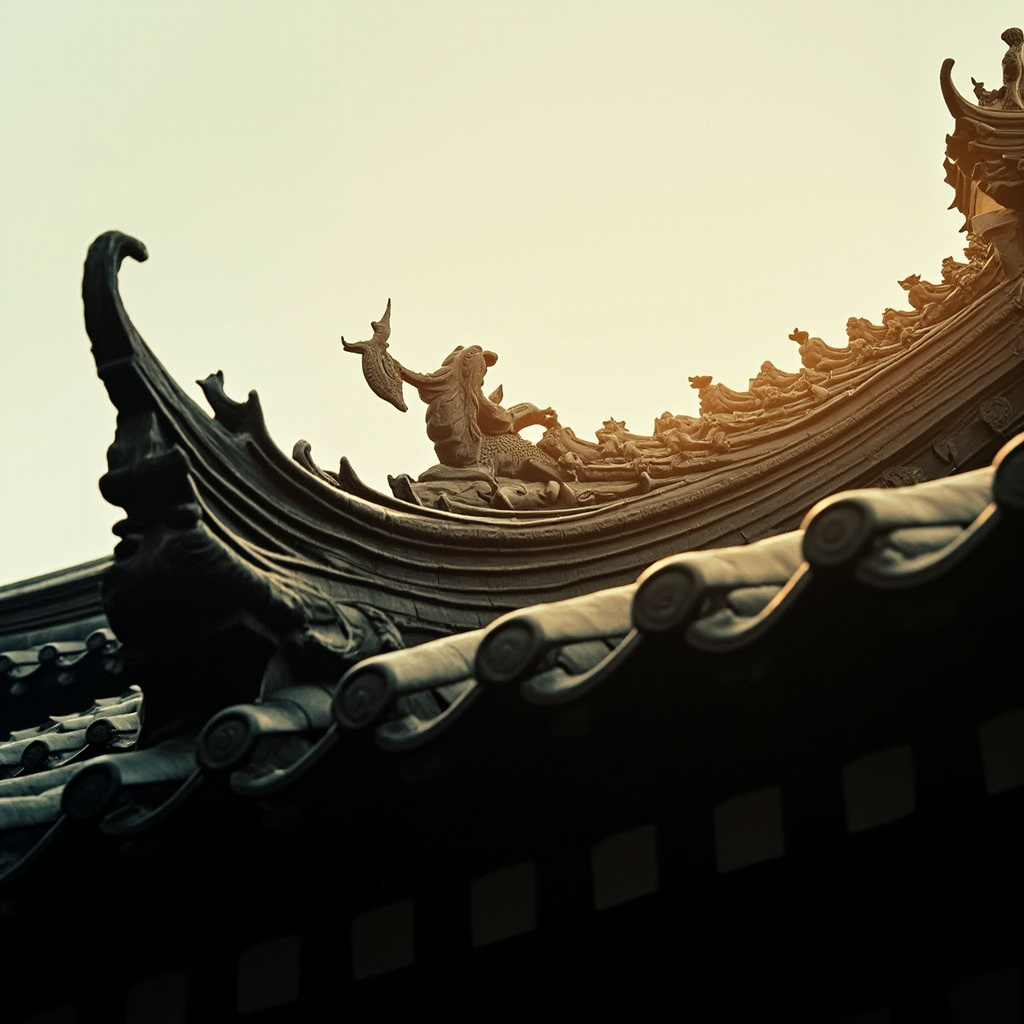
A roof ridge beast is a fired clay or glazed ceramic figure fixed permanently to the highest lines of a timber roof. Two kinds matter. At each end of the main ridge sits a large hollowed form, the chiwen, gripped around the ridge cap as if biting it. Along the sloping corner ridge that runs down toward the eaves sits a procession of smaller figures, led by a man riding a bird. The most famous set, on the Hall of Supreme Harmony in Beijing, numbers nine behind its leader plus one extra figure found on no other roof.
Why They Sit on the Ridge and Not at the Door
Look at a traditional Chinese roof and you are looking at a mountain range in miniature. The main ridge is a summit line, the sloping tiles are its flanks, and the upturned corners are the spurs where the slope releases. Feng shui reads a building the way it reads land: a house wants a strong spine, a protected back, and ends that are finished rather than left open. The roof ridge is therefore the building’s own dragon line, and a dragon line is exactly where a guardian belongs. Door guardians face outward at visitors. Ridge beasts face up and away, toward weather.
The Chiwen: the Fish That Swallows the Ridge
The chiwen is a dragon-headed creature with a curling tail, seated at the end of the main ridge and appearing to swallow it. In one telling it is a son of the dragon whose appetite is to swallow, and it is placed there so that the ridge can never be cut. In another it is a sea creature that raises waves, stationed on the most fire-exposed line of a wooden building. The two readings converge: this is a water animal holding the end of the spine. The chiwen does not stand on the roof; it closes it.
The Small Beasts Behind the Immortal
On the descending corner ridge, the queue begins with a figure of a man riding a phoenix, then proceeds through a dragon, a phoenix, a lion, a heavenly horse, a sea horse, a lion-like suanni, a fish-tailed yazi, and several further animals depending on the building. Each carries one attribute rather than a personality: speed, endurance, ferocity, the ability to ride water. Read them as a stance repeated down a slope. Every figure faces outward and slightly down along the eave, never back across the roof surface, so the whole row watches the edge rather than the tiles.
Why the Number Is Odd, and Why Nine Was the Ceiling
Odd numbers are yang, and a roofline is the most sky-facing part of a house, so the count on it is kept yang. Traditional sets run three, five, seven, and nine. Nine was the imperial maximum at the Hall of Supreme Harmony, and one building alone was permitted a tenth figure, which is why nine-plus-one is the celebrated count. Rank reduced the number from there: princes at seven, senior officials at five, lesser halls at three, and most ordinary dwellings at none. The row is therefore a rank badge rendered at roof height, legible from the street.
Reading the Roofline as a Spine
If the ridge is a spine, then a broken ridge is a broken spine, and that translation works without any knowledge of Chinese culture. Four things to look at on any roof, old or new: a sagging main ridge line; a ridge cut through for a badly fitted flue or antenna; a corner that has lost its figures and shows raw mortar; and weight stacked on the highest line, whether boxes, a solar frame bolted through the cap, or stored equipment. Each is a straight line that stopped being straight, and a structural line that no longer runs clean is sha chi in plain view.
Fire and Water: the Element Logic of a Tiled Roof
A timber frame under dry thatch is a fire waiting for a reason, and the roof is the plane that takes the sun all day. Traditional roofing answers with water imagery rather than fire suppression. Barrel tiles overlap so rain runs off in sheets, the glaze fires to a glassy sheen, the ridge terminations curve upward so wind lifts away instead of pressing, and the guardians themselves are sea creatures. The logic is consistent: on the most fire-prone surface of the building, put the animals that belong to water.
Where the Logic Still Applies in a Modern Home
You have no ridge tiles and no clay fish, but the principle transfers to the highest horizontal lines you live under.
- Keep the highest line clean. Sweep the roof, or in an apartment, clear the top edge of your tallest wall and the ceiling line above the bed.
- Do not cut the spine. No cable, pipe, or shelf bracket should slice the main horizontal line of the wall you face.
- Finish the ends. A room with one raw end reads as a ridge with no chiwen; give it a terminal element: a pier, a plant, a lamp.
- Keep water above fire. A leak over a kitchen or stove is the domestic version of the mistake the chiwen was invented to prevent.
What Not to Do
Salvaged clay beasts glued onto a modern gable are inert, because the geometry is wrong: a pair needs two real ridge ends to hold, and a flat parapet has none. A single beast with no partner is worse than none, since the entire logic is a matched pair closing a line. Do not repaint glazed figures with modern acrylic, which seals the glaze and traps moisture until frost spalls it. Do not load one end heavier than the other, and do not replace a fallen figure with a stone one; the point of fired clay on a ridge is lightness.
The Guardian Nobody Meets
The roof ridge beast is the only Chinese guardian that asks nothing of you. It does not face your door, does not take offerings, and does not need to be seen to work. It holds a line, and the line it holds is the highest one a house has. The next time you pass an old roof, count the figures along the corner. The number tells you who lived beneath it, and the fact that they are still standing tells you the ridge held.