Chinese Peacock Feng Shui Meaning: Kongque, Dignity and the Bird of Rank
Of all the birds in Chinese art, the peacock is the one most often imported and misunderstood. In Western interiors it means elegance; in Indian tradition it belongs to Krishna and Saraswati. In China it means something more exact: rank. The peacock, kongque, is the bird that earned its feathers, and how it did that explains why it sits where it sits in a home.
The Bird That Earned Its Rank
The peacock’s place in Chinese culture begins with a bureaucratic fact. Under the Qing dynasty, an official who had distinguished himself in service could be granted a peacock plume to wear at the back of his court hat. The plume was not decoration but a mark of imperial favour, and it could be withdrawn. Plumes were graded by the number of eyes visible on the feather; the more eyes, the higher the honour. The peacock also appeared on the rank badge of the third-rank civil official, embroidered so finely that the bird’s tail and crest were worked in peacock-feather thread.
Twelve Symbols of Sovereignty
Before the Qing, the peacock’s importance was already encoded in the imperial wardrobe. The Twelve Symbols of Sovereignty were the twelve motifs reserved for the Son of Heaven’s robes, and one was the pheasant, recorded in the Book of Documents as huachong, a bird whose five-coloured plumage was read as an image of the sage ruler’s civil refinement. The dragon and the pheasant together stood for the animal and bird kingdoms, and so for the natural world under imperial order. The motif on the emperor’s robe was not a peacock but the pheasant; the peacock entered official dress through merit rather than birthright.
Five Colours and the Five Elements
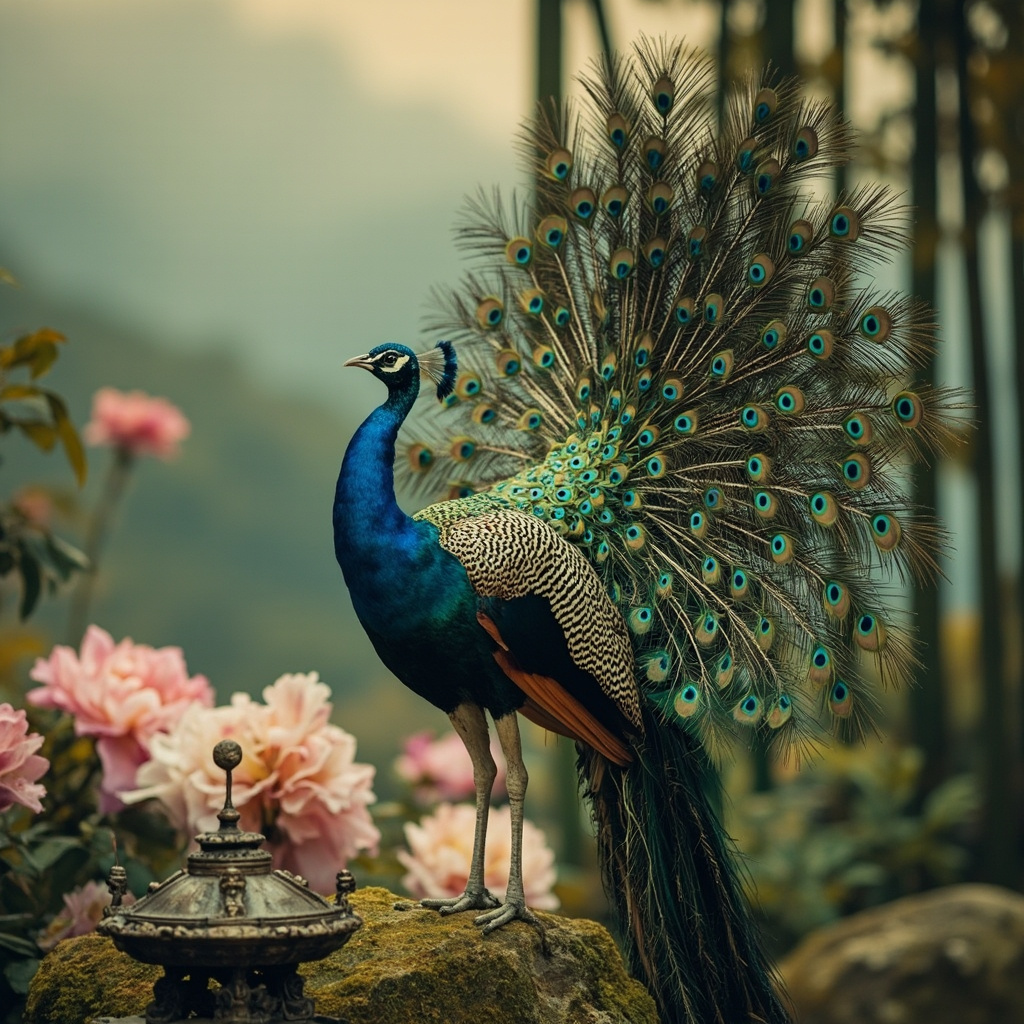
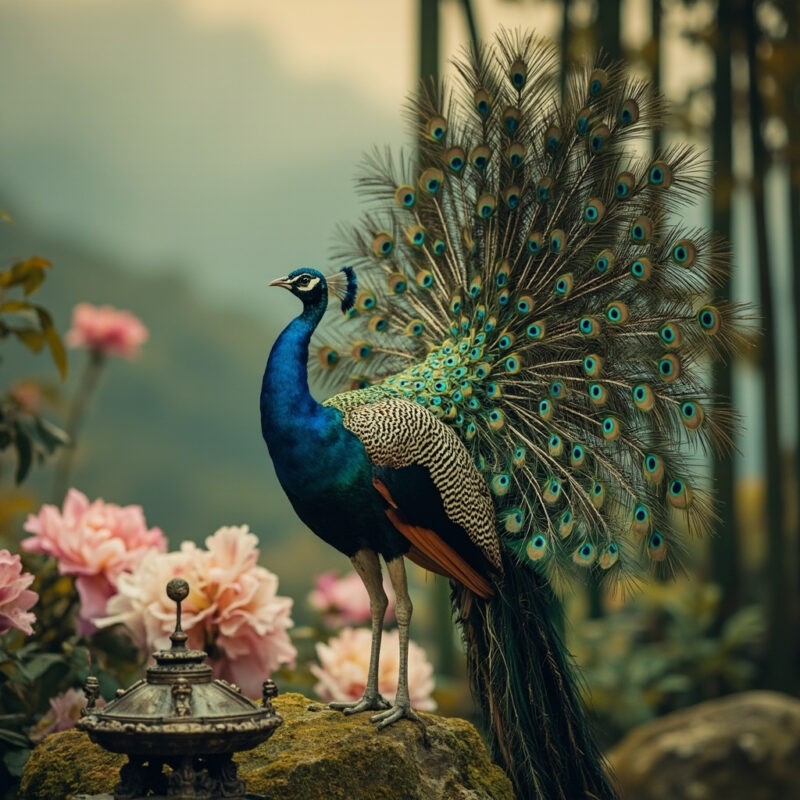
Every peacock is a five-colour bird, and the five are not decorative. Blue, yellow, red, white and black map directly onto the five phases of the cosmos, which are also the five elements of the working tradition. The blue-green of the neck carries wood and the direction of the Azure Dragon; the yellow of the crest carries earth; the red of the body carries fire; the white of the pure-feather varieties carries metal; and the green-black of the true Indian peacock carries water. Read this way, a peacock is not a pretty bird at all but a portable diagram of the whole system — which is why it works as a feng shui object.
Rain, Monsoon and the Timing of Auspiciousness
Peacocks dance before rain. The old Chinese poems speak of the bird spreading its train as a storm approaches, and in the agricultural calendar that gesture was never merely decorative. Rain was the condition of the harvest, and a bird seen calling it in was a bird that could be trusted with the timing of fortune. In feng shui this survives as the notion that the peacock belongs to the moment before relief arrives rather than after. A peacock in a home is a statement about the future tense: something good is coming, and the bird has already seen it.
The Peacock and the Phoenix
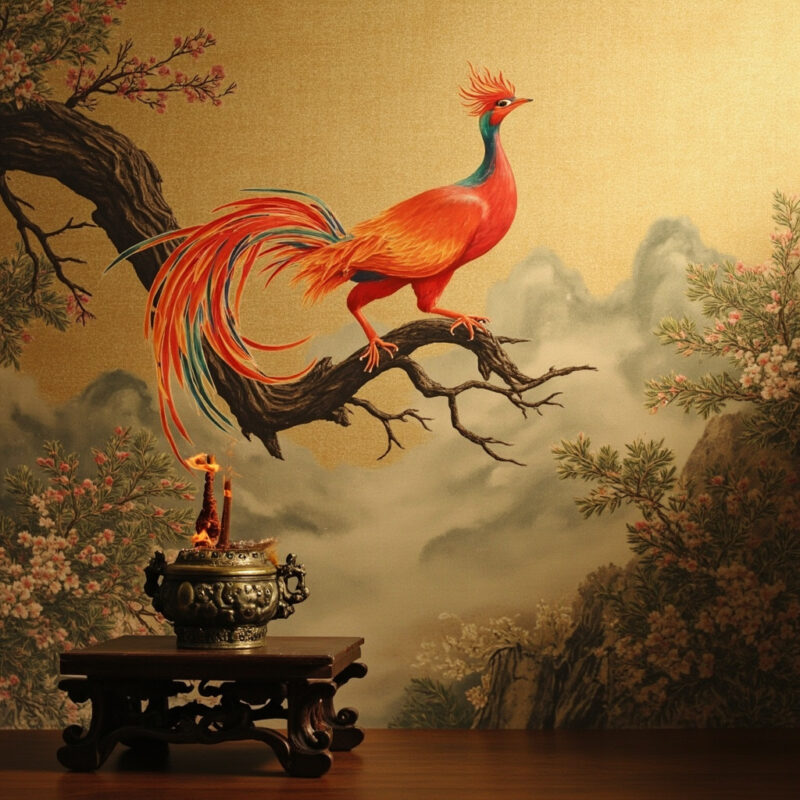
Chinese tradition holds that the peacock is the earthly manifestation of the phoenix, or that the peacock is the ordinary bird from which the phoenix is imagined. The pairing explains much decorative art in which the two appear together. The phoenix arrives in a state of peace and shows only one sex at a time, which is why it reads as a sovereign rather than a creature of appetite. The peacock is the everyday world the phoenix is drawn from. Where the phoenix is unattainable perfection, the peacock is the beauty that actually lands in a courtyard — which is why a home may carry the peacock when the phoenix is only a courtesy.
Kongque Mingwang and the Protective Feather
Buddhism gave the peacock a second career. The Great Peacock Wisdom King, Mahamayuri, is a bodhisattva of the Mahayana and Vajrayana traditions, known in Chinese as Kongque Mingwang and in Japan as Kujaku Myoo. The deity holds peacock feathers and, in the ritual manual of Amoghavajra, sits upon a golden peacock king. The central story is protective: in a past life the Buddha was a golden peacock who recited a mantra daily for safety, forgot it once, was trapped by a hunter, and freed himself by remembering the words. His powers are the removal of poison and disease, the dispersal of disaster, and prayer for rain.
In the Daoist and folkloric register, the feather works less through doctrine than through habit. It is carried as a charm against the evil eye and placed in a sickroom, since the bird was thought to draw off poison and fever as well as misfortune. The Great Peacock Wisdom King inherits that instinct and systematises it — one feather carrying both readings at once, which is why it never had to choose between the temple and the household shrine.
Peacock Feathers Woven into Imperial Silk
The material has a Chinese history of its own. Nanjing Yunjin brocade, inscribed by UNESCO as intangible cultural heritage, is woven on a large wooden drawloom by two craftspeople working in tandem, one lifting the warp above and one passing the weft below. They produce only a few centimetres of cloth a day; the saying for its value is that an inch of it is worth an inch of gold. Peacock feather yarn is woven in alongside silk, gold and silver thread, and the green of the imperial robes comes from peacock feathers. The Ming Wanli emperor’s tomb yielded a gold-woven peacock-feather gauze dragon robe whose seventeen dragons were worked in real gold thread.
Where a Peacock Belongs in a Home
Because the peacock carries wood and water at once, it is unusually flexible in placement, and it is the pairing that does the work rather than any single direction. The peacock is a wall piece and a display piece: it does not belong on an altar, and it does not want to be handled as a talisman.
- One bird for a study or reception room, where it reads as dignity and clarity.
- A pair for a marital chamber or living space, turned toward one another.
- A feather for a writing desk or small devotional corner, kept close to hand.
- A dancing bird with the train fully spread, for a bright entrance or wide wall.
Reading the Feather Without Over-Reading It
It is worth closing on plain honesty, because the peacock is a magnet for over-interpretation. Nothing in the classical record says that a peacock painting in a hallway will make money, and the “dancing peacock” placement manuals circulating online for other traditions are largely modern, mutually contradictory, and not Chinese doctrine. What the record does support is more durable: the peacock has always meant dignity earned rather than inherited, colour signalling cultivation rather than extravagance, a bird that arrives with the rain, and a feather that carried protection through three thousand years of temple and court. Read it that way and it becomes what it was, an emblem of grace under authority.