Tiger Head Shoes: The Feng Shui Meaning of Chinese Children Protection Shoes
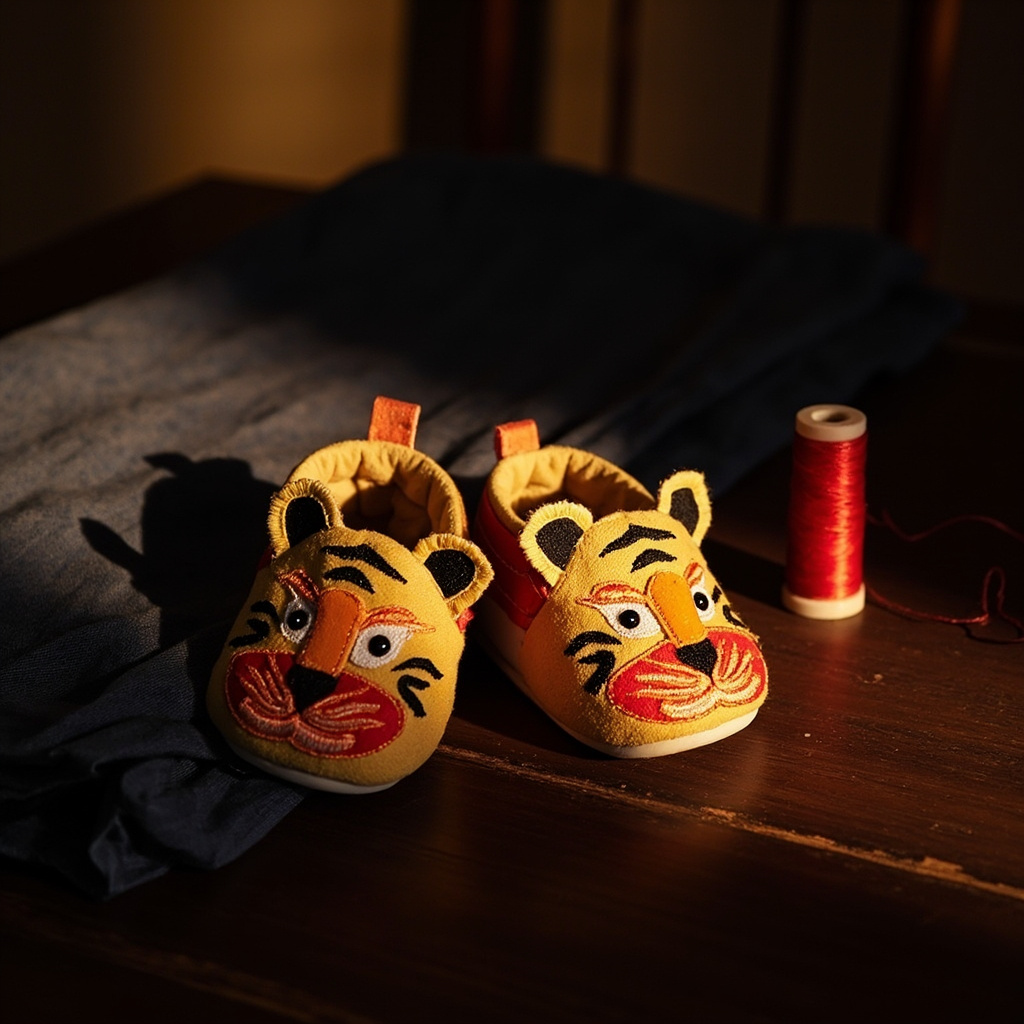
Before a child in old China could walk without holding a hand, someone in the household was already sewing. The tiger head shoe is a soft cloth slipper with a stitched tiger face across the toe, two small ears standing up as flaps, and a short tail flicking at the heel. It was made for a foot that had only just learned to carry weight. The object is one of the most recognisable pieces of Chinese folk needlework, and one of the least understood by outsiders, who see a charming baby shoe where the family saw a small piece of protection.
What Tiger Head Shoes Actually Are
A tiger head shoe is a constructed cloth shoe, not a knitted bootie. The sole is layered and quilted, often with a stitched pattern underneath so the tread itself is decorated. The upper is built from several pieces of fabric joined so the toe can hold a shape, and the face is applied last: eyes of glass bead or dense satin stitch, brows in black, a wide mouth worked in red, whiskers of stiffened thread, and the character for king marked on the forehead. Ears and a tail complete the animal. The pair is finished by hand, usually without a pattern, which is why no two traditional pairs look quite alike.
Why a Tiger and Not Another Animal
The tiger was chosen because it is the one fearsome creature a family could plausibly put on a child. Dragons belong to emperors and temples, lions guard gates in stone, and both keep their distance from a crawling infant. The tiger could be domesticated into cloth. Folk belief held that the tiger devours what harms a household, and that a predator looking at a small child sees the face on the toe first. The shoe therefore borrows a predator rather than inviting a blessing, which is a different move from most Chinese protective objects.
The Foot Is the Root of the Body
In the old household the floor was the enemy. Stone flags, packed earth and cold brick drew damp upward, and a child sitting or toddling on that surface was thought to take cold directly into the body. Illness arriving through the feet is the logic behind thick quilted soles and the habit of keeping a baby off the ground in winter. This is where the tiger head shoe differs from an amulet worn at the neck. The lock protects the child, while the shoe protects the step, the single point where a small body meets the ground.
A Face Worn, Not Hung
Most protective objects in Chinese homes are placed: a mirror over a door, a guardian figure on a shelf, a charm above a bed. The tiger head shoe is worn, and it moves with the child. That changes what the protection is for. A hung object guards a fixed place, while a worn one follows the child into every room and out into the yard. Consider also the direction of the face. It points forward and down, at the ground the child is about to cross, rather than outward at a doorway. The shoe meets the world one step before the child does.
Reading the Embroidery
The decoration is a short written message, not ornament. The king mark on the forehead claims authority over the small space ahead. Black brows and a red mouth give the face enough contrast to be legible from a distance, which matters when the wearer is knee high. Gold thread, where a family could afford it, marks the eyes rather than the body. Some pairs add a bat, a peach or a pomegranate to the heel, quietly asking for fortune, long life or many children. None of these motifs are hidden. They are meant to be read by anyone the child passes.
Made From What the House Already Had
Traditional pairs were rarely made from new cloth. Scraps saved from worn garments were pieced into the upper, which is why the shoes are often a patchwork of several colours with one brighter fabric reserved for the face. The practice was practical before it was symbolic: good cotton was expensive and small offcuts were free. But the result carried the household inside it. A child walked in fragments of a father’s shirt and a grandmother’s jacket. The maker was usually the grandmother or an aunt, and the sewing was done in the evenings, slowly, over weeks.
An Object Measured in Months
A tiger head shoe is built to be outgrown. A toddler’s foot changes size several times in a year, so a pair might last one season and sometimes only a few weeks. Unlike a longevity lock, which a person can wear for decades, this object has a short working life by design. Families kept the outgrown pair rather than discarding it, often in a drawer or a wooden box, because the shoe recorded a specific weight and length of a specific child. The protection ends; the record remains. That is a very different relationship to an object than ownership.
Where a Kept Pair Belongs in a Home
If you own a pair, treat it as a record rather than an active remedy. A nursery shelf at the child’s eye level is the natural place: the shoe is seen daily, and the story is retold. Avoid hanging it over a cot or a bedhead, where small objects above a sleeping child are a practical hazard and a symbolic muddle. Do not repurpose a wearable pair as wall decoration while the child is still small enough to use it. The shoe works by being walked in. Once it has been outgrown, its job is to remind the adults what they were paying attention to.
Buying and Using Them Today
Modern pairs are sold as keepsakes, photo props and, less often, as actual footwear. Three checks matter before buying:
- The sole. Soft leather or layered cotton is what the tradition assumes; a hard rubber sole turns the object into a costume.
- The face. Hand stitched features survive a child, glued applique does not, and the face is the whole point.
- The fit. A shoe that pinches is not protective. Buy for the foot the child has now and expect to replace the pair.
If the pair is meant as a gift, say plainly that it is a keepsake rather than footwear, and let the parents decide whether it is ever worn.
What the Tiger Head Shoe Actually Teaches
Stripped of folklore, the shoe is a device for making an adult pay attention. Someone had to notice the child was nearly walking, choose the cloth, and spend evenings on a face that would be scuffed within days. The tiger does not do the work. What survives the tradition is the habit behind it: watching where a small person puts their feet, and putting something between them and the cold ground. That is the part of feng shui worth keeping in any country. The object is the reminder, and the reminder is the practice.