Chinese Kang Heated Bed Feng Shui Meaning: The Warm Ground Beneath the Bed
Most objects in a feng shui inventory earn their meaning from what they do to a room: a mirror deflects, a bell disperses, a scholar stone steadies. The kang, the raised brick platform bed of northern Chinese houses, does something quieter. It changes the temperature of the ground you lie on, with no flame near the sleeper. The fire that warms it burns in another room, connected by a hidden tunnel of flue. Its working parts are deliberately not where the person is.
What a Kang Actually Is
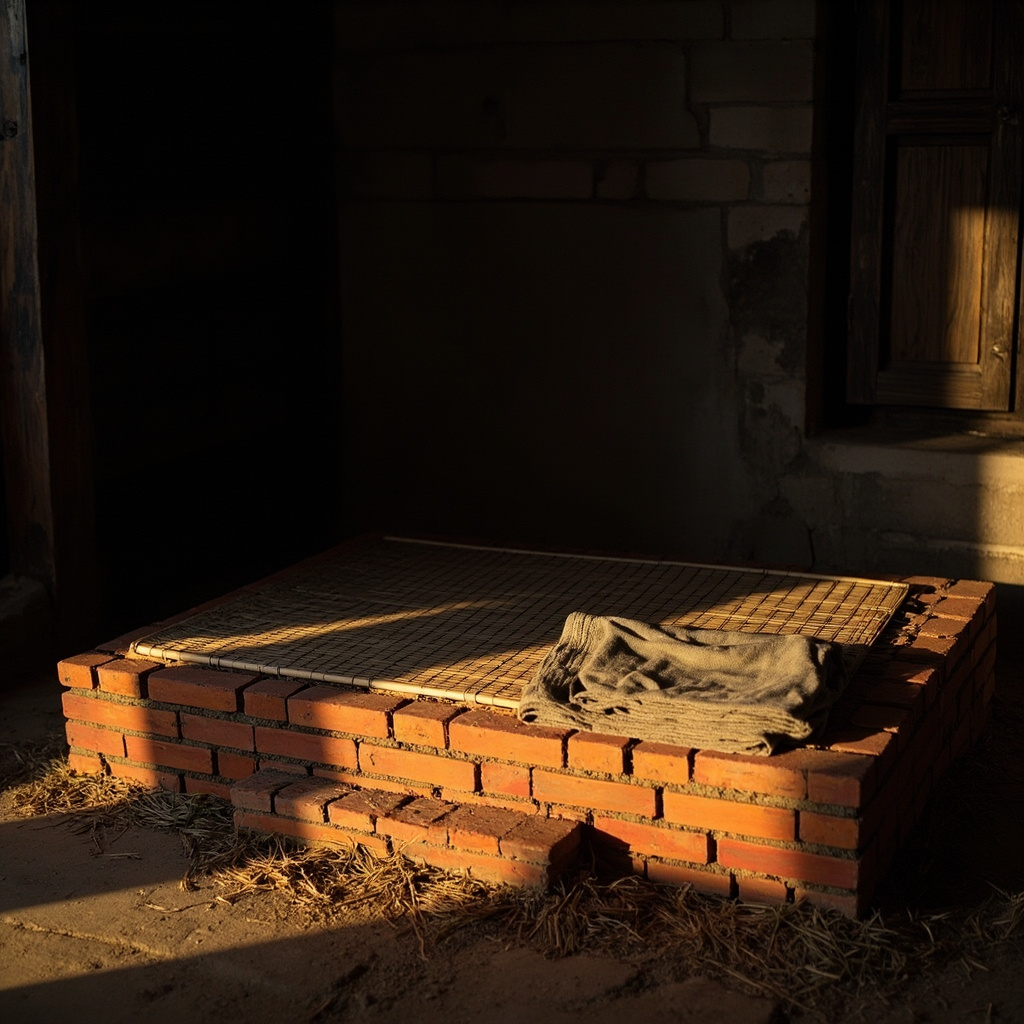
The kang is not a bed frame. It is masonry. A pit is dug in the floor, lined with brick, and packed with rubble and charcoal so heat travels evenly instead of pooling. A narrow flue tunnel runs lengthwise through that fill. The platform is bricked over to a level surface, finished in brick, board, or woven mat, and the sleeper lies on it. What feels like furniture is closer to a wall that happens to be warm.
- A lined pit packed with rubble and charcoal
- A flue tunnel running the length of the platform
- A hearth at one end and a chimney at the other
- A bricked surface, sometimes topped with mat
The Fire Is in Another Room
Everything else in a traditional Chinese interior is self-contained. A censer burns in front of you, a bell hangs where you ring it. The kang breaks that pattern. Its fire sits in the hearth of the adjoining chamber, and heat is drawn along the flue under the bed and up a chimney at the far end. You sleep in a room with no flame, and the warmth arrives anyway, through a passage you never see. Its purpose is not to contain heat but to deliver it from somewhere else.
Warmth Used as Insulation
A normal bed lifts you off a cold floor with timber: a frame, slats, a mattress. The kang lifts you off the same floor with trapped heat, and the insulation is the structure itself. Brick conducts slowly and releases slowly, so the platform stays warm long after the fire has been fed. The sleeper is separated from the earth not by a cushion but by a temperature difference. In the vocabulary of the five elements, earth supports while fire warms, bound into one object rather than split between a frame and a heater.
The Warm Half of the Day
Fire was fed to the kang on a schedule, usually morning and evening, and the bed was warm at the hour it was used. The heat arriving hours after the fire was lit is the part that matters. This is not a live flame under your body but a residue held in stone. Cinders in the fill kept the platform alive through the night. The kang is an object built around delay, rewarding a house that plans its hours rather than reacts to them.
Why the Hearth Sits in the Coldest Room
In a walled courtyard house the range of rooms is chosen by light. Rooms facing south take the winter sun and lose it in summer; rooms on the north side take the low sun that clears the opposite wall, hold their heat through the night, and stay the driest. It made sense to put the fire in the north range, close to the stored grain and the entrance, and run the kang into the rooms meant for sleeping. The arrangement is climate engineering, not symbolism.
The Pit, the Flue, and the Ash
A kang is not a low-maintenance object. The flue has to be swept, the ash pit emptied, the embers fed and drawn. Block it, and the heat stops travelling, the platform goes cold, and the chimney smokes. This makes the kang a rare piece of Chinese domestic architecture that requires a keeper: it must be tended on a rhythm by someone who knows which end the fire is at. In a house left empty for a season, the platform tells you whether anyone lived there. The temperature is a record of a routine, and it goes flat when the routine stops.
What the Kang Means for a Home
The feng shui reading follows the mechanics rather than the folklore. The kang returns warmth to the ground under the body, so the ground stops being a cold surface and becomes a support. That is a statement about earth element as the base of a life, and fire used to moderate rather than display. It is also about attention: the platform is built into the floor and cannot be moved once it is cold, so no rearranging fixes a badly sited flue. The kang rewards correct construction over correct placement, near the opposite of a compass school of feng shui.
Where It Works in a Modern Home
The kang survives in the modern home in three recognisable forms. A raised platform bedroom keeps the body at a different level from the floor and leaves the space underneath free. A tatami or low platform bed does the same with less mass. Underfloor heating is the kang’s true descendant: a boiler in one room, a circuit under the floor of another, warmth arriving at the feet of people in a room with no radiator. In tian xing terms the alignment is not a direction you pick but a condition you build. Nothing in the platform’s logic improves by being moved around the room.
Common Mistakes
The usual errors are practical rather than spiritual. Sealing the kang with a rug or bed base traps the heat and can damp the fill. Setting a metal frame on the platform conducts cold down into it and defeats the purpose. Storing tea, paper, or cloth on a warm surface invites moisture. Expecting the kang to be warm in July and reading its coldness as unlucky is a category error, because it was a winter technology and always seasonal. Do not treat it as a wealth symbol. It is a heating device, and a very good one.
A Small Practice for a Modern Home
You do not need a brick flue to use the principle. Three moves are enough.
- Put the bed where the floor is coldest and the room emptiest, away from the heating vent.
- Keep something solid and continuous under the mattress instead of an open frame, so the floor is bridged.
- Use warm light low on the wall to suggest the fire that is not there.
Travel in northern China or Japan and notice that the first thing a traditional house shows you is the heated platform, described as a comfort rather than a symbol. That is the honest framing.
A Warm Place With No Flame
Every feng shui object in this catalogue asks you to look at a visible thing. The kang asks the opposite: it asks you to look for the part of the house with no ornament on it at all, that sits under the floor and out of sight, and that a household had to keep alive by hand for the warmth to reach the sleeper above it.