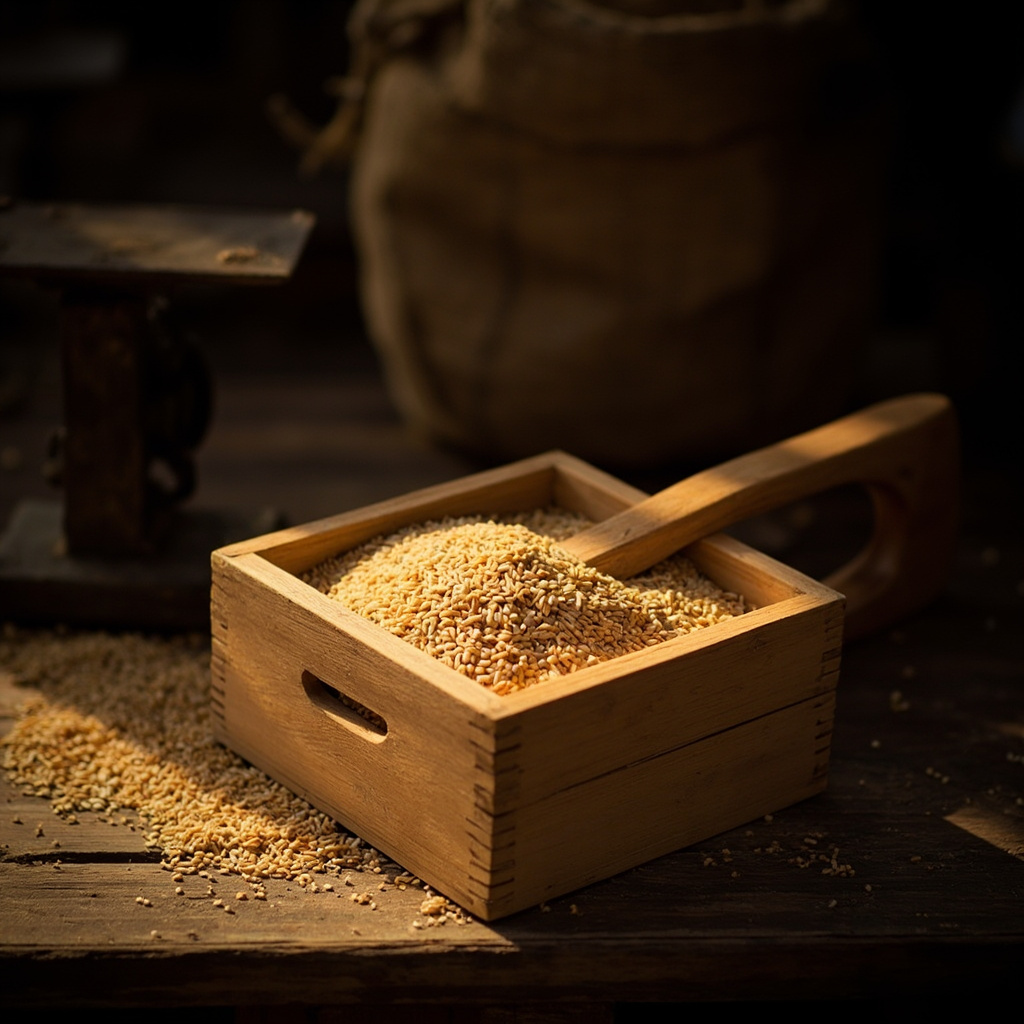
Chinese Grain Measure Feng Shui Meaning: The Dou and the Standard of Fair Share
Most objects in a feng shui inventory do one describable thing: a mirror deflects, a bell sounds, a bowl holds a fortune. The Chinese grain measure is stranger. It divides a whole into an exact share, and it can be proved wrong. That is why it means more than the drawer it sits in, and why its character also names the Big Dipper.
What a Chinese Grain Measure Actually Is
The measure was called a dou: a working vessel for dry grain, usually a squared wooden box with a flat bottom and a straight handle. Its size was not left to local custom. The state defined it, cast official prototypes in bronze and iron, and sent those out so a market measure could be checked against the capital one. What matters is the purpose: not a container that holds grain, but an instrument for establishing how much grain a person is owed.
The Handle Is the Point
Judge other pieces of a household inventory by what they keep: the caddy by its contents, the treasure bowl by its coins, the water vat by its reserve. The dou is judged by something else, by what it lets you carry and check. The handle separates it from a bowl. A bowl is a fixed address for what you own; a measure is a portable claim that can be tested anywhere it travels. Households carried theirs to market and back. That mobility is the difference between storing grain and agreeing on its quantity.
One Character, Two Meanings
Chinese characters often keep a tool hidden inside a later meaning, and this one is unusually literal. The grain measure and the Big Dipper are written with the same character, and both begin as a picture of a long-handled dipper. A dipper was the original tool of the wine ritual, and the grain measure grew out of it, the handle staying on the form after the contents changed. The Big Dipper is the pointer that never sets, swinging around the celestial pivot, so a traveller who has lost their bearings can read direction from the handle.
Why a Standard Was Worth an Edict
The measure was not left to private judgement for long. In the fourth century BCE the state of Qin standardised weights and measures under Shang Yang, and its first emperor followed with an edict unifying them empire-wide. Later law codes carried the item forward, listing the grain measure among the private instruments whose manufacture and use were punishable. The recurring abuse was always the same: the short measure. A merchant whose dou held a little less than the official one could charge the price of a full one and hand over less.
The Failure Mode You Can Check
Almost everything else in the tradition works by tradition: a bell is said to scatter, a mirror to deflect, a stone to hold a room, and none can be settled at a counter. The dou works differently, because its failure carries a number. A measure is either the standard or it is not, and the test takes three steps and no belief at all: fill it, level it, compare it against something you trust. Where most difficulties read as a slow loss of balance, the measure shows the loss as a gap rather than a mood.
The Gesture of Leveling
Fill the vessel slightly past the rim, then strike the surplus away with a straight edge until the grain sits flush with the wood. The tool is built out of excess and subtraction. To use it you must give it more than it keeps, then remove the difference by hand in one stroke. That motion describes how correction works in feng shui. A correction is not the addition of something better; it is the removal of what exceeds the measure. You do not cure a room by piling good objects into a corner. You level it.
A Portion, Not a Whole
Ten sheng made one dou, and ten dou made one dan. The dou was never the harvest; it was a numbered share of one, and the hu beside it later changed value, from ten dou down to five. A measure speaks about the part issued to a person rather than the field it came from, and it insists the part be exact, because a share that cannot be counted is an argument, not a quantity. Feng shui works the same way: a year holds a field of qi, a person receives a portion, and the art never claims the whole.
Reading the Measure in Feng Shui
No classical text tells you where to put a dou, and no auspicious shelf applies to it. It is better read as a principle, and it translates into three habits:
- Dose the correction. A change applied at full strength is a small measure of what it was fixing. Size it to the space available.
- Check the ledger. Ask what the household actually holds against what it claims to hold, in time, money and patience. Most imbalance is a bookkeeping error.
- Compare against a standard, not a neighbour. A standard tells you where you are. A neighbour only tells you where they are.
This is also why Taoist ritual objects are tools to be used rather than ornaments owned. The dou makes that logic unusually exact.
Common Mistakes
The most common error is buying a handsome dou and expecting it to protect a room. The dou never protected anything by standing still. Its authority was that of an agreed standard inside a live exchange, and once decorative it keeps its shape and loses its meaning.
- Keeping it full. A measure packed with grain is simply a bowl, and a bowl of abundance carries different meanings.
- Treating it as a display of plenty. Heaping the dou high for visitors makes it read as an offering vessel, not a standard.
- Hunting for a rare example. The lesson of the measure is that it gets checked. An untested antique proves nothing.
- Never measuring anything. A measure used only as furniture has become furniture, and loses its reading.
A Practice You Can Start Today
Choose one quantity that recurs in your household and fix it deliberately instead of by habit: the evening meal, the offering bowl, the hour given to the work that matters most. Then level it each time. Overfill, trim, and notice the surplus that falls away. Most households discard more than they think, in money, in hours, and in attention given to people tired of receiving it. It is not a talisman, and it makes nothing auspicious. It is an instrument for noticing the excess good intentions leave behind.
The measure is one of the plainest objects the tradition ever made, and one of the few that argues its own case: fairness is not a mood but a comparison, and a fair share comes from being exact, level and willing to trim. Chinese farmers carried the word for it in one hand, and the name of the Big Dipper lives in the same character. Both asked the same question.