Chinese Wooden Fish Feng Shui Meaning: The Muyu, Struck Not Sounded
Most sound objects in a Chinese decorative inventory either ring or sustain. A bell keeps ringing after the strike, a flute holds one note for as long as the breath allows, a cricket holds a whole season. The wooden fish does neither. It is struck once, and the room is quiet again almost at once. That short dry hollow knock is why it means something specific, and why it is not simply one more temple percussion piece.
What a Chinese Wooden Fish Actually Is
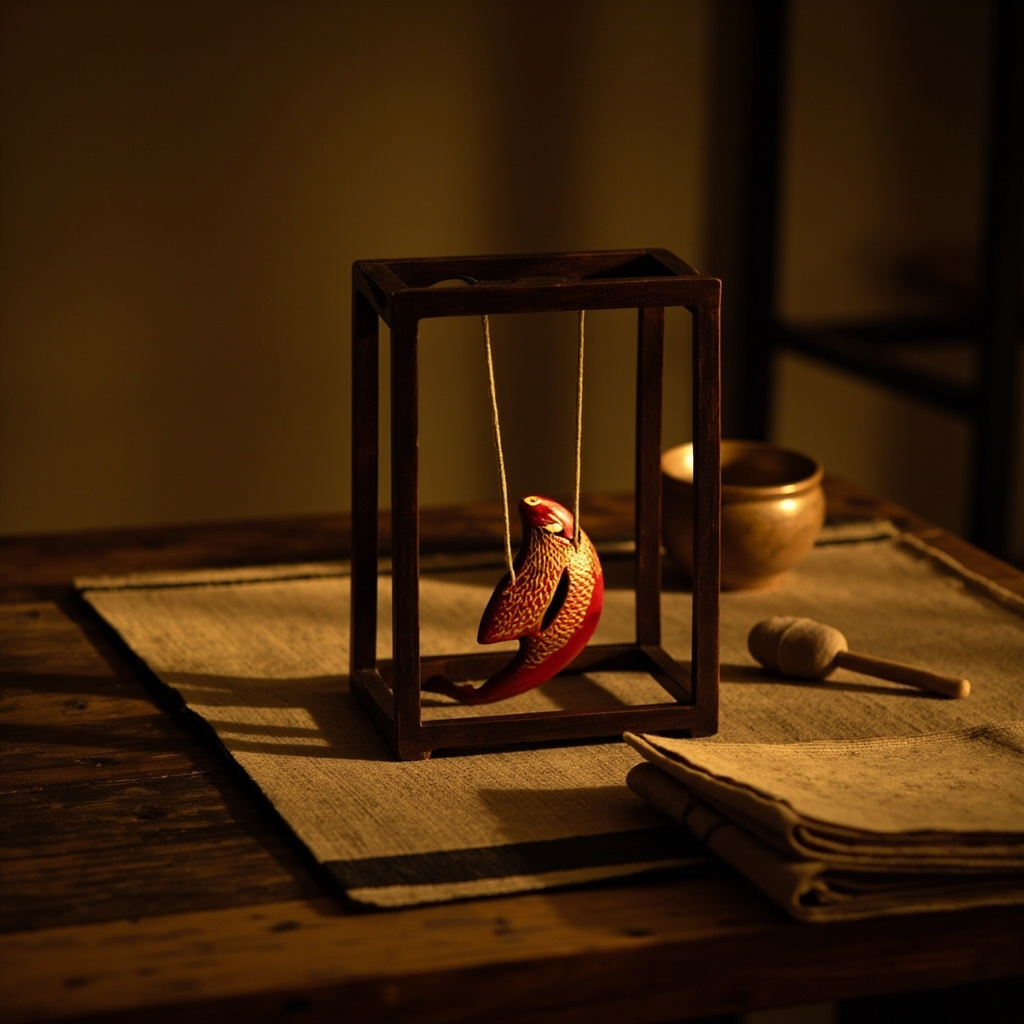
The muyu is a small percussion instrument used in Chinese temple practice, carved from a single block of wood and shaped as a fish. The block is hollowed from the inside, leaving a thin wooden shell, and a narrow slit is cut along the back so the cavity can open to the air. It hangs inside a simple wooden frame by two cords, and it is struck with a small mallet rather than blown or shaken. It is a modest object, used in chanting to keep a recitation moving and to mark its close.
Struck, Not Sounded
Every other sound object in this tradition is asked to produce a sustained result. The bell rings for minutes after the strike, the firecracker bursts and scatters, the incense clock burns down while it is read. The wooden fish has almost no sustain at all. Its cavity gives a compact wooden knock, with an immediate beginning and a quick end. That matters more than it sounds: the muyu does not disperse anything, does not sustain a field, and does not measure a duration. It marks a boundary. The stroke is the punctuation, and the silence after it is the point.
The Hollow Body, the Slit, and the Soft Mallet
The wood is the instrument and the trapped air is the other half. Strike a solid block and you get a dull thud; strike a hollowed shell and you get a clear pitch, because the air inside is what moves. The slit along the back is what lets that air work, giving the fish its short ringing edge. The maker’s work is subtraction: a solid block is hollowed to get the tone, and what you hear is the shape of what was removed.
Temple practice uses a padded or cloth-wrapped mallet rather than a bare stick, for two reasons. A hard striker would split a thin hollow shell, and a hard striker would also be loud. Softness here is not politeness but engineering: the right sound damages neither the wood nor the space around it.
Hanging Free Inside the Frame
The cords matter more than they look. The fish is suspended so that it can swing, and the swing lets a stroke land cleanly at any angle without the fish knocking against the frame. A bell hangs from a beam and gains amplitude as it moves. The muyu is hung so that it strikes nothing at all. In a home this is a clear image: the object that works is attached to the room but not resting on it, held in place without being pinned down.
The Fish That Marks an Ending
Watch a chanting service and the wooden fish does something no other object in the room does. It is not summoned, like a bell, and it does not march, like a drum. It is struck at the turn of a phrase and then it stops. Its function is to close. Feng shui is full of endings that are easy to hurry past: a renovation finished, a season of work completed, a hard year closed. The wooden fish is the instrument for that moment, because the moment is already over the instant the mallet lands.
The Fish as Release and Transformation
The form carries a second layer of meaning. Fish in Chinese art carry abundance and freedom, and the carp that leaps the dragon gate becomes a dragon, which is why a fish motif is read as a wish for transformation rather than stillness. A wooden fish therefore represents release while functioning as an instrument of ending. Even its shape suggests movement through a barrier, and its sound records a change of state that has already happened.
Reading the Wooden Fish in Feng Shui
No classical text assigns a wooden fish a compass position, and it belongs to no auspicious shelf. It reads better as a way of working than as an object to place.
- Mark the closure. Sound the end of the last thing before starting the next. A fixed beat at the turn of a project gives the room a before and an after.
- Interrupt the accumulation. Where a fountain keeps adding and a chime keeps ringing, a single dry knock stops. Use it on a room that has grown loud, not one that has grown empty.
- Deliver the correction softly. It works because it is struck gently and takes nothing from the wood. A change made to a home should not cost the home its structure.
Placement and Care
A wooden fish belongs where it can be reached and heard without dominating, most often on a shelf above a desk or on a low cabinet near a study. Temple care applies in a home too, and it comes down to three habits.
- Pick the wood for the room. Paulownia and sandalwood both ring differently, and older pieces are often dark lacquered red with gilt scales.
- Hang it so it swings free. If it leans against a frame the tone is dead on arrival, and a cracked shell cannot be repaired.
- Keep it dry and dust it lightly. Wipe with a barely damp cloth, never with oil or polish, which closes the grain and dulls the tone. Direct sun and dry heat shift the pitch as well.
Common Misunderstandings
Two errors are easy to make. The first is to treat the wooden fish as a luck token and hang it without noticing that its working property is sound rather than image. A silent decorative fish does none of what the instrument does. The second is to set it among other sound objects and expect the effect to add up. It does not. The wooden fish works by contrast, by being the one short sound in a room, and once bells and chimes are added it has lost the quality that made it worth keeping.
Frequently Asked Questions
Is the wooden fish a Taoist object? Its use belongs most closely to Buddhist chanting in Chinese temples, though the surrounding decorative tradition is shared across schools, so feng shui readings of it are folk practice rather than formal doctrine.
Does it need to be struck to have an effect? The object carries the symbolism on its own, but the ritual of striking gives the instrument its character. A home that keeps it silent keeps only the fish.
Where should it go in a home? Above a desk or on a low cabinet near a study, where it can be reached and heard without dominating.