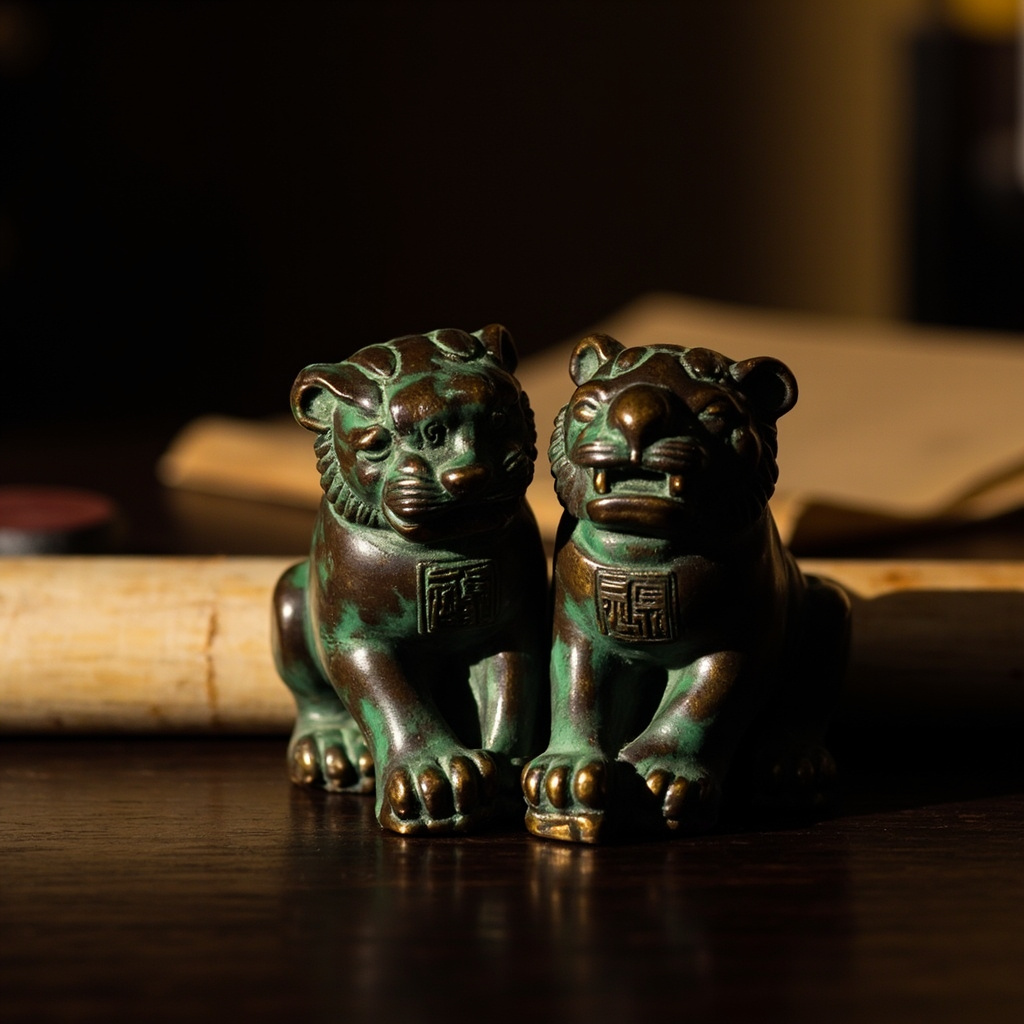
Chinese Tiger Tally Feng Shui Meaning: Hu Fu and the Authority of Two Halves
Long before feng shui borrowed the language of command, Chinese government had solved a problem every household still has: how to ensure power is exercised only when properly given. The tiger tally, or hu fu, was the answer. A token of bamboo or bronze split in halves, it authorized an army, and remains the clearest classical image in the Chinese tradition for authority that can be assumed, never inherited.
What a Tiger Tally Actually Is
A tiger tally was bamboo or cast bronze bearing the characters of an order, divided lengthwise into two matching halves. The ruler kept one, the commander in the field kept the other. No order was valid until the halves were brought together and found to correspond. Museums in China hold bronze examples from the Qin and Han periods, each a tiger-shaped casting with a fixed handle and a body that opens in two. The object was never ornament but a working credential, and its design exists to make one person’s word insufficient.
Why the Order Was Split in Two
Splitting was not distrust of the general. It was the design. A general who wanted troops to march carried his half to the ruler, who held the other. If the halves agreed, the order was genuine and the army moved; if the ruler withheld his, no army moved. The arrangement transferred enormous practical authority while keeping the final release in one place. Later dynasties extended the method to civil administration, splitting a bamboo record so the tally stood as proof that an order had been issued.
How Two Halves Were Matched
Matching was physical. On the inner faces the two halves carried raised characters and ridges that corresponded line for line; set together, the strokes met, and a forgery or altered order simply would not close. The inscription was a second layer of control, naming the unit, the strength of troops, the place, and the conditions under which the order held. The token answered two questions: is this really from the ruler, and is this exactly the order I was given. An unreadable half proves nothing, which is why tallies were carved by specialists and kept in a chest.
Bamboo, Bronze, and What the Material Does
The earliest tallies were cut from bamboo, split along the grain so the two pieces would correspond exactly; splitting bamboo to issue an order was old enough to give the language its word for tallying. Bronze castings came later, in the shape of a crouching tiger, so the object announced who it spoke for before a character was read. Material choice was not incidental. Bamboo is light and quick to split, suiting a credential that must travel fast; bronze suggests durability for orders meant to last. A bamboo tally is an order for tomorrow; a bronze one, for a campaign.
The Tiger as the Emblem of Command
The tiger was the emblem of the armed forces and of the power to move and punish, and putting it on the token made the claim legible before a character was read. What interests feng shui is the pairing of that fierce emblem with a mechanism built to restrain it. The tiger supplies decisiveness, the split the counterweight. A swift, unchecked command is a correction without direction, and in feng shui vocabulary that is the shape of a problem: force without a matched response simply moves the disturbance elsewhere. The tally says the strongest force is the one already answered.
Authority That Ends When It Is Used
Once the halves were matched and the order carried out, the tally did not remain a permanent licence. The halves were separated again, and the right to that order returned to the ruler. Authority here is not a possession but a limited event: it exists in the interval between matching and separation. This is why a tiger tally is a poor model for a permanent charm and a precise model for a good arrangement. A remedy switched on forever is a heavy, undifferentiated influence; a remedy with a clear beginning and end is a correction with a timing.
What the Tally Means for a Home
Read as feng shui, the tiger tally describes a household where nothing is settled by one voice. Decisions taken alone create the domestic equivalent of unchecked force: one member becomes the authority, everyone else the problem. The old mechanism suggests the opposite, in a specific way. Both halves must be present for anything to happen, and both carry the same inscription, so neither is more important. A home where important decisions are spoken once by one person holds half a tally. A home where a decision is stated plainly, held in common and acted on together holds both.
Where It Belongs, and Where It Does Not
Placement is the wrong question for this object. A tiger tally is not hung on a wall to attract luck, not worn as an amulet, not placed in a doorway as a guardian; those uses belong to other objects with other logic. If you own a genuine token or a faithful reproduction, the honest treatment is documentary: keep it in a study drawer with the inscription facing up, so it is read rather than displayed. If you work in a team, a framed pair of matching halves in the room where you decide things is a faithful adaptation.
Common Misunderstandings
Three mistakes are common, and each changes the object into something it is not:
- It is confused with tiger imagery used for courage and protection. The tiger here is a signature of the military, not a charm against misfortune.
- It is confused with the personal seal. A seal carries one person’s own name; a tally speaks for a line of command checked beforehand.
- It is treated as a luck token for personal promotion. This reverses the logic. The tally was never a charm for the person who carried it; treating it as one discards the check that gives it meaning.
Choosing a Piece You Can Trust
The inscription is the object. Many tiger tallies sold as souvenirs carry decorative pseudo-characters that mean nothing, and a token whose halves do not correspond, or whose text is a modern invention, has no standing in the tradition. If you buy, work through three checks:
- Confirm the two pieces came from one object, with matching text on the inner faces.
- Read the inscription. A real historical order names a unit, a place and a condition; decorative nonsense names nothing.
- Prefer a casting of a documented Qin or Han example, characters in seal script: a legible token can be studied, an empty one can only be displayed.
An unmarked piece, however handsome, is a sculpture of a tiger rather than a tally, and will behave like any ornament.
A Closing Thought
A thousand years of museum cases and one practical idea survive in the tiger tally: power that must be matched before it can be used. For anyone arranging a home or a working life, that is still the most useful correction it offers, and it asks for no bagua, compass or ceremony.