Chinese Wind Vane in Feng Shui: The Instrument That Reads What It Cannot Move
Most feng shui objects are arranged once and then left in place. A wind vane cannot be treated that way. It is the rare instrument in the tradition whose whole purpose is to change position, and whose value depends on being read every day rather than positioned correctly once. That difference is worth understanding before you mount one on a roof.
What a Chinese Wind Vane Actually Is
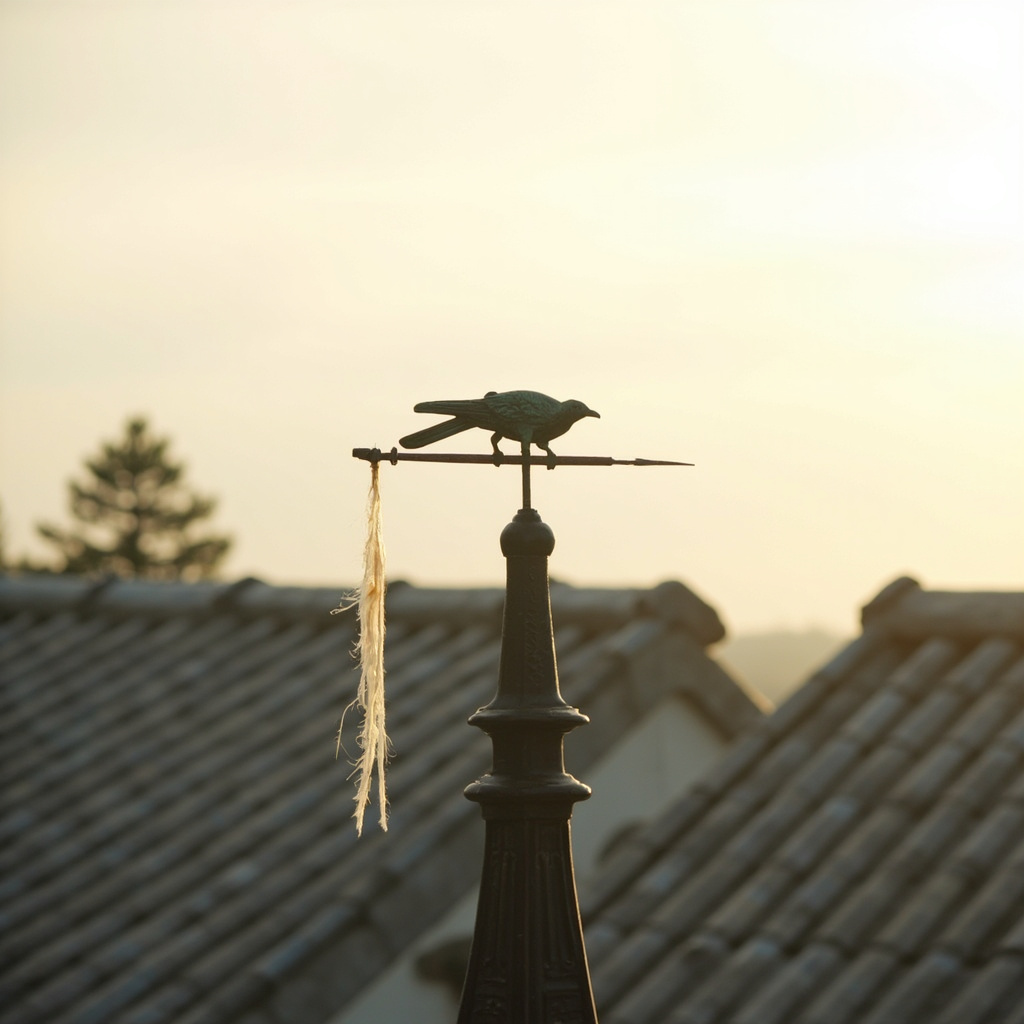
The classical instrument is the xiang feng wu, the “wind observing crow”: a bronze bird set on a slender vertical spindle so that its beak turns to face the oncoming air. Observatories, palace weather towers and watchtowers carried them, which is why surviving examples are usually small, thin-walled and beautifully balanced rather than large and decorative.
Sailors used a humbler version called the wu liang, a streamer of silk feathers tied to a pole top. Both instruments answer a single question: from where is the air arriving at this moment?
Why Wind Comes First in the Name
The practice is called feng shui, wind and water, in that order. Water can be led, stored, diverted and corrected. Wind can only be met. That asymmetry explains why a vane belongs in the tradition at all, since it is the reading instrument for the half of the name that no arrangement can change.
A compass describes the sectors a room occupies. A vane describes what is moving through them right now. Those are different kinds of knowledge, and the tradition needs both.
The One Instrument That Must Stand Unprotected
Nearly every placement rule in feng shui reduces exposure. Screens slow chi at a door, walls block it, hedges soften it, and a backless desk is given a mountain. The vane inverts that logic completely. It has to stand at the point of maximum exposure, above the roof ridge or on the tallest free mast, because a sheltered instrument reports the shelter and not the weather.
Put a vane behind a wall, a tree or a taller building and you are measuring the obstacle. In practical terms this is the only feng shui object whose first siting question is where the wind is worst.
A Vane Points Into the Pressure
A bagua mirror is turned outward to meet a threat and turn it away. A vane is turned by the same force and records it. One deflects, the other submits, and the difference matters because deflection is a claim about outcome while reading is only a description.
Reading becomes action when it changes what you do next. A vane that has held a northern bearing for three dry days is an instruction about timing, not a statement about decoration.
Friction Is the Enemy: Balance Over Ornament
A vane is only as honest as its bearing. A sticky spindle will keep the last position it was pushed into and then quietly report its own stiffness as weather. This is the commonest failure in modern reproductions, where a heavy cast ornament is sold as a weather instrument and cannot move in anything under a strong gust.
The classical crow was thin bronze with a flat tail plate, light enough to answer a light breeze. A useful test in still air is to tap the tail and watch: a good vane swings past the mark and settles, while a bad one stops where your finger left it.
Direction as a Report, Not a Map
A luopan is a map. Its rings assign fixed sectors, and the practitioner fills or drains each one over years. A vane is a report filed continuously, with no permanent claims at all. Confusing the two is how people end up rearranging furniture to answer a question about the weather.
Used together, the division is clean. The compass governs arrangement, and the vane governs schedule: when to plaster, plant, paint, hang a heavy object, or move a bed. Wind direction this week is a fact that expires. A sector reading is a standing judgement.
The Crow, the Feather, and Weather You Cannot See
The bird form is not arbitrary. A bird standing in moving air already faces into it, so a crow-shaped vane shows the answer in its posture rather than in a painted arrow. The cast body also gave the instrument enough surface to answer a slow wind without a heavy tail.
The feather streamer was cheaper and travelled further. Five ounces of silk on a pole top held an angle that told a boatman what his face could not feel, which is the whole purpose of the instrument: converting an invisible force into an angle readable from the ground.
Reading the Air Around a House Before You Buy One
The building will tell you where the instrument belongs if you watch it for a week:
- The roof peak shows the highest clean line, and therefore the honest mounting point.
- Chimney smoke shows ground-level direction at the hours you actually use the house.
- Laundry drying unevenly marks the sheltered side of the yard, which is where a vane must never go.
- The corner that stays wet longest is the one the wind leaves alone, and it is the corner a vane would lie about.
What a Wind Vane Is Not
It is not a remedy. A vane does not cut sha chi, does not correct a facing direction, and does not substitute for a mirror, a screen or a plant. It measures, and measurement is not protection. Expecting it to fix a bad entrance is the same error as expecting a thermometer to heat a room.
A small decorative vane hung indoors carries the idea of wind into a room and nothing more. That is a legitimate use as symbolism, as long as nobody claims the needle is reporting anything real.
Mounting and Keeping One
If you decide to install a working vane, four habits keep it honest:
- Mount it above the highest obstruction within roughly ten metres, or the reading belongs to the obstruction.
- Clear the bearing once a year, since dust and oxidised bronze are enough to stiffen a light spindle.
- Keep the tail light. Replace heavy ornament with a flat plate if the vane will not settle in gentle air.
- Note the dominant direction by season for a full year before drawing any conclusion about your site.
A Final Word
The wind vane is the humblest object in the tradition and the most disciplined. It makes no promise, offers no protection and cannot be left to work unseen. It simply asks to be mounted where nothing shelters it, kept free enough to answer, and read. That is a small practice, but it is the only one in feng shui that keeps the wind half of the name in view.