Chinese Rosewood Wenwan Beads Feng Shui Meaning: Zitan and the Golden Stars
Among Chinese beadwork, few objects carry as much quiet seriousness as a strand of zitan. It has no moving part, no mechanism and no function beyond being handled. Yet a collector will spend a year choosing one, and then wear it every day for a decade. The reason has nothing to do with luck in the abstract. It is that the wood, the density and the hand of the maker are legible at a glance, and that a well-made strand records the years it has been used. That is the feng shui meaning of wenwan beads in its clearest form: an object whose value grows with the attention paid to it.
What Wenwan Actually Means
Wenwan is a category rather than a single object. The characters mean playthings for the cultivated, and they cover the small hand-made things a Chinese household acquires not for a function but for the pleasure of the material: carved seals, brushes, ink stones, snuff bottles, and above all the strung beads worked by hand for years. A wenwan strand of zitan is the most patient of these. Its entire content is the wood and the workmanship, and its use is to be handled. Nothing about it is decorative in the modern sense, and that is what makes it a feng shui object rather than an ornament.
Why Rosewood and Not Any Wood
Zitan means purple sandalwood, and the term covers several species. The one that sets the standard is Indian small-leaf rosewood, Pterocarpus santalinus, imported into China for centuries by way of tribute and long-distance trade. The first test is density. Old growth zitan sinks in water, and this sinking grade separates a strand of genuine hardwood from a dyed substitute dressed to look like one. Wood that floats, or that is made to look dense with filler, will not improve with age.
The Golden Stars
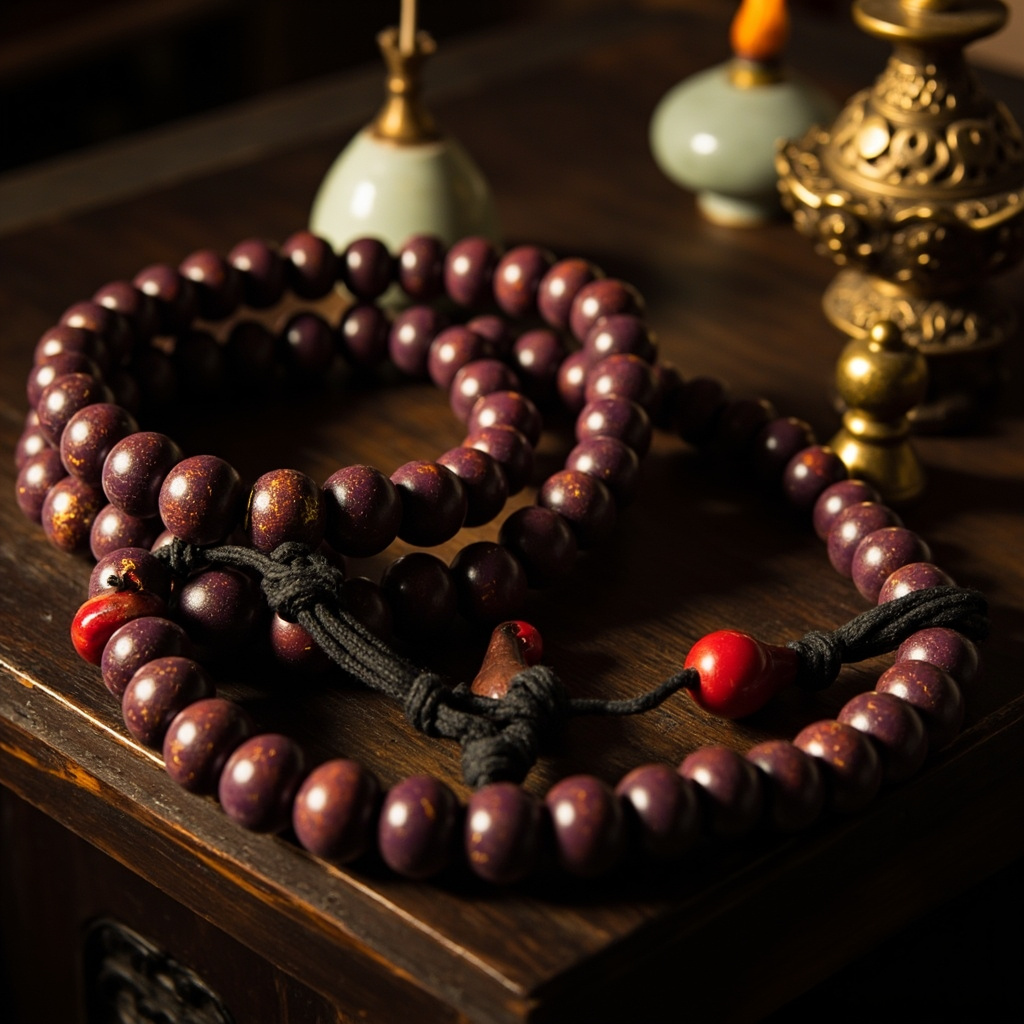
The feature that draws the eye first is the golden star. These are not inlays but mineral deposits held in the open pores of the wood, which catch the light as fine flecks once the surface is polished. On a well-made strand they run evenly through every bead and shift as the strand turns, warm gold in direct light and nearly invisible in shadow. Look for the density of flecks rather than a few dramatic ones, and be wary of beads where the gold sits only in the recesses of the carving.
How a Strand Is Built
A 108 bead mala is counted, not simply worn. The standard strand is assembled from a fixed set of parts, and each answers a question about how the strand will be used.
- 108 main beads, the count itself, one for each of the defilements a practitioner passes through.
- A guru bead, the turning point that lets the wearer feel the end of a cycle without counting aloud.
- A stupa bead above the guru, a small cone separating the counting beads from the cord.
- Spacer discs and counter beads, which keep the count honest.
- Two gourd drops hanging from the ends of the adjustment cord.
- A sliding Chinese knot that sets the length.
Together these make a tool rather than a decoration. The strand can be worn as a single daily loop, wrapped three or four times around the wrist for counting, or lengthened into a necklace for recitation. The components exist so that all three uses work.
Yellow Pear Wood, the Other Hardwood
A second wood belongs in the same conversation. Hainan huanghua pear, or huanghuali, is lighter and warmer, golden copper with dark chocolate streaks and the tiger stripe grain the trade looks for. Its figures include the so-called ghost eye, the concentric growth ring on the face of a well-cut bead. Where zitan is dense, dark and heavy, huanghuali is aromatic, strongly patterned and lighter in the hand, and a serious collector commonly keeps one strand of each for the contrast.
The Five Element Reading
Wood is the wood element: green, east, spring, growth, the patient disposition. A dense red-brown hardwood sits at the edge of wood and of the fire colour, so it is read as wood that has passed through fire and holds a settled quality. In the generating cycle, wood feeds fire, and a personal strand is therefore described as supporting whatever a person is trying to ignite: a practice, a study, a business. The reading is a way of choosing, not a claim about the chemistry of the wood.
Patina and the Long Ageing
The finish that develops on a well-handled strand is called baojiang, a gloss produced by the oil of the skin and the friction of handling, and it takes years to establish. It darkens the wood, softens the edges of the beads, and makes the golden stars read warmer than when the strand was strung. No factory finish does this, which is why a strand worn by one person for three years is not the same object as one shipped in the same week. It is the clearest sign that a piece is being lived with rather than displayed.
How the Strand Should Be Worn
Water, perfume, detergent and long hours in direct sun are the four enemies of the surface. The wood tolerates ordinary wear, but the cord, the knot and the star flecks do not. The strand should come off before sleep, before swimming and before the beach, and wiped with a soft dry cloth rather than soaked. Keep it out of the bathroom and away from a heating vent. A piece kept in a cloth bag between uses stays in better condition than one left out on a table.
Choosing a Strand
Six things can be checked before money changes hands, and each of them is a physical fact rather than a description.
- Turn the strand over and look for dye pooling in the pores, which means the colour is only on the surface.
- Count the beads against a light, since a short count is the most common fault in a cheap strand.
- Check that the golden stars run through the beads and not only across their tops.
- Strike two beads together softly and listen for the short dry knock that dense hardwood gives.
- Inspect the knot work, where the cheapest strands are short-cut, and confirm the guru and stupa beads are present.
- Weigh it, because density is the physical fact that every other description in the trade is a way of talking about.
One Working Rule
Judge a strand by what it will be in ten years, not by what it is in the shop. A wenwan is a record of use, and a piece dense enough to sink, finished well enough to take a patina and strung well enough to keep its count will still be worth handling when the beads have darkened past the cord. Buy the material rather than the story, and let the surface take its time.