Chinese Red Envelope Feng Shui Meaning: The Hongbao and the Blessing It Carries
The red envelope is the smallest and most travelled Chinese object of value. It moves hand to hand at New Year, at weddings, at births and at house-warmings, and it is the only everyday object in which money and blessing are physically inseparable. Red envelope feng shui meaning is therefore less about the paper than about what the paper is asked to do: to make a transfer of wealth visible and deliberate.
What a Red Envelope Actually Is
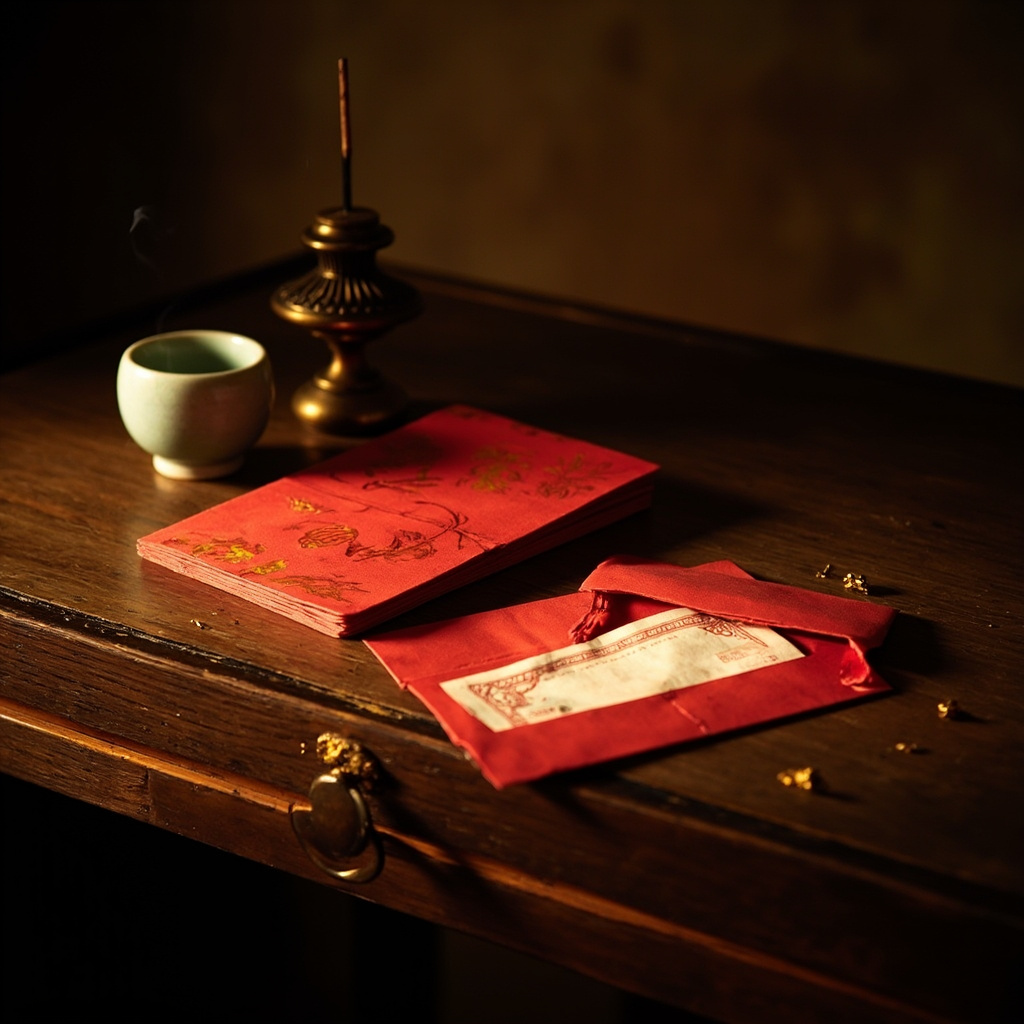
A hongbao, also written hong bao, lai bao or ang pao, is a flat paper envelope printed on both sides, usually red with gold foil, sized so that a folded banknote sits inside it without bending. There is no metal, no stone, no cord, and no inscription that must be read for it to work.
What makes it matter is the defined edge. Loose cash changes hands and vanishes into a pocket. Money inside a red envelope stays in view until it is deliberately opened, and the empty packet stays in view afterwards, because the empty envelope is kept.
Why Red and Not Any Other Colour
Red is the yang colour in Chinese practice. It carries life, fire, celebration and the ward against the pale colours associated with death and cold. The contrast that makes this legible is the funeral packet, which in Chinese custom is white or plain, because that transfer is a condolence and not a gift.
So the colour is the statement. The same sum of money in a white envelope is sympathy; in a red one it is a wish for the recipient’s life to go well. The packet, not the amount, is what changes.
The Number Inside the Envelope
The amount is chosen rather than measured, and it is read for what it sounds like rather than for what it buys.
- Even numbers are used, because a pair reads as complete.
- Figures containing eight are favoured, because eight sounds like the word for prosperity.
- Four is avoided in ordinary gift giving, because its sound is the word for death.
- The amount expected rises with the seniority of the giver, not with affection.
Modern usage adds a layer. In spoken Mandarin 520 is heard as a declaration of love, and 1314 carries the same idea. Numbers have always been read for what they sound like; the red envelope simply gives the sound somewhere to sit.
When the Envelope Is Given
The New Year packet is the best known, but it is only one of several occasions. The common thread is a transition, and a transfer of resources is made at the moment the transition is marked.
- Through the first lunar month, packets go to children and to those who have not yet received one.
- At a wedding, a red envelope sits inside the larger bridal gift rather than replacing it.
- A packet is tucked to a newborn, as a first provision for a life just beginning.
- The family that arrives first at a new house carries a packet in with them.
What joins them is not celebration in the loose sense but a beginning. A year, a marriage, a household and a life are all starting, and the packet says so in the plainest form available: here is something you will need, and here is the reason it is yours.
It is worth separating this from joss paper, which looks similar and means the opposite. Joss paper is money made for burning, sent to the dead so that they can have what the living have. The red envelope is money made for the living, and it travels the other way.
How It Is Handed Over and Opened
Two customs are kept by everyone and rarely seen by outsiders. The packet is presented with both hands, which marks the giving as an act of respect rather than a handover of goods. And it is not opened in front of the giver: the recipient takes it, thanks the giver, and opens it later.
Both rules protect the giver as much as the recipient. An envelope opened on the spot turns the intention into a judgement of whether the sum was enough, and the custom removes that moment. What is left is a gift that cannot be evaluated at the exchange.
The Five Element Reading of Paper, Red and Gold
Read in the five element scheme, the ordinary materials of the packet already carry a structure. The red field is fire. The gold foil or metallic printing is metal, the element of storage and of what holds value. The paper itself reads as wood. The pale ground of a note written inside reads as earth.
The generating cycle runs wood to fire to earth to metal to water and back to wood, so the envelope contains a movement: the wood of the paper feeds the fire of its colour, the fire warms the earth, and the metal of the gold print sits downstream as the part that keeps. It is a modest claim, and the only kind the scheme supports.
Where a Red Envelope Belongs in the Home
Placement follows what the packet actually contains. A packet holding a blessing or a certificate is a written object, and written objects in the home tradition sit where the family’s records are kept: on a shelf near the altar, in a drawer with the important papers, in a box that closes.
Two habits are worth keeping. An empty packet should not be thrown away, because the kept packet is the record of the year it came from. And it should not be stepped on, which is the ordinary treatment of paper. Where the money goes is a separate question from where the envelope rests.
What Red Envelope Feng Shui Meaning Cannot Do
A red envelope does not attract money. It has no power over the sum inside it, and a packet given with the wrong intent does not become auspicious because it is red and gold. It cannot rescue a badly chosen plan, and it is no substitute for a conversation a family is avoiding.
What it does is more ordinary. The person receiving an envelope receives, at the same time, the fact that somebody thought of them, chose a number for them, and wanted the year to go well. That is not nothing, and it is not a claim about invisible forces.
Choosing and Using One Well
Two practical tests. Paper thin enough to tear when you open it is the wrong paper, because the packet is meant to be kept, and gold foil that flakes into the contents is wrong for the same reason. Beyond that the printing matters less than the occasion, and a plain red packet is never the wrong answer.
One rule to carry away. The red envelope earns its place by being an envelope first: a small boundary that keeps a gift visible until it is opened, and visible afterwards as a record. A blessing that has been sealed, handed over with two hands and kept in a drawer is still there next year. That is the whole of its power.