Chinese Prayer Beads Feng Shui Meaning: The One Hundred and Eight Bead Mala of Counting and Release
The mala is the most quietly useful object in Chinese spiritual practice, and the least understood abroad. It is a string of beads with a fixed number, and almost everything else follows from that number. Prayer bead feng shui meaning is not really about the material. It is about what a fixed count does to attention when a person repeats it.
What a 108 Bead Mala Actually Is
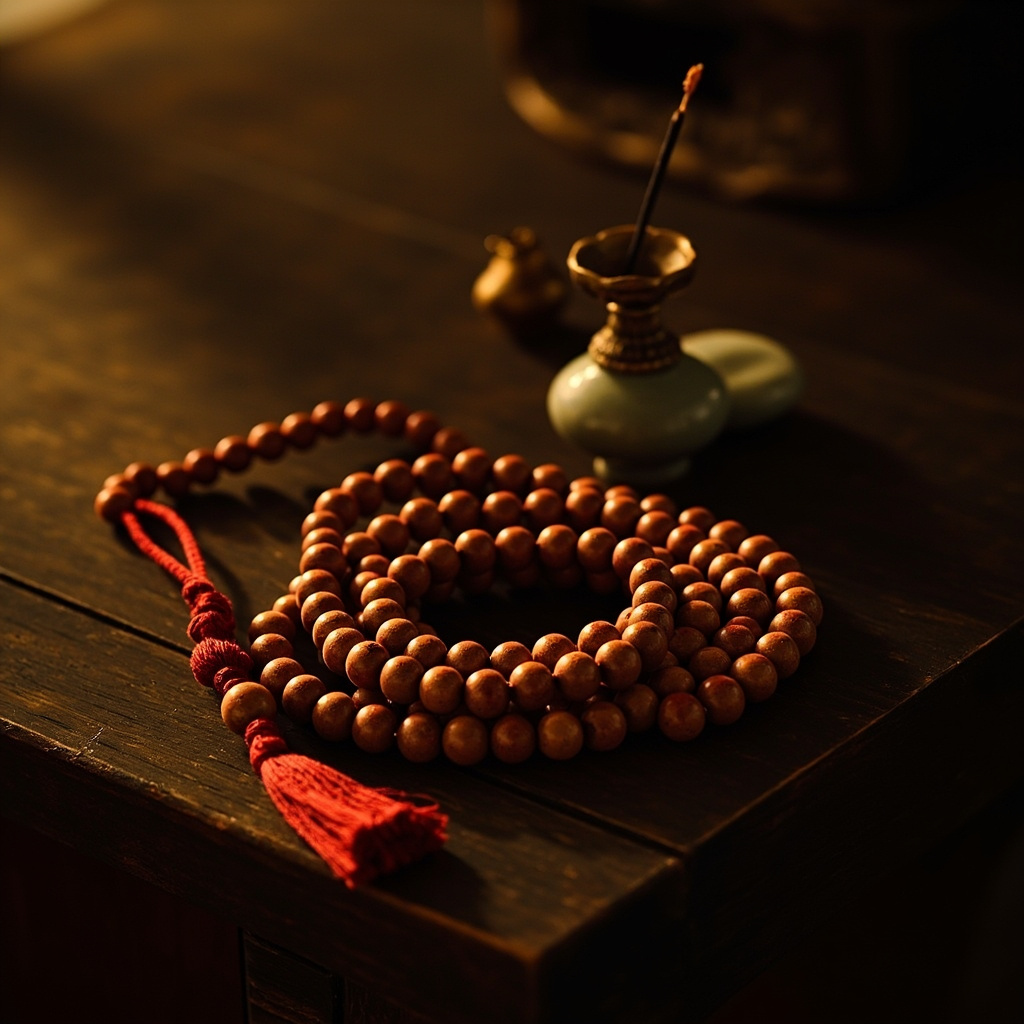
A mala is a counting instrument. The person moving through it recites a formula with each bead, and the count carries the practice beyond the point where attention would otherwise drift. The Chinese form uses a guru bead, larger or differently finished than the rest, as the marker for the start and the end, with small counter beads recording completed rounds.
The 108 bead strand is the long form. Shorter malas of 27 or 54 beads exist, but the full strand is what most households own, usually as a bracelet wrapped several times round the wrist or a long loop worn against the chest.
Where the Number 108 Comes From
The most widely taught explanation is enumerative: 108 is the count of afflictions and temptations a person has to work through, and a full round says that all of them will be visited rather than avoided.
It also decomposes. 108 is 36 multiplied by three, and 36 is the classical count of the divisions of time, so the number reads as heaven, earth and human time together. In Chinese literature it is also the number of the stars of destiny, giving the count a sense of assembled company rather than solitary effort.
The Guru Bead and the Direction of Counting
The guru bead is the practical centre of the strand, and it is never counted through. The hand moves from it along the string in one fixed direction, and the finger is not allowed to slide over the bead itself, because that would restart the cycle without a decision being made.
Counter beads, usually three small spacers, sit beside it so that a practitioner who has finished a full 108 knows where to resume rather than starting from scratch. On a four wrap wrist mala these markers also fix the orientation of the strand once it is on the arm, which matters because the counting hand and the resting hand are not the same.
What a Mala Is Made From
Wood and seed dominate. Bodhi seed, boxwood, sandalwood, rosewood and paulownia all turn well, take a polish, and smell faintly resinous as they warm. The bodhi seed mala sold as a consecrated piece for spiritual balance is a good example: pale cream drum shaped beads on cord, broken at intervals by green and mottled accent beads, a larger guru bead, and a carved lotus pendant at the dangle.
Rosewood strands are denser and darker. The piece sold for spiritual protection is a single long strand of round purple brown beads carrying fine golden flecks inside the wood itself, threaded on thin dark braided cord and finished with a short dangle of six smaller beads. Stone strands are a different category: harder, heavier, and more often a continuous bracelet.
The Five Element Reading
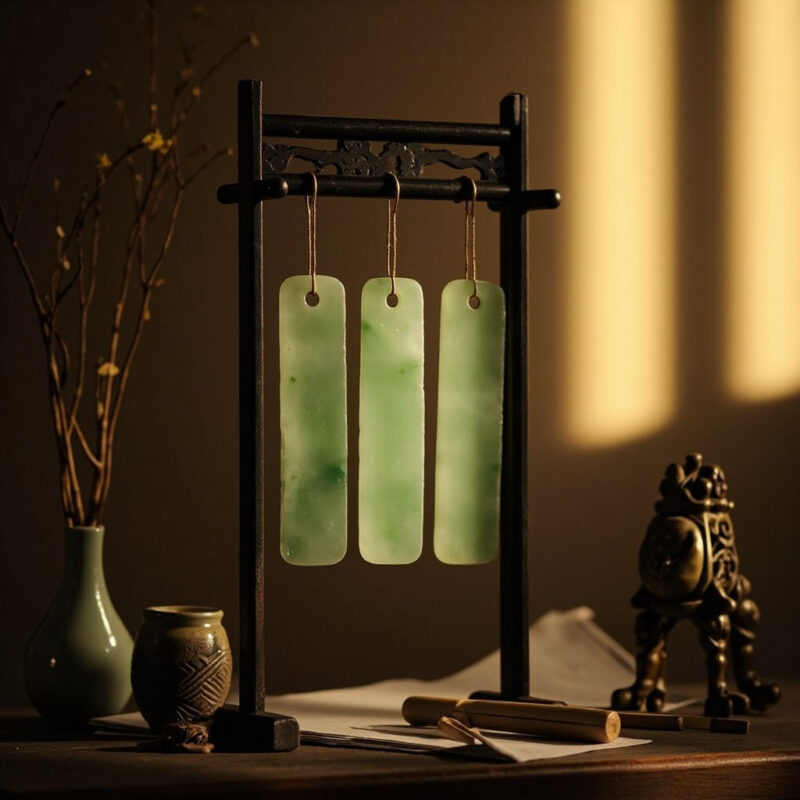
In the five element scheme a wooden mala is wood, a pearl mala is water, a jade mala is earth, and a string of clear stone reads as metal. This is not decoration. A person whose chart is short of water is not advised to add a second wooden strand and hope; the wanted element is matched by the material, and the material is worn rather than displayed.
Two rules apply. The generating cycle says that water nourishes wood and wood feeds fire, so a bead string can be read as a way of feeding what the wood feeds. The controlling cycle says that wood parts earth and earth blocks water, so a strand can also be chosen deliberately to interrupt something stuck.
Wearing It and Where to Keep It
A mala is a working object. It is handled, turned, and put down again, which makes it a poor ornament and a good habit. The common arrangements are a single long strand worn against the chest, a double wrap around the wrist, and the four wrap form that sits high on the forearm and is turned with the right hand.
In a home the placement follows the practice rather than the theory. A desk strand belongs in the study, within reach of the hand that writes, where the counting punctuates work. A mala kept in a bedroom should be on a high shelf rather than on a bedside table, and it should never be dropped to the floor.
What Prayer Bead Feng Shui Meaning Cannot Do
A mala does not attract money, settle a dispute, or substitute for a decision that has been avoided for months. It has no power in itself, and a strand bought for its colour rather than its count will not behave differently from any other bracelet.
What it offers is a floor under attention. The count is long enough to be tedious and short enough to finish, and a person who has counted a full 108 has made a statement about where they were and for how long. That is modest, which is exactly why it has held for so long.
Choosing a Mala You Will Actually Use
The most common failure is buying the most expensive strand and leaving it in a drawer. A strand too fine for the fingers will not be turned, too large will not be worn all day, and a colour that is beautiful in a photograph is not one anyone wants against the wrist for years.
Two practical tests. Check the bead against thumb and forefinger: if it slips or catches, it is the wrong size. And pick the length for the habit you already have, because a four wrap strand for a beginner is frustrating, while a single loop worn daily will be used for a year.
Round wooden beads of a comfortable diameter, a cord that does not pinch, a lotus or bodhi figure if the making has one, and a guru bead easy to find by touch, are enough. The rest is refinement.
The Long Practice
None of this is decorative in the way the market usually means it. The 108 bead mala is an inexpensive, portable, repeatable practice a Chinese household has kept for centuries, and its appeal is that it asks almost nothing. Sit down, turn the beads, finish the count. The feng shui reading is that it changes what a person attends to and for how long, which is the only claim worth making about any object in a room.
One rule to carry away. Treat the mala as a tool rather than a talisman, and choose it the way you would choose a good chair: by how it behaves after a year of daily use, not by what it promises on the first day.