Chinese Dougong Feng Shui Meaning: The Joint That Gives Way
Most objects in a feng shui inventory earn their meaning from what they do to a room: a mirror deflects, a bell disperses, a scholar stone steadies. The dougong, the cluster of interlocking wooden brackets at the top of a column in a traditional Chinese building, does almost nothing visible. It holds a roof up. Its meaning comes from the way it holds it, and from what that method reveals about the building that uses it.
What a Dougong Actually Is
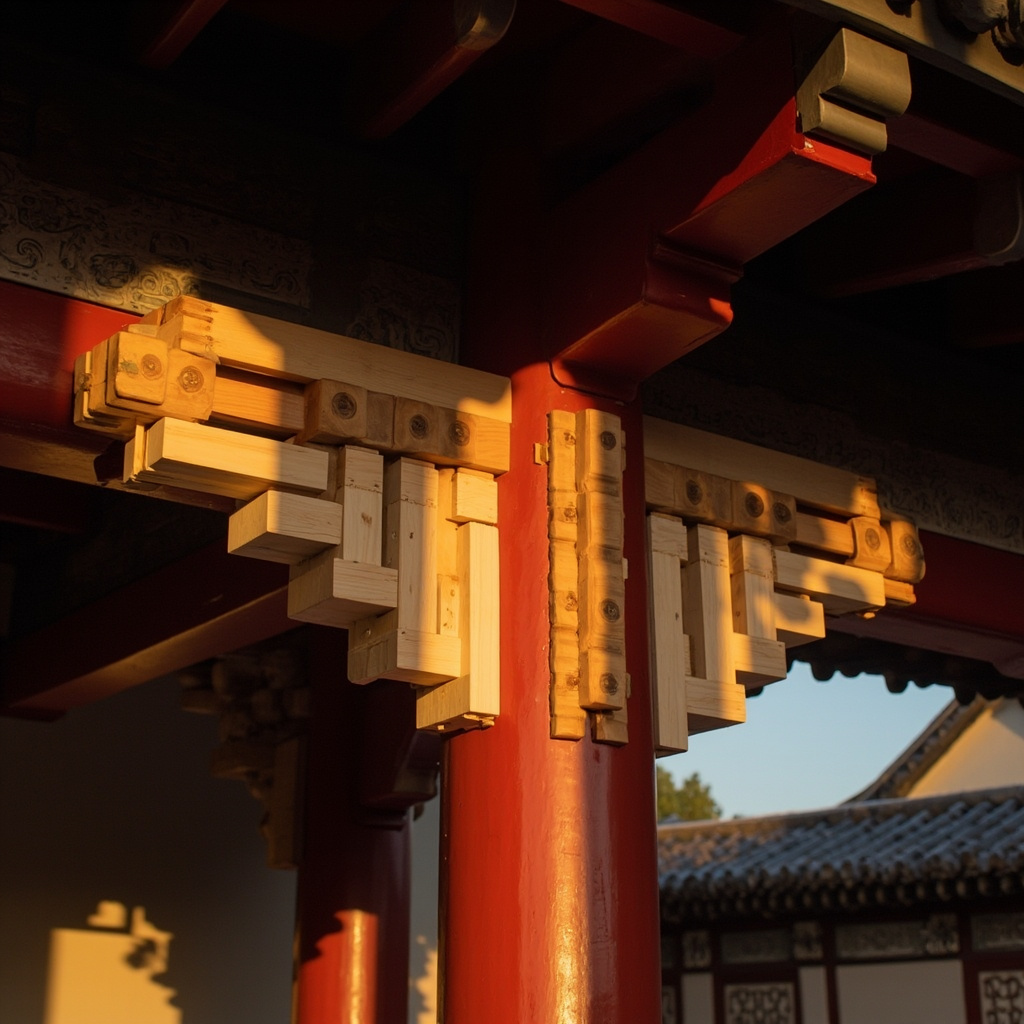
The dougong is not a carved ornament. It is a set of plain wooden blocks and arms fitted at the head of every column, between the vertical timber and the horizontal purlins that carry the roof. Nothing in the set is carved for its own sake. Every piece is a shaped block whose usefulness depends entirely on the pieces around it, and the whole assembly is put together without a single nail or iron plate.
- A bearing block seated down on the top of the column
- Curved arms stepping outward and upward in widening stages
- A transverse arm on top that receives the roof purlin
- Wedges driven into the contact faces to lock the set
Read that list as a chain rather than a heap. Each item exists to serve the one above it, and the final member, the purlin, is the part that a person actually sees: the roof resting on a stack of timber that appears to be floating.
A Joint That Gives Way
This is the part that unsettles people who expect a Chinese bracket to be a fixed thing. The pieces are fitted with deliberate clearance. The joint is not locked rigid; it is allowed a small, controlled freedom to move, and it is held by wedges driven into it rather than by glue. Craftsmen have long put the principle plainly: leave the joints loose and keep the frame rigid. The structure is rigid because of how the joints are arranged, not because each joint refuses to yield.
The Weight Locks It
When the frame is finished and the roof is loaded, the mechanics change direction. Gravity drives the arms down against one another, and the wedges are pulled further into their gaps. The more weight the roof carries, the tighter the joint becomes. Add a load and the connection firms itself; add movement and the same clearances let the frame rock a little and come back. A dougong is therefore both a load path and a shock absorber, and it performs the second job precisely by not being rigid.
Where the Column Meets the Roof
Every column head carries a dougong, which makes the bracket the exact point where the vertical of the building and the horizontal of the roof meet. In the working vocabulary of Tian Xing feng shui, the roof is where a building receives the heavenly plate and the ground is where a person stands inside it. The bracket is the exchange between those two conditions. It is where a building takes the weight of the sky and delivers it into a column, and down through that column to a foundation and the earth.
The Bracket Is Why the Roof Can Reach Out
Remove the bracket and the wide overhanging roof of a Chinese hall becomes impossible. The arms cantilever outward well past the face of the column, carrying the eave purlins and the roof tiles far outside the wall line. A dougong therefore does something no post can: it spreads a heavy and wide roof across the top of a much narrower column footprint. It works like a foot, spreading a load that would crush a single point, and it does this at every column in the building, in the same way, at the same height.
The Count Told You the Rank
Because the set repeats at every column and grows more elaborate with the standing of the building, the count became a public statement. Building regulations in the imperial capital specified how many bracket sets a column carried and how finely they were worked, so a visitor could read the importance of a hall from the street, at a distance, without ever entering it. The bracket was one of the few places where a hierarchy was made visible in the structure itself rather than written on a plaque beside it.
Reading the Craft
Modern reproductions are worth examining closely, and the differences are legible if you know where to look. A short inspection order works well:
- Look at the chamfers on the arm ends for hand-tool facets and slight irregularity
- Check that the wedge slots are cut to fit their wedges rather than filed to fit later
- Note whether the arms are made to a set pattern or cut to fit one another
- Confirm the joint is assembled with timber wedges and not with hidden metal fixings
Machine-cut sets are geometrically identical, which is faster and structurally sound, and that difference is exactly why hand-worked pieces carry a different value. Timber shaped by a craftsperson holds a record of judgement that a machine output cannot. The guilds that produced these sets trained masters and apprentices over years, and that transmission is now treated as heritage in its own right.
What the Joinery Teaches a Home
The feng shui reading of the dougong is not that a bracket should be installed in a bedroom. It is about what a bracket does. In a house, the arrangement that causes trouble is rarely the arrangement that is simply wrong; it is the arrangement fixed too tightly. Households argue over a rigid schedule, a fixed layout, a permanent division of rooms, and then name the friction bad luck. The joinery tradition offers a different instruction: keep the arrangement that carries the load, and leave the joints free to move. What bears weight should be firm; what is negotiable should never be nailed down.
Where the Work Is Kept Alive
Timber-frame buildings are also demountable. Traditional Chinese halls were assembled from numbered components that could be taken down and rebuilt, and the joint that permits that is the same joint that lets a frame survive an earthquake. That logic survives in the present. The traditional architectural craftsmanship for timber-framed structures was inscribed on the Representative List of the Intangible Cultural Heritage of Humanity in 2009, and the number of apprentices learning the bracket sets remains a live question in the workshops where the craft is still taught.
Bringing the Joint Home
If you want the dougong in a home rather than in a building, the honest options are a documented reproduction of a bracket set, a study model, or a carved plaque showing the joint in section. Whichever you choose, treat it as a diagram of a principle rather than a talisman with a listed effect. It carries no placement chart, no auspicious direction, and no promise attached to it. What it does carry is a lesson that holds up outside the tradition entirely: a good connection is one that holds the load and still lets the structure move.