Chinese Six Syllable Mantra Feng Shui Meaning: Om Mani Padme Hum
Few texts entered Chinese daily life as completely as the six syllable mantra. It is written on jewellery, carved into beads, braided into coloured rope, and recited in homes with no Buddhist furniture at all. Six syllable mantra feng shui meaning is not a claim that the object is lucky. It describes what happens when a formula of speech, treated as language with effect, is carried on the body.
What the Six Syllable Mantra Is
The mantra belongs to Avalokiteshvara, the bodhisattva of compassion, who is said to have heard the cries of the world and answered with this set of sounds. Chinese readers know him as Guanyin, and the mantra travels with that name everywhere: on pendants, in temple murals, and in carved beads sold for wear.
Written in Tibetan script and transliterated as om mani padme hum, it is commonly glossed as a greeting to the jewel in the lotus. That is the traditional English rendering rather than a literal translation, and the version most Western buyers meet first.
Why the Meaning Is About Sound, Not Object
A mantra is a formula of speech, and its working element is the recitation, the sound made in a voice. A carved copy carries that formula; it does not replace it. This explains why the mantra is engraved where it can be touched and read, and worn rather than displayed.
Two ideas travel with the formula. Wisdom is the first: the six characters describe the working of reality clearly, without sentiment. Compassion is the second, and it is the bodhisattva’s own quality, carried in the words rather than added by the reader.
The Six Syllables and Their Meanings
The syllables are glossed individually, and these readings are the ones in ordinary use.
- Om, the opening syllable of many Buddhist mantras, addressed to the body, speech and mind of the awakened.
- Ma, associated with the removal of self-seeking.
- Ni, the fisherwoman’s yarn, an image for drawing beings out of difficulty.
- Pad, the firm holding, read as holding firmly to the practice.
- Me, paired with ma, and often given as the mother syllable.
- Hum, the seed syllable, associated with the indivisibility of the three jewels and with auspicious completion.
The meanings are deliberately broad. A six syllable formula is built to be recited rather than analysed, and its power comes from the whole sequence.
How the Six Characters Are Carved and Worn
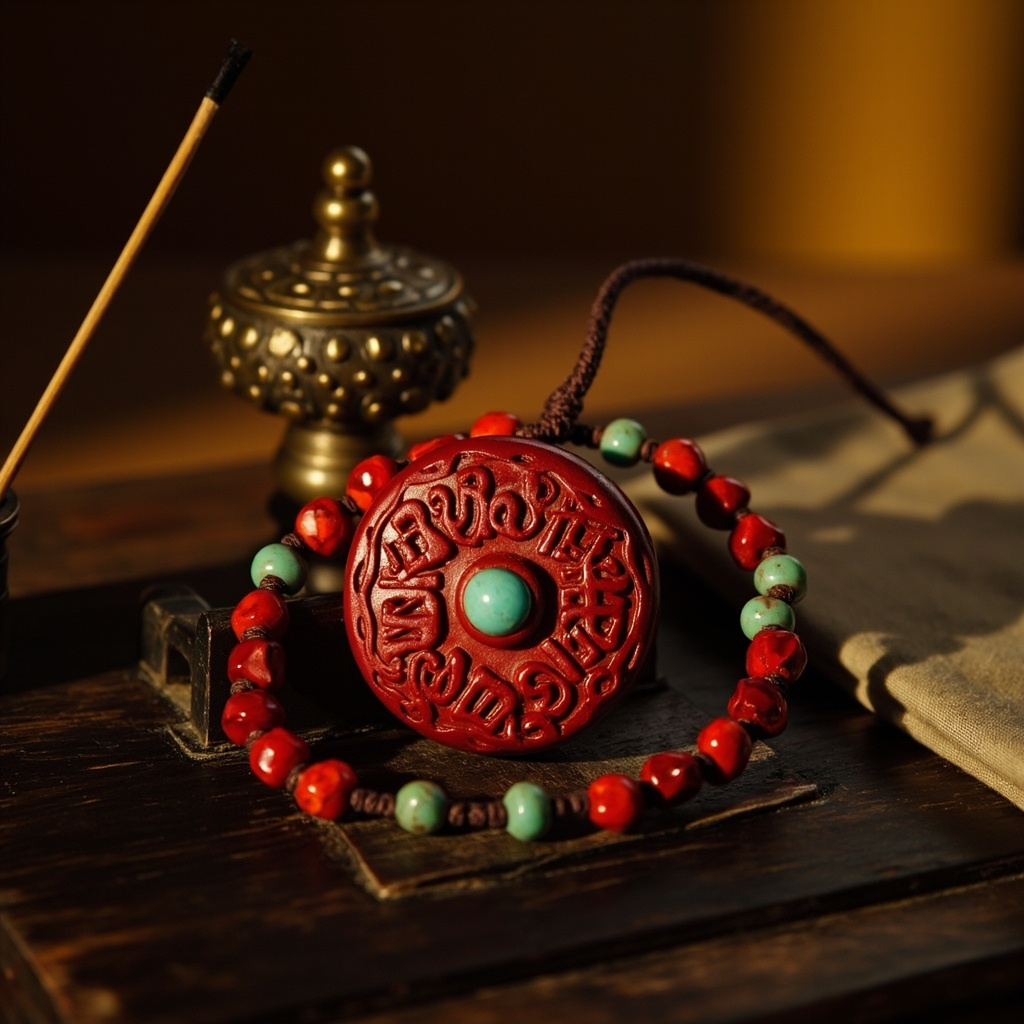
When the six characters are carved, they are almost always set in a circle with a centre point rather than in a line. The form is common to the cinnabar beads sold as consecrated jewellery: one round bead, six characters in a radial pattern, the rest of the surface filled with scrolling relief.
The cinnabar bead sold as the Six Syllable Mantra piece is exactly this shape: a matte red bead with six characters cut around a small pale turquoise inlay at its centre, on an adjustable dark braided cord with a sliding knot closure, flanked by faceted red beads and flat turquoise-green spacers. Some catalogues list it as a necklace, but the construction is a wrist bracelet, and the difference matters for how it should be worn.
Why Cinnabar and the Mantra Are Paired
Cinnabar is the most yang material in the Chinese decorative and talismanic tradition, and it is the most yang in colour: an opaque vermilion with no translucency. It has been used for centuries for exactly this reason, as a substance that stands against poisoning, malign influence and damp qi.
Set against it, a text of compassion changes what the material does. Raw yang in a household tends toward a defensive posture. Cinnabar carrying a compassionate formula is the same strength held in service, and that pairing is why the two appear together so often.
The Five-Colour Rope and the Metal Bell
The Tibetan colour rope bracelet sold under the same name is a different object, and it shows how the mantra travels as a craft rather than a text. The braid is worked in royal blue, red, grass green, gold and white thread, each colour carrying an association within the five elements scheme.
Along the braid sit three gold-toned barrel beads, one carved with the six mantra characters in Tibetan script, another carrying coloured enamel and repeating patterns. A small gold bell hangs from the upper bead. Here the recitation is handled by sound alone: the bell marks the sequence, and the wearer’s voice completes it.
The Koi and the Coin: Auspicious Company
The third form is a silver bracelet built around a single koi charm, with an antiqued finish and darkened recesses. Two flanking beads carry the old Chinese coin motif, a circle with a square hole, the plainest statement of wealth in the culture. Two further cylindrical silver beads have engraved Chinese characters.
Read together, the composition is a sentence rather than a pile of symbols. The koi stands for the carp that became the dragon, which is persistence rather than luck, while the coin and the characters say prosperity and instruction. A silver koi bracelet is a claim about endurance that happens to be funded.
Where to Place It and Where to Wear It
Because the formula works through recitation, placement splits into two different problems. Worn, the mantra is on the body and travels wherever you go. A wrist bead is the daily form: unobtrusive, always available for the moment when you say it through.
In a home, the practical choice is a shelf, a study wall or a small corner where the recitation happens, rather than the centre of a room. A mantra in a hallway is a decoration; beside a chair where someone sits and recites, it becomes a practice object.
The bathroom is the usual exception, for the standard reason that water and drain flow do not support a ritual text. The bedroom is neutral but worth thought: a text of compassion suits a household with a sick member, and not one marked by severity.
What the Six Syllable Mantra Cannot Do
No carving of six characters will settle a contract, reverse a diagnosis, or supply a decision you have been avoiding. The mantra is a text with a long history of disciplined use, and it does not advertise the power to replace judgement. It has traditionally been used for something harder: making a stated intention repeatable, in a form that can be carried, spoken and kept in sight.
Is the six syllable mantra the same as the Heart Sutra?
No. The Heart Sutra is a longer text of the Prajnaparamita tradition. The six syllable formula is separate and much shorter.
Does the mantra have to be spoken to work?
Traditional practice treats the recitation as the working element and the carving as its support. Wearing the characters without ever speaking them is reasonable, but it is not the whole of the practice.
One working rule: choose one form and stay with it. The formula rewards repetition, not variety, and the piece you actually wear and recite will serve you better than three you rotate.