Chinese Plum Blossom Feng Shui Meaning: The Flower That Opens the Year
The plum blossom is the one flower in Chinese culture that people meet in the wrong season. It opens in deep winter, before the lunar new year, on branches that carry nothing else. Plum blossom feng shui meaning is not about a pretty flower in a vase. It is about the flower that marks the turn, the hinge on which a year changes direction.
What the Plum Blossom Means in Chinese Culture
The plum leads the Four Gentlemen (mei, lan, zhu, ju) of Chinese art, because it is the only one that flowers in cold. Where the orchid stands for refinement, the plum stands for the harder virtue: beginning before conditions justify it.
Its timing is calendrical, not decorative. In the classical flower-message system, twenty-four winds were assigned to the five-day periods between Minor Cold and Grain Rain, and the plum holds the very first, opening the minor cold term in January. Every other flower follows in sequence.
Culture has honoured it for more than a millennium. It was called the head of the hundred flowers and remains a standard motif in painting and porcelain.
Why Plum Blossom Feng Shui Meaning Is About Timing
Most feng shui objects make a promise: this will attract wealth, this will calm a household, this will guard a door. The plum makes a different claim. A year does not begin on a calendar date. It begins when conditions are cold and the flower opens anyway.
Read this way, the meaning becomes a discipline of timing rather than placement. It asks a practical question: are you acting in the season your situation is actually in? A venture begun before the market is warm makes the statement a branch makes in snow, which is why the plum is the motif for a new business.
Five Petals, Five Blessings
The five petals of the plum are read as the five blessings, a pairing old enough to take seriously rather than treat as decoration. The five are listed in the Shangshu, in the chapter on the nine categories of governance.
- Long life.
- Wealth.
- Health and a settled mind.
- Love of virtue.
- A peaceful ending.
Plum therefore carries the full range rather than one narrow promise. It is the flower of a household that hopes to do well and stay well. A five-petalled plum on brocade or a seal does not say the recipient wants more money, but that they want a life which holds together.
Blossoms on Old Wood, Fragrance on a Bare Branch
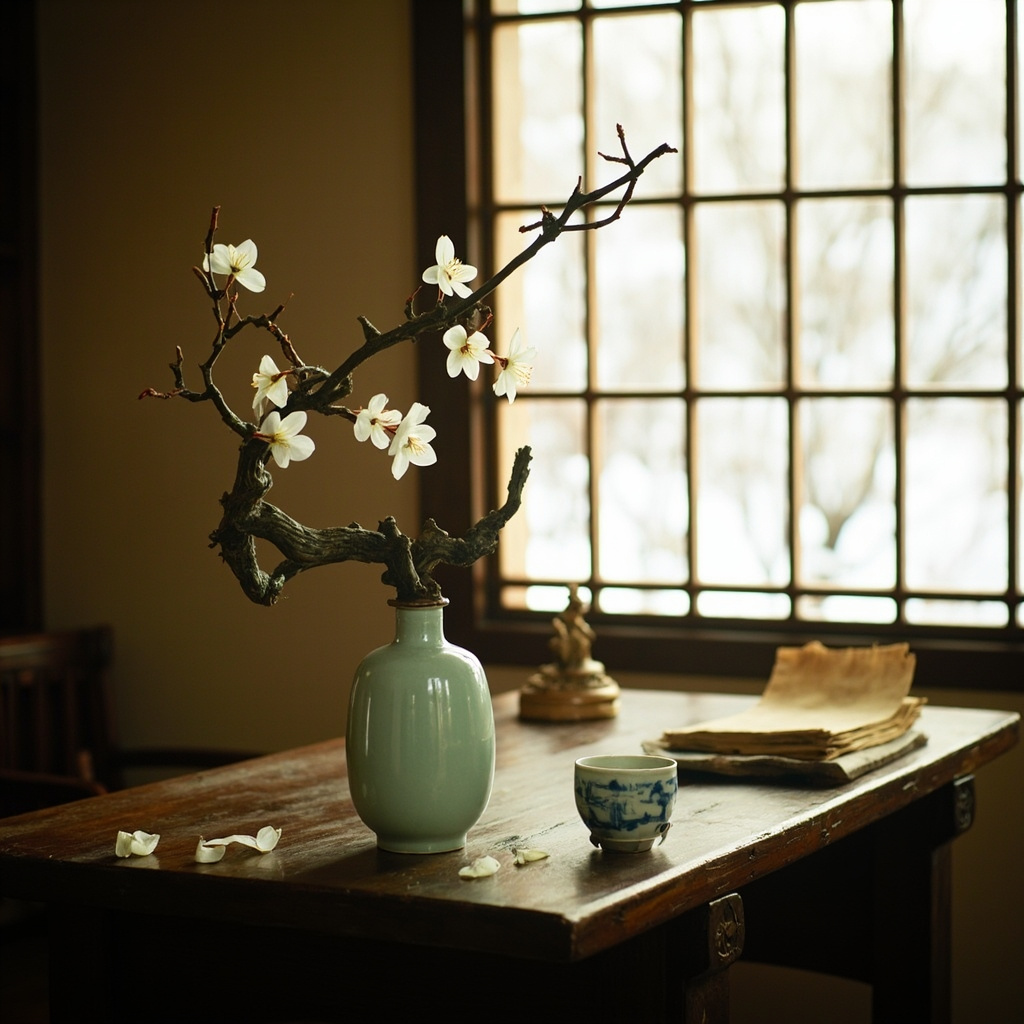
The plum flowers on bare branches, not at the tips of new shoots but directly from old, cracked wood, the branch Chinese art calls iron bones. The tree spends its stored reserves on flowers before it commits to leaves. The old wood carries the new, and in a tradition that asks how a family maintains itself across generations, that is an argument, not a decoration.
The most quoted line about the plum observes that white petals on a bare branch can be mistaken for snow, and that you know they are not by the scent. The fragrance is dark and unnoticed, and that contradiction sits at the heart of the flower: it advertises and withholds at once. Visible risk and real value differ.
The Five Element Reading: Wood That Blooms in Water
In the five element system the plum is wood: spring, growth, the east, the opening of a cycle. It is also the one tree that flowers while the calendar still says winter, and those two facts sit together more interestingly than they appear.
Water nourishes wood, so a plum blooming in the water months states the generating relationship at its most literal. The flower uses what is available rather than fighting the season. For a household between generations, that is the reading: be sustained by what is present rather than waiting for better material.
The Plum in Painting, Ceramics and Textiles
Plum is the most painted subject in Chinese art, and the reason is technical as much as cultural. A painter working in monochrome ink must build form from a few strokes, and the plum offers the hardest exercise: a branch carrying its own weight without leaves, and a five-petalled flower.
That is why the motif migrates cleanly into other media. In porcelain it becomes one white flower on a blue ground. In embroidery, five stitches. In paper cutting, a lattice of negative space. In lacquer, a gold line on black. A plum reduced to five strokes still reads as a plum, and that is the real test: holding its meaning once the decorative is stripped away.
Where to Place Plum Imagery in a Home
Placement follows from what the flower is a sign of. Because the plum marks an opening, it belongs at thresholds rather than at the centre of daily life: an entrance hall, a console by the front door, a guest room, or a window taking the first winter light.
The bedroom is the place to be careful. Plum is a winter flower and a symbol of persistence, which in a room where someone is unwell reads as effort, not ease. In the study it suits a student sitting an examination: the theme is not wealth, it is the first unglamorous cold part of the work.
Cut, Potted or Painted
Three forms behave very differently, and the difference matters more than the choice.
- A cut branch is a visitor. It lasts weeks and is at its best for a few days, so it belongs in the entrance or living room through the blossom season. Treating it as a fixture is a mistake of scale.
- A potted plum tree is a resident. It needs cold winter dormancy and a bright sill, and in return it marks the seasons in your home for years.
- A painting, scroll or embroidered panel is the permanent version. It can be moved freely, and suits offices and households where nothing alive survives the winter indoors.
All three carry the same meaning; only the duration changes.
What Plum Blossom Feng Shui Meaning Cannot Do
A plum branch does not create opportunities, mend a strained relationship, or substitute for a deferred decision. It is a symbol, and it works by changing what a household attends to and when it acts. The plum asks for patience and courage in equal measure, and is no charm that resolves anything on its own. Where it helps is in the slow business of beginning: making the first move while conditions are still unfavourable.
Does a dried plum branch still carry the meaning?
Yes, though as a record rather than a living signal. A dried arrangement speaks of a season that has passed.
Is wintersweet the same plant as the plum?
No. The yellow wintersweet sold as plum by florists is a different genus, and a mixed branch is an imprecision worth avoiding.
One working rule: treat the plum as a marker, not an ornament. Put it where an opening happens, an entrance, a beginning, and let the rest of the house be unmarked by it. The flower that opens the year needs to be early, not everywhere.