Chinese Spirit Wall Feng Shui Meaning: The Ying Bi Shadow Screen at the Gate
Most feng shui objects sold overseas are small enough to sit on a desk. The spirit wall is the opposite: a piece of architecture built across the sightline of an entrance to interrupt a straight line. In Chinese it is the ying bi, the shadow wall, and that name is more exact than the English trade term used for it.
What a Spirit Wall Actually Is
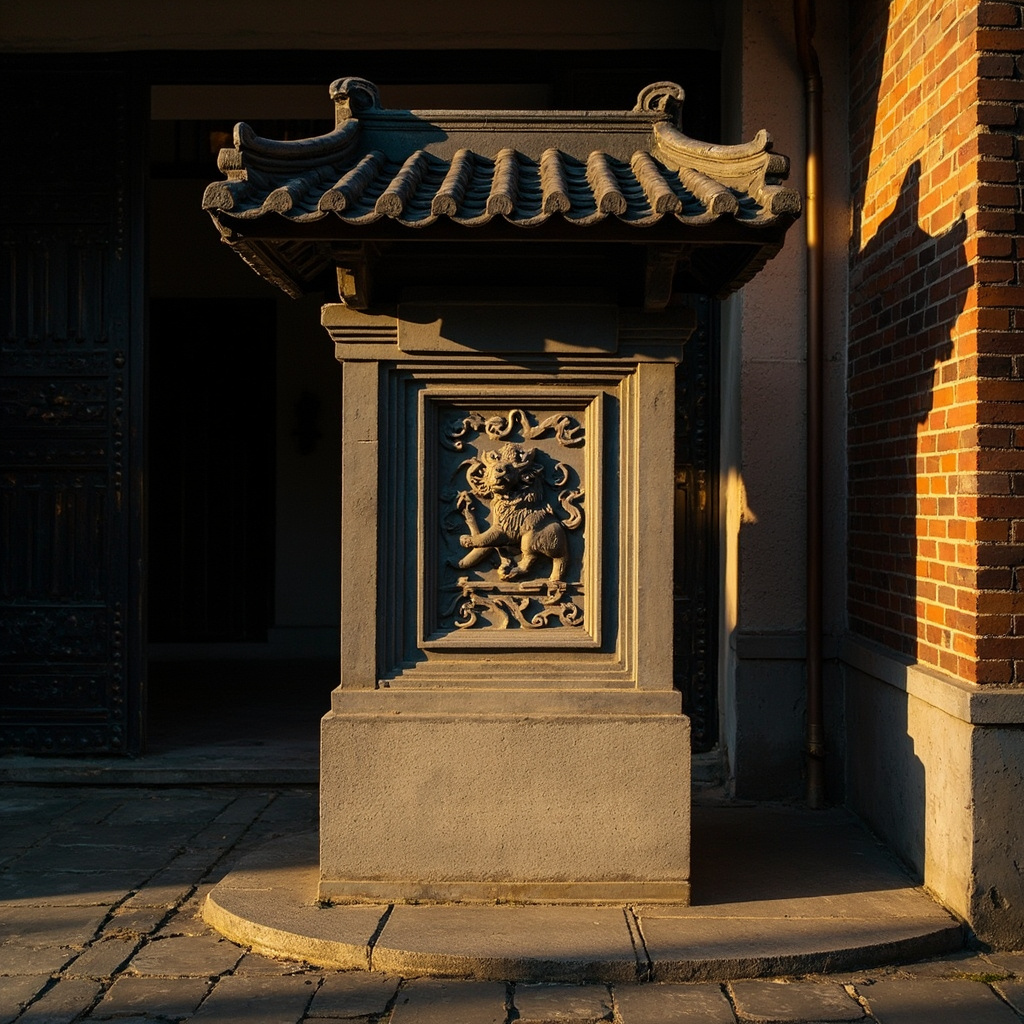
A spirit wall is a freestanding wall set just inside a compound’s main gate, across the direct view from the street into the courtyard. It carries none of the gate’s weight, standing independently a few paces behind the entrance, in line with the doorway, so a person outside sees the wall rather than the house. In a Beijing courtyard it takes the form of a carved brick panel in a moulded frame, raised on a stone base and capped by a small tiled roof.
The Name Is About Shadow, Not Spirits
The English phrase spirit wall is a trade name, and it misleads in a way that matters for how the object is described. The Chinese ying bi contains no word for a spirit: ying means shadow or reflection, bi means wall. The screen works because it throws the viewer’s shadow against its surface, so the house stays hidden behind an image rather than behind a ghost.
Why a Wall Was Built Inside the Gate
The screen answers a problem the gate alone creates. A doorway is an opening in the enclosure, and qi moves through openings. When that line runs straight and uninterrupted from the street into the room, it arrives fast and concentrated. Chinese feng shui treats a fast straight line as a sharp qi and calls the effect a shooting sha, an arrow of harmful influence. The remedy is not to seal the door, which would stop good qi as well, but to bend the flow.
The Poison Arrow and the Choice of Position
The traditional story behind the practice explains a detail that is otherwise puzzling. Practitioners hold that a Taoist observer, looking at a house, would identify a fixed direction from which sha was arriving: often a nearby hill, a tall tree, a neighbouring roofline, or a corner of the street. The screen was then built where it could intercept that line, which is why its position is not a matter of symmetry alone. It is placed across the offending axis, and its distance from the gate is set by where that axis falls.
How the Wall Turns the Qi
The modern description is simpler. The incoming qi enters the covered space between the gate and the screen, hits a surface that does not yield, and is deflected along the face of the wall. It travels sideways rather than straight, arriving at the doorway already slowed and already curved. A curve holds, a straight line discharges. The screen protects the interior without blocking it, because qi that is turned still arrives, and the visitor is made to walk, which is the older and more practical reason for the arrangement.
The Pedestal, the Panel and the Inscription
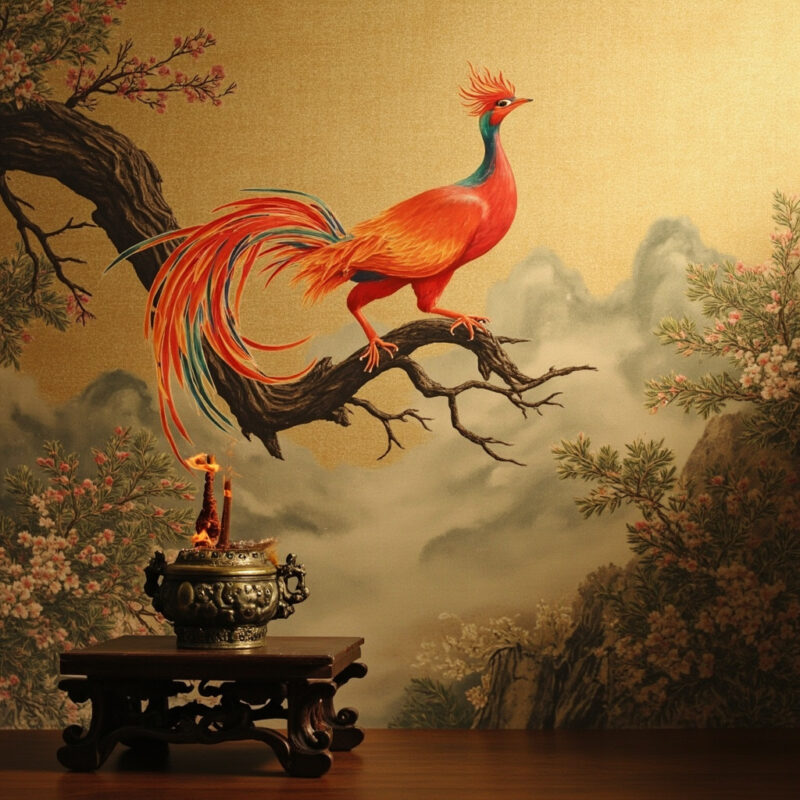
A spirit wall is read from the bottom up. The base is a plain stone or brick plinth, shaped like a Buddhist altar platform and kept deliberately plain, because it carries the load. Above it sits the carved centre panel, carrying the imagery: usually a lion, a phoenix, a peony, a landscape, or a pair of deer. Around the panel runs the moulded frame, sometimes with pendant flower columns at the corners. Above the assembly is the miniature roof, sometimes glazed tile, sometimes plain grey.
The Axis of the Courtyard
Behind its protective function, the spirit wall does something architectural: it fixes the central axis of the compound. The plan of a traditional courtyard house runs gate, screen wall, courtyard, main hall, in a straight line, and every room, door and roof ridge is measured from that line. The screen is the first structure that declares where the axis is, which makes it the first place the composition can be read from either side.
The Elemental Reading: Earth That Holds
Built of brick, stone and tile, the spirit wall reads as earth in the five-element classification, and its job in the language of feng shui is to contain. Earth holds, banks, stops movement. This distinguishes it from other protective objects. A metal mirror reverses an incoming line and sends it back out; a spirit wall does not reverse anything. It absorbs the force of the straight line and converts it into a slow lateral flow.
Placement and Proportion in a Modern Home
Almost no overseas home has a courtyard, and few owners want a masonry screen built across the entrance. The principle can still be carried over, and it is more useful than the object. If a front door faces a busy road, a neighbouring building or a hard corner, the straight line is the problem, not the door. A low divider that forces the entry path to turn reproduces the working of the screen. Two rules are worth keeping:
- Turn the flow rather than merely blocking it, or you will have built a wall that also stops good qi from entering.
- Keep the screen low and open enough that it delays the view instead of sealing it off entirely.
The second rule is the one most often broken. A wall that hides the house completely also hides the household’s welcome. The traditional screen worked because you could walk around it.
Brick Carving and the Regional Schools
The best-known examples come from Shanxi and Hebei, where merchants built elaborate brick-carved screen walls, and the craft of Shanxi brick carving is recognised as part of the national intangible cultural heritage. A tradition of inscribed screen walls also survives in the classical gardens of Suzhou, where the panel carries calligraphy rather than picture. Two points matter when looking at one. Brick carving is subtractive and irreversible, so a damaged panel cannot be repaired back to its original state. And the finest work is on the inner face of the wall, in shadow, which is why photographs rarely do it justice.
What a Spirit Wall Cannot Do
It is worth stating the limits plainly. A spirit wall does not generate qi, it does not choose a person’s fortune, and it does not make a house safe from every hazard. It works on one specific problem, a straight and forceful line entering a dwelling. Read as a general talisman it sounds stronger than it is; read as a piece of environmental design it is exactly as strong as it needs to be. What is unusual about it is that it is one of the few objects in Chinese material culture that is not primarily symbolic. A lion carved on a gate is a wish, a character cut into a lintel a blessing, but a spirit wall is a piece of engineering that happens to be beautiful.