Chinese Tong Shu Feng Shui Meaning: The Almanac That Chooses the Auspicious Day
Most feng shui writing begins with a floor plan or a compass direction. The Chinese tong shu begins somewhere else entirely: with a date. For centuries the practical question behind every undertaking was not whether a design was auspicious in the abstract, but whether the day it was begun would carry enough support to succeed. That question was answered with a book, printed in thick folds so it could be carried, consulted at a glance, and consulted again the following year.
What the Tong Shu Actually Is
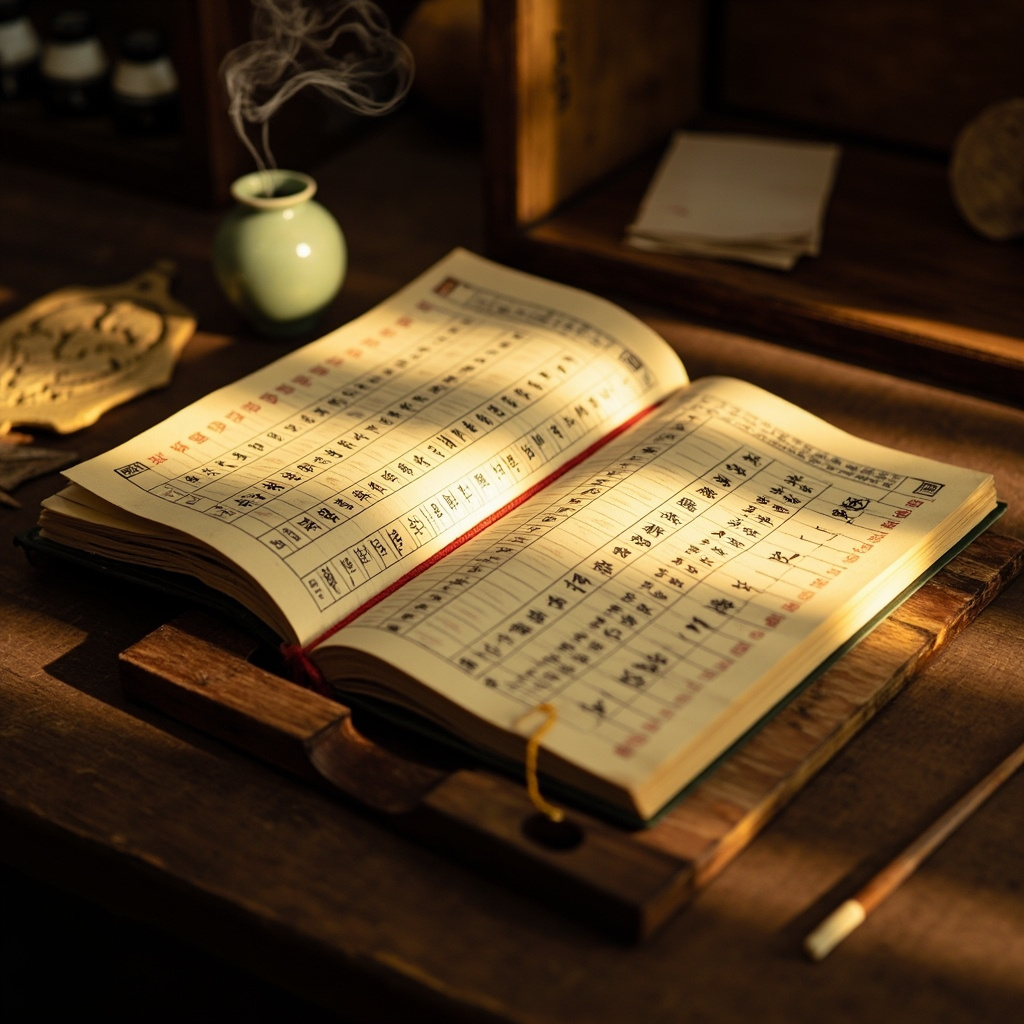
Tong shu is the general name for a Chinese almanac, a book that pairs the calendar with a system of calculation. The word itself is plain: tong means a calendar that governs, shu means a book. What makes it remarkable is the range of material compressed into one volume.
- The sexagenary cycle of sixty years, which governs the year and every date within it.
- The twelve earthly branches, the fixed sequence that gives each year and each day its position.
- The twenty-four solar terms, the solar markers that divide the year into agricultural and ritual seasons.
- The nine stars and eight gates, which supply the selection layer.
- A long table of what should and should not be attempted on each date.
Most households bought the almanac for the calendar and consulted the rest only when a decision mattered.
Two Systems in One Cover
The tong shu historically carried two distinct layers, and confusing them is the most common error in modern summaries. The first is the calendar proper, the practical instrument used to record the passage of the year and fix the correct date for a letter, a contract or a ceremony. The second is the selection layer, the part that judged whether a given day was suitable for a particular activity. One is bookkeeping. The other is judgement, and it is the second layer that later became famous as feng shui date selection.
The Nine Stars and the Eight Gates
The working vocabulary of the selection layer is small and precise. Nine stars describe the quality of the day’s energy, from the auspicious seat of the day’s ruling star down to a set of disruptive influences. Eight gates describe what kind of activity the day permits, each gate favouring particular undertakings and barring others. A traveller consults a different gate than a bride, and a builder consults a different one again. This is why the old books are not a list of good and bad days but a matching exercise between the day’s character and the task in hand.
The Three Principles of Day Selection
When a date is chosen, three tests are applied in sequence.
- The activity itself: whether the day permits this kind of work.
- The person: the individual’s own eight characters, checked against the day’s branches for harmony or clash.
- The direction of travel: whether departing on that day carries the right orientation for the destination.
A date that passes the first test but not the second may still be sound. A date that passes all three is considered strong. This is the mechanism behind choosing a wedding day, a moving day, or the opening of a business.
Why the Calendar Lost Its Authority
The tong shu was once the most widely owned specialist book in China, in a market that ran to thousands of printing houses and editions that differed from town to town. Its decline was not caused by the arrival of modern astronomy but by the arrival of the printed calendar, which for a small price could tell any household the date. Once the calendar itself became cheap, the part that had to be bought separately was only the advice, and much of that advice moved into the hands of professional divination rather than the household shelf.
How a Modern Reader Uses the Tong Shu
For a reader in the West, the value is not the prediction but the framework. The almanac supplies a vocabulary for time that treats a day as a quality rather than a number, and it supplies that vocabulary in a form that is unusually systematic. Where much popular metaphysics is impressionistic, the tong shu is arithmetic: stems, branches, star assignments and gate tables that can be checked, cross-referenced and argued about. That rigour is what makes it useful, and it is why practitioners who work with date selection tend to combine an almanac with a proper reading of the person’s chart rather than relying on the book alone.
Working With the Daily Column
A practical reader looks at three columns on a daily page. The first is the day’s branch, read against the activity being considered. The second is the ruling star, which describes the general tone. The third is the gate list, which narrows the choice. A beginner’s method is to start from the gate, since it is the least technical of the three, and to work outward. It is also important to treat a poor indication as information rather than a prohibition. The tables were written to guide a decision, not to frighten a person away from a task that had to be done regardless.
What the Almanac Cannot Decide
Honesty is part of the tradition here. A tong shu is a reference work, not an oracle, and no page of it can read a person’s character, judge a marriage or correct the siting of a house. The classical texts are explicit that the day supports the effort but does not supply it. This is the point at which a date selection service becomes genuinely different from the book: the calendar supplies the timing, and the analysis of the person and the space supplies the reason.
The Object as Cultural Artefact
The surviving copies are worth knowing for their own sake. They are printed in a distinctive accordion fold, sometimes bound with a red cord, sometimes sold with a separate rotating disc for the month and day, and they carry the compressed typography of a commercial production line that ran for centuries. Held in the hand, a tong shu has a density that no modern equivalent reproduces, and the brush-written day columns alongside the printed tables show how a printed framework was still annotated by hand in every generation that used it.
A Framework That Outlasted Its Authority
What survives from the tong shu tradition is not the authority of the book but the discipline behind it: the belief that timing is a structural part of any undertaking, that a task has a quality before it begins, and that the quality can be matched to the work in hand. That discipline is still visible in feng shui practice today, usually attached to a proper chart calculation rather than to a printed column. The book is no longer the first thing a practitioner opens. It remains the clearest historical statement of the principle, and it was written by people who expected to be read by ordinary households, not only by specialists.