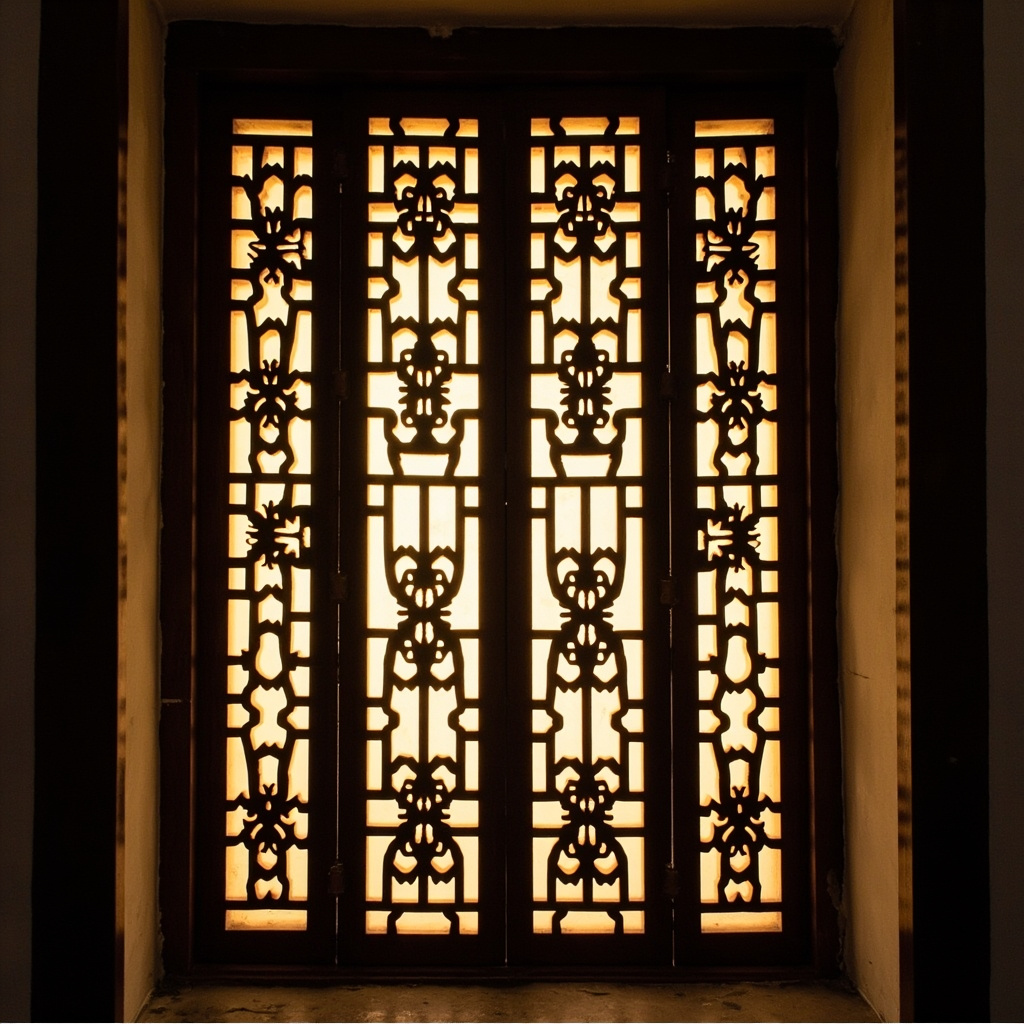
Chinese Lattice Window Feng Shui Meaning: The Hua Chuang Filtered Aperture
Most openings are either open or closed. A Chinese lattice window, or hua chuang, refuses that choice. It does several jobs at once, and how it does them is where its feng shui meaning lives. This is not about superstition. It is about how a wall holds a boundary and a connection at once, and how much of the outside world you admit at any given hour.
What a Chinese Lattice Window Actually Is
A Chinese lattice window is a wall opening filled with a wooden grille instead of glass. In Cantonese it is called a le chuang; in Mandarin and in modern feng shui writing it is usually a hua chuang, the flower window. The craft behind the name was floral, with the grille built from interlocking members forming repeating blossoms and a matching carved frame. What reads as decoration is in fact a structural system. The bars are not applied to a flat panel. They are the panel, and load travels through the mortise and tenon joints into the frame, which is why an old lattice window outlives the glass in the same wall.
The Aperture Is Graded, Not Open or Shut
This is what separates a lattice window from a decorated window. A Chinese wall containing a lattice opening is divided into three horizontal bands, each carrying a different degree of openness:
- The lower panel is solid timber or plaster, a durable band that grounds the opening.
- The middle band is half-lattice, giving light while preserving enclosure.
- The upper band is fully open lattice, admitting light and air with the least obstruction.
Read from bottom to top, the wall grows progressively more permeable. That gradient is the design, not an accident of carpentry. A feng shui reading needs no magic to describe it: a wall that changes character across its height lets one opening serve a private lower room and a shared upper room simultaneously.
Light as a Filtered Substance
Traditional lattice windows were often backed with translucent paper or thin silk, turning direct sun into a soft wash across the floor. The grille then multiplied that light into a moving pattern of shadows that shifted through the day. This is why the lattice window carries such a strong feng shui reputation. It does not merely admit light, it edits it. The window that softens a hard noon sun also blocks the low western glare, without you having to think about the angle of a curtain.
Air That Moves Without a Draft
A perforated surface slows and redirects moving air. That is the principle behind a lattice screen, and why lattice windows were paired with deep eaves and courtyards in southern Chinese architecture. The screen does not stop the breeze. It breaks it into thousands of small, gentle streams, so a room is ventilated without the cold blast an open casement produces. In feng shui terms, the air stays moving without becoming aggressive, the difference between a space that circulates and one that is merely ventilated.
Sight Lines and the Problem of Being Seen
Because a lattice is a dense screen rather than a clear surface, it resolves visibility in a way no curtain does. Through a fine grille you can read the movement and shape of a person in the courtyard, and know someone is there, but not who. That is graded disclosure. A curtain gives you all or nothing, pulled or closed. A lattice gives you a continuous scale, because openness is built into the pattern. The privacy lives in the architecture rather than in a daily gesture, which is why it feels more settled.
The Joinery Is the Whole Point
Traditional lattice work is a display of carpentry. Each bar is cut, notched and fitted into its neighbour, sometimes with more than a hundred pieces in one panel, with no visible nails or screws. This matters because it shows the pattern is not applied to the surface. Pattern and structure are the same object. A reproduction nailed onto flat board may look similar across a room, but carries none of that integrity, and the difference shows under your hand.
Borrowed Scenery, Framed Twice
The classical garden strategy of jie jing, borrowed scenery, means pulling a distant view into your own space as if it grew there. A lattice window participates directly. The courtyard becomes the borrowed subject, and the grille a second frame around it, cropping and grading whatever passes through. Walls in southern China were often thick and windowless precisely so that a single framed, filtered view carried more weight than a row of clear openings. Restraint in the wall made the aperture worth looking at.
Bringing the Principle Into a Modern Room
Most contemporary apartments have no hua chuang, but the principle travels well. A slatted timber divider near a window softens glare while keeping the room connected to its light source. A lattice screen between a door and a window breaks the direct line from a street view into the room. Because the grading happens in the screen rather than the glass, the same solution works with double glazing, aluminium frames and air conditioning. You are not copying a period object. You are copying a decision about how much of the outside world enters, and when.
What the Lattice Window Cannot Do
It is worth being direct about limits. A lattice window is an architectural element, not an energy device. It does not rectify qi, and no placement of one transforms a room on its own. It cannot substitute for a proper reading of a space or cure a structural problem in a home. What it offers is more durable than a cure: architecture whose purpose was to make a boundary adjustable. In feng shui practice an adjustable boundary is more useful than a lucky object, because it responds to the hour, the season and the person inside.
Choosing and Caring for a Wooden Lattice Screen
If you are adding a lattice element to a home or studio, practical details matter more than symbolism.
- Solid hardwood such as elm, teak or Chinese catalpa outlasts veneer, which chips at the edges where joints are cut.
- Look for visible mortise and tenon work rather than dowels or staples, and check the frame sits flat without warping.
- Keep the wood out of standing damp and wipe it dry rather than soaking it, since repeated wetting darkens the grain.
- Stand the screen slightly away from a window so it casts a shadow, where the moving pattern becomes visible.
A Boundary That Stays Adjustable
What makes the Chinese lattice window worth studying is not the folklore attached to it. It is that a vernacular craft, built for thousands of years, answered a question most modern architecture avoids: how do you keep a room private and open at once? The hua chuang answers with graduated transparency, filtered light, softened air and load-bearing joinery. For anyone arranging a home on feng shui principles, that is more useful than any single object. The best boundary is not the strongest one. It is the one that still lets you change your mind.