Chinese Lion Dance Feng Shui Meaning: A Remedy You Perform, Not Place
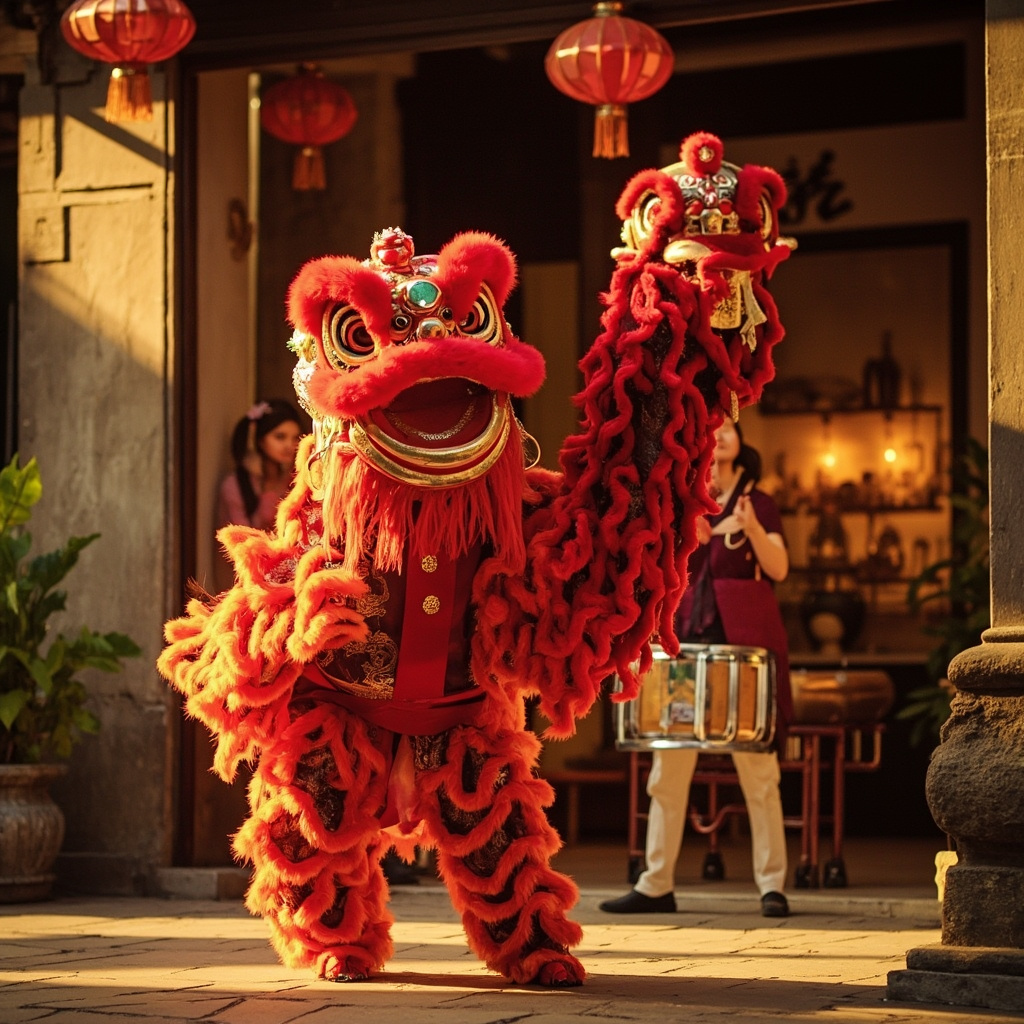
Almost every feng shui correction is an object: a mirror, a plant, a stone guardian set at a gate and left there. The Chinese lion dance is the exception. It arrives with a drum, crosses a threshold, works the rooms in a fixed order, and leaves. Nothing remains but a red envelope and a scatter of lettuce. Why that sequence works explains how Chinese spatial thinking treats movement, time, and agreement.
The Lion Is Not a Chinese Animal
There are no lions in China. The creature in the dance arrived the way most auspicious animals did, through tribute routes carrying descriptions of real lions from Central and South Asia. What artisans built was never a portrait: a broad flat face, a mirror or horn on the forehead, a mane of tufts. It reads as a lion the way a dragon reads as a reptile, recognisably and without interest in accuracy.
This matters. Because the lion is constructed rather than documented, it carries no fixed astrological weight, no trigram, no assigned direction. Its power is procedural: what makes it effective is not what it is but what is done with it.
Two Dancers, One Animal
A southern lion is worked by two people inside one costume. The front dancer holds the head and controls expression, bite, blink, the startled lift. The rear dancer is bent double under the tail, holding the front dancer’s belt, carrying every jump. Neither sees the whole animal. The front dancer sees forward; the rear sees the floor.
The lion is only coherent when both agree. A front dancer who leaps before the rear is ready produces a stumble the audience reads instantly as bad luck. That pairing is the point: the animal pictures a household moving as one body, the one who sees ahead and the one carrying weight keeping faith.
The Drum Is the Spine
Every lion has a drum, usually with cymbals and a gong behind it. Visitors assume the music is accompaniment; it is closer to a nervous system. The drum sets the pulse, signals transitions, and tells the lion when to sleep, test the ground, or strike. A tight drum troupe makes mediocre dancers look competent. A loose one makes skilled dancers look drunk.
The drum also does a feng shui job: it announces the remedy before the remedy is visible. In a procession it is heard a block away, so the household is already in the doorway, already attentive, when the lion arrives. Sound here is not an energy field but a summons, and a summons changes the posture of everyone present.
Cai Qing: The Transaction at the Threshold
The central sequence in a business blessing is cai qing, plucking the greens. Lettuce, sometimes with celery and a red envelope tucked in, is hung above the shop door or held on a pole. The lion approaches, sizes it up, retreats, feints, then rises and takes it in one motion, chews, and spits the leaves back over the doorway. The envelope stays.
Green leaves stand for growth and the raw, unprocessed fortune of a new venture. The lion takes the uncertainty out of the air above the door, chews it, and returns it shredded and harmless. What it keeps is the payment. It is a contract performed in public: the household feeds the lion, the lion clears the approach.
Waking the Lion
A new lion head is not usable as it arrives. It is awakened in a rite translated as eye-dotting: invited guests paint the eyes, the horn, and sometimes the mirror with cinnabar or ink, in a set order, while the drum holds a slow beat. Until the eyes are opened it is a decorated object in storage. Afterward it is a lion, treated like any consecrated implement: never stored face-down or where it looks at a bed.
The rite draws the boundary the tradition depends on. A lion head on a wall as a souvenir is decor. A lion head that has been awakened and is taken out and worked with a drum is a working remedy. The object is the same; the difference is whether anyone performs it.
The Route: How the Lion Enters and Leaves
In a house or shop the lion enters at the main door, works front to back, visits the rooms that matter, and exits the way it came, facing outward. It does not enter by one door and leave by another, and does not turn its back on the entrance while inside. The sequence treats a building the way a reader treats a page, in one direction, without skipping.
This is the part most easily transplanted. If you cannot host a troupe, respect the route in smaller acts: walk a new space once, deliberately, front to back, before furnishing it; open the furthest room’s windows last; keep party traffic from reversing through a bedroom corridor.
Keeping a Lion at Home
Many overseas households own a small lion head or a pair of lion figures and ask where they belong. The traditional answers are consistent.
- Face it outward, toward the entrance, so it looks at what arrives rather than at the family.
- Keep it above children’s reach and at or above chest height.
- Never place a lion in a bedroom or facing a bed.
- Never store it in a bathroom, on a garage floor, or among cleaning supplies.
- Keep a pair together.
Figures bought as travel souvenirs can stay souvenirs. The rules above apply once you decide the object is doing work: once it has been awakened, and once you dust it and acknowledge it on days that matter. Half-commitment is the one position the tradition has no instructions for.
What the Lion Cannot Do
It is worth being blunt about limits. The lion dance clears an approach and marks a beginning. It does not repair a front door opening onto a blank wall, fix a beam pressed over a bed, or replace the ordinary work of a house kept lit, dry, and uncluttered. A troupe hired to compensate for a badly planned building is an expensive way to do nothing.
What it does well, no static remedy does at all. It changes the mood of a place for the people standing in it, on a given day, before witnesses, and converts an intention into a public event. That is the honest value of the lion: not a permanent field, but a dated, shared act a household can point to and say, this is when we began.
The Short Version
The lion dance is the one classical remedy that lives in movement rather than placement. It needs two people who agree, a drum that keeps them honest, a threshold to trade with, and a route that goes forward and comes back out. Take the sequence if nothing else: announce, approach, take the uncertainty, give it back shredded and harmless, leave the payment behind. Everything else is costume.