Chinese Ghost Work Ball Feng Shui Meaning: The Concentric Puzzle Bead of Lu Ban
Feng shui jewellery is usually described by what a stone is meant to do. A bracelet of carved spheres works differently, because the material is beside the point. What matters is that the sphere turns. Each bead is a puzzle of nested shells, hollowed and pierced so that a smaller carved ball sits free inside a larger cage and turns whenever the wearer moves. Its Chinese name carries a word overseas buyers often misread: it has nothing to do with ghosts.
What a Ghost Work Ball Actually Is
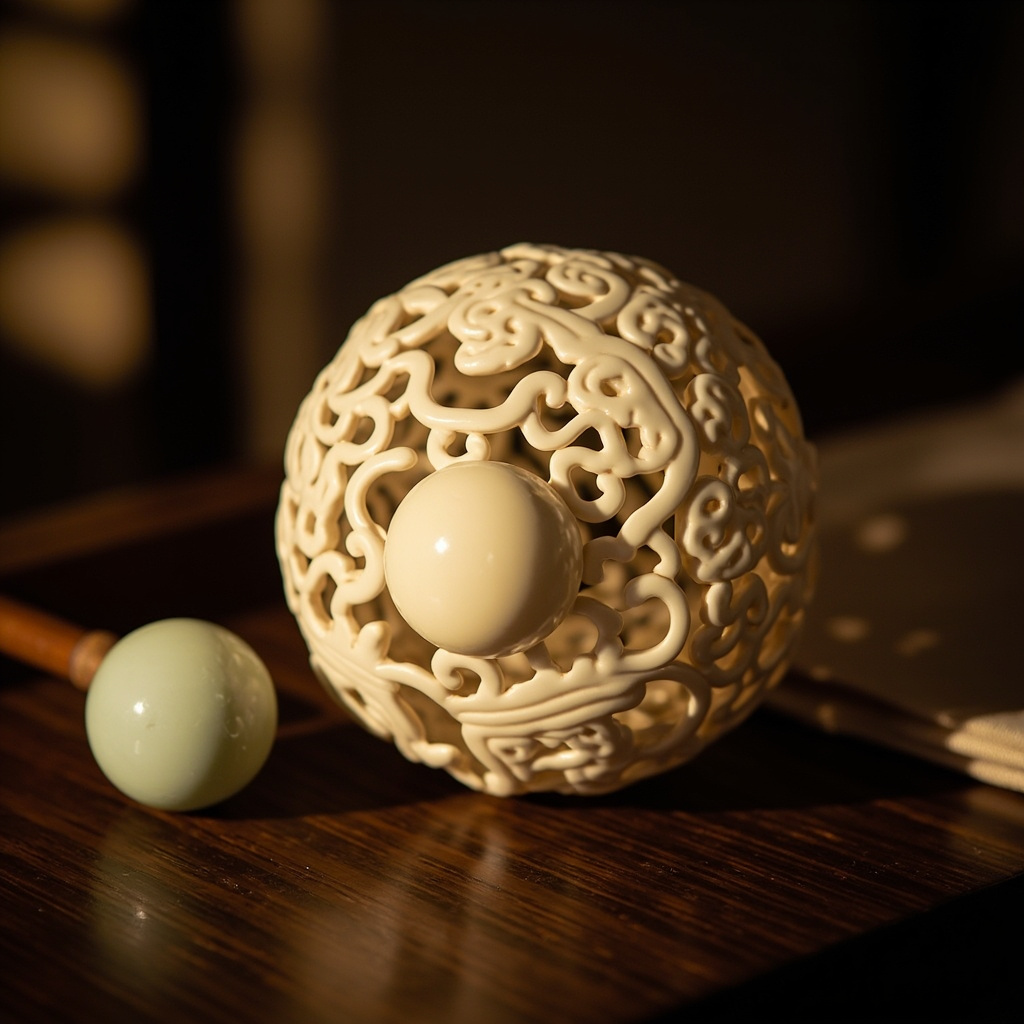
Every bead is a single piece of dense, cream-coloured material, drilled through the centre and hollowed into a shell. That shell is pierced with openings, and inside sits a second, smaller sphere, carved and pierced in turn, fixed to nothing. It is held only by the inner bore, so it turns whenever the bead moves. In Chinese it is a lu ban qiu, the Lu Ban ball; in the workshop, a guigong qiu, work beyond human skill.
Why the Name Ivory Fruit Is a Real Name
The trade name for these pieces, ivory fruit, is neither a mistake nor a piece of citrus. It comes from ivory fo shou, ivory Buddha’s hand, a description carvers use for the object. Buddha’s hand is a citron whose segments split from one core and curl outward like a many-fingered hand. The outer shell of a puzzle ball does the same in carved material: from a single centre, lobes and pierced panels fan outward. The resemblance is the point: the name settled around the object rather than the fruit.
The Craft: Concentric Openwork Carving
Making one is a matter of subtraction. The carver starts with a solid blank and removes everything that is not the object, working inward until the smallest sphere is left, still carrying its own pierced pattern, inside its shell. Nothing is glued and nothing is hinged. The tolerances are tight enough that the inner ball rotates freely but cannot rattle. On the outer shell the usual vocabulary is ruyi, the cloud-scroll whose name means as you wish, worked with dragon forms, both read as wish-granting.
The Lu Ban Attribution and What It Claims
The name Lu Ban deserves care. He was the legendary master craftsman of the Lu state in the later Spring and Autumn period, honoured in Chinese folk religion as patron of builders, carpenters and engineers. Attributing a puzzle ball to him is not a claim about a surviving work. It is a maker’s blessing, the way a woodworker signs a chest with a master’s name to say the work honours that standard. The attribution claims difficulty, and it is why the puzzle ball became the carver’s test piece.
The Elemental Reading: A Hard White Material in Metal
In the five-element classification, a hard, dense, close-grained material of white or cream colour reads as metal, the same category as jade, gold and bone. The ghost work ball therefore belongs to metal, and is worn in a metal bracelet rather than a wooden or glass one. In the generating cycle, earth produces metal, so a piece of this kind is held to call in the steadiness and support of earth. What metal produces in turn is water, the element of flow and circulation. The material gathers support and then circulates it.
Why the Turning Core Matters More Than the Carving
Here the construction matters more than the colour. In feng shui a static form holds its qi in place, while a moving form circulates it. Most jewellery is static by nature, because a fixed carving cannot turn. A puzzle ball can: the inner sphere rotates against the inner wall of the shell, and the outer shell turns against the hand. The practical reading is that this is a bead chosen for the travelling of energy rather than its anchoring, worn during movement, work and change rather than kept as a static ornament.
Twelve Beads and the Twelve Branches
A bracelet of this kind is commonly strung with twelve beads, and the number is not arbitrary. Twelve corresponds to the twelve earthly branches, the cycle running through the twelve zodiac animals and the twelve-year reckoning. A twelve-bead bracelet therefore carries the idea of a complete circuit and of return, the cycle closed rather than interrupted. The carving is uniform from bead to bead, a claim about the maker’s control: every layer has to run true for the inner sphere.
Size, Weight and What You Are Buying
The practical figures are simple. A bracelet of this kind is commonly made with fifteen millimetre beads, twelve of them on a hidden elastic cord, making a fine, close-fitting strand. Better-finished versions come with a tassel and a gift box. One point deserves care. These objects are traditionally worked in three materials:
- Elephant ivory, the classical material, governed by international trade controls under CITES.
- Mammoth ivory and ox bone, both dense, pale and workable in the same way.
- Vegetable ivory such as tagua, a modern alternative now widely used by workshops.
The legal position under those controls differs between countries, and between antique and non-antique material. A dealer who cannot state plainly what the material is has not answered the question that matters.
Caring for a Carved Puzzle Bead
The material is dense but organic, and the inner sphere is the vulnerable part.
- Keep it dry and do not soak it; water can dull the surface and swell the material unevenly.
- Take it off before perfume or hairspray, which stain the cream surface permanently.
- Avoid dropping it. A hard knock can tighten the inner bore so the ball no longer turns freely, the one fault worth worrying about.
- Store it loosely in a soft cloth pouch, away from direct sunlight, which warms the colour over time.
What a Ghost Work Ball Cannot Do
It is worth being clear about the limits. A ghost work ball is a carved object with a documented craft tradition and a legible place in Chinese material culture. It does not move qi on its own, it does not protect a household, and it does not substitute for a proper reading of a person or a site. What it offers is a well-made thing with an honest meaning, a recorded history of difficult workmanship, and a movement other jewellery cannot provide. That is a modest claim, and the one it can keep.
A Rarity in the Age of Flat Surfaces
What makes the ghost work ball worth a collector’s attention is that it is the rare piece of Chinese jewellery whose meaning is written into its engineering rather than its material. The colour is common ivory white; the skill is not. Twelve beads, each a nest of pierced shells with a free-turning core, take far longer to carve than a comparable bracelet of plain spheres, and the wearing is the point: a hand that turns the bracelet turns something inside each bead. It rewards handling, which in an era of flat polished surfaces is its own rarity.