Chinese Divination Stick Feng Shui Meaning: The Qiu Qian Numbered Answer
Not every feng shui object works by doing something to a room. The mirror deflects, the bell disperses, the incense changes the air. The Chinese divination stick, called qiu qian, does none of that. It sits in a tube until a visitor asks it a question, and its entire contribution is to hand back a number. That number is a pointer rather than a prophecy, and the tradition is built around the gap between the two.
What a Qiu Qian Set Contains
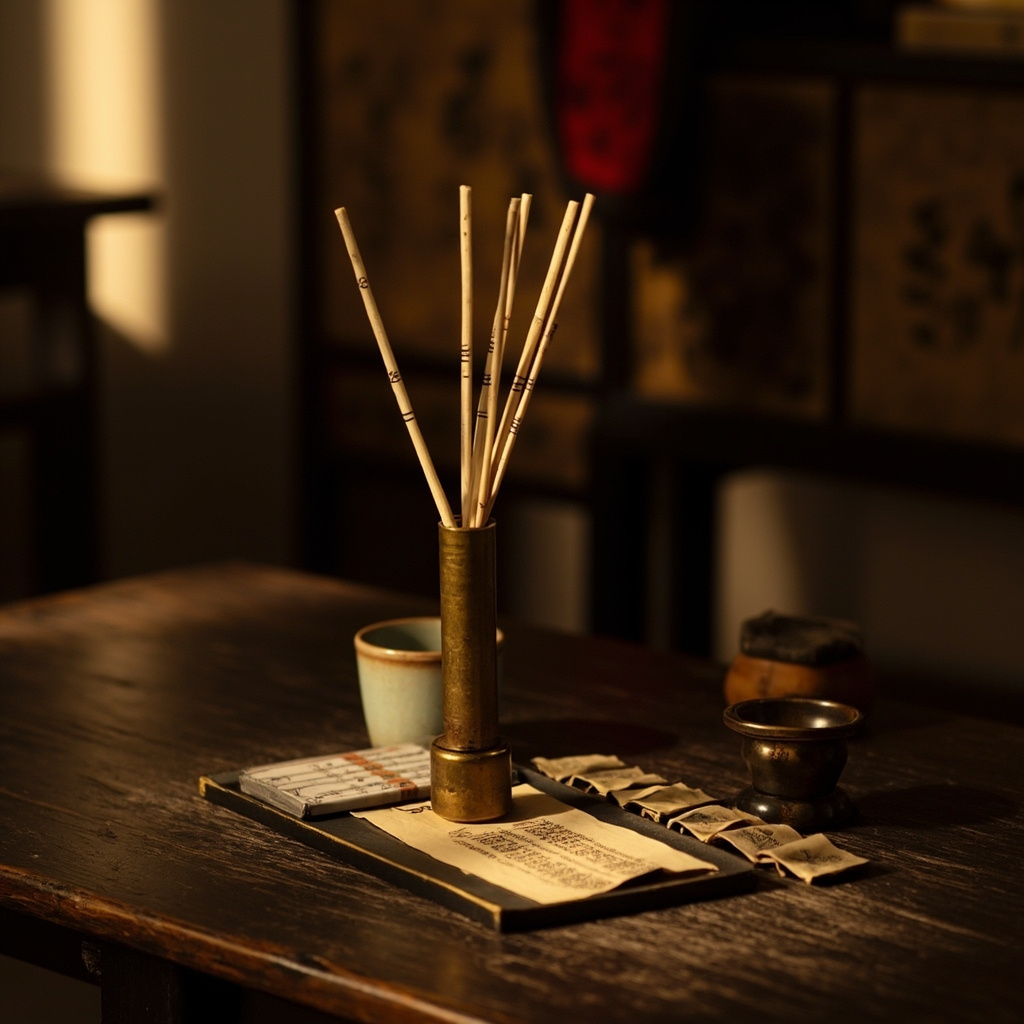
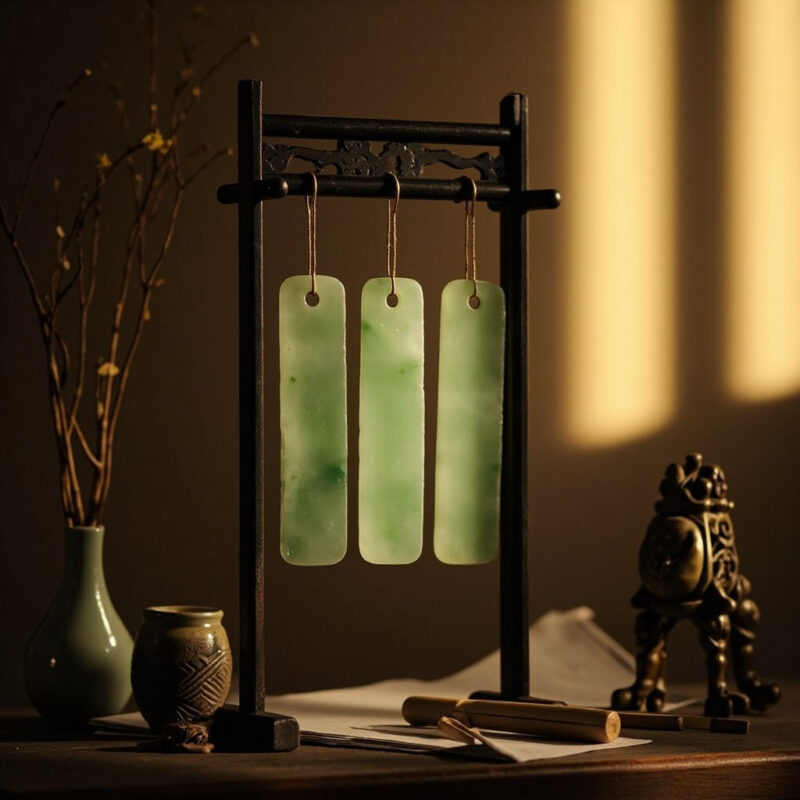
A qiu qian set is a tube, a bundle of slender bamboo or wood sticks, and a shelf of numbered paper slips. Each stick carries one number, written in Chinese characters and Arabic numerals. Temple sets number in the dozens or hundreds; the widely used Guan Yin sets run to one hundred, each with its own verse and reading. The sticks are light and straight, bamboo polished to a honey tone, and the tube is often brass, bronze or turned wood with a fitted lid.
- A cylindrical tube, usually brass, bronze or turned wood
- Slender bamboo or wood sticks, each numbered once
- A matching set of printed paper slips with the verse
- A flat case or shelf to keep the slips in sequence
The Stick Carries a Number, Not an Answer
Here is what surprises people who expect a prophecy. The physical object in your hand says nothing about your future. It is an index. The number must be matched against the printed set, and only then does a poem and its commentary appear. The stick is deliberately emptied of meaning so the text can be consulted and kept. In feng shui terms this is a striking inversion: the object most people call the oracle is only a label, and the real content lives in a book you can read at home.
How the Draw Is Performed
The ritual is short. You put a coin into the tube, state the question, grip the tube with both hands and shake it. Some temples have you keep your eyes closed. You shake until a single stick rises to the top or slips out of the mouth of the tube, and only that stick is read. The shaking is not theatre for its own sake. It mixes the set so no stick keeps a position, and it is the mixing, not the selection, that makes the draw honest.
Why the Drawer Cannot Choose
This mechanic gives the qiu qian its place in a feng shui toolkit, and it is unusual. Every other instrument in this catalogue is aimed. The mirror is angled, the wind chime is hung, the crystal is placed, the compass is pointed toward a sector. In each case the practitioner controls the variable and the instrument reports. With the divination stick, control is surrendered at the moment that matters. A harder shake changes nothing about which stick rises, because effort affects the randomness and never the preference.
Reading the Numbered Slip and the Grades
Once the number is known, the slip is found. Temple slips are short, usually four lines of verse, followed by a plain-language reading and a graded result. The verse is deliberately ambiguous, readable toward a favourable or an unfavourable outcome depending on the reader’s situation, so the commentary beneath it matters as much as the poem.
The order of a reading
- Note the number and find its slip before reading anything else
- Read the verse twice, then read the question again
- Read the graded result and treat it as the range
- Write the question, the number and the grade in one line
Not all numbers are equal. Slips are sorted into graded buckets, traditionally running from the most auspicious to the least, and the number on the stick decides which bucket you land in. The outcome is decided in two stages: the draw sets a range, and the poem fills in the detail. This is why the same question asked twice can give different answers without anyone cheating, because the range shifts first.
The Stick Goes Back
After the reading the stick is returned to the tube. Nothing is consumed and nothing is broken. The set is a closed, finite system: the same numbered slips are available for the next visitor and the next question. If the identical stick comes out a second time for the same question, the answer is taken as withheld rather than repeated, and the question is rewritten. A tool that cannot be worn out by asking expects precision.
Buddhist, Taoist, and Secular Sets
Different sets carry different vocabularies. Guan Yin sets lean on compassion, protection and safe passage, and they are the style most people recognise from Hong Kong and Southeast Asian temples. Taoist sets can be dedicated to particular deities or to a specific concern, such as examinations or trade. Secular sets are sold for home use and often carry the widest vocabulary, covering business, marriage, travel and health. What separates a serious set from a novelty is the quality of the printed commentary.
What a Reading Can and Cannot Tell You
A qiu qian reading is most useful when you already know the options and cannot rank them. That is a real and common position: two contracts, two dates, two ways to spend an inheritance. The set does not invent the question. It gives you an external point of view on a choice you have been circling, and the graded result sharpens that into a decision you can defend later. Read it as consultation rather than command.
The limits are worth being clear about, because this is where feng shui copy usually goes wrong. The qiu qian does not choose a direction for your house, replace a compass reading, or tell you where to hang a mirror. It cannot diagnose an illness or settle a contract. What it can do is put an ordered, external judgement in front of a question you have been avoiding. Where a compass describes a sector and a bagua map names a family member, a qiu qian reading describes a decision.
Keeping the Set in the Home
If you keep a set at home, treat it as a working instrument rather than an ornament. Keep the sticks in their tube, dry and out of direct sun, because bamboo splits when it dries out quickly and the numbering on a cracked stick becomes hard to read. Store the numbered slips in order and never fold them. A missing or out-of-sequence slip is the one thing that will ruin an otherwise careful reading.
Used well, the Chinese divination stick is a modest object with a precise design. It hands over a number, it refuses to be steered, and it depends entirely on the reader for the part that matters. What it offers is not prophecy but method: a fixed procedure, an external sequence and a graded answer recorded against a stated question.