The Courtyard Water Vat in Feng Shui: The Jar Called a Sea
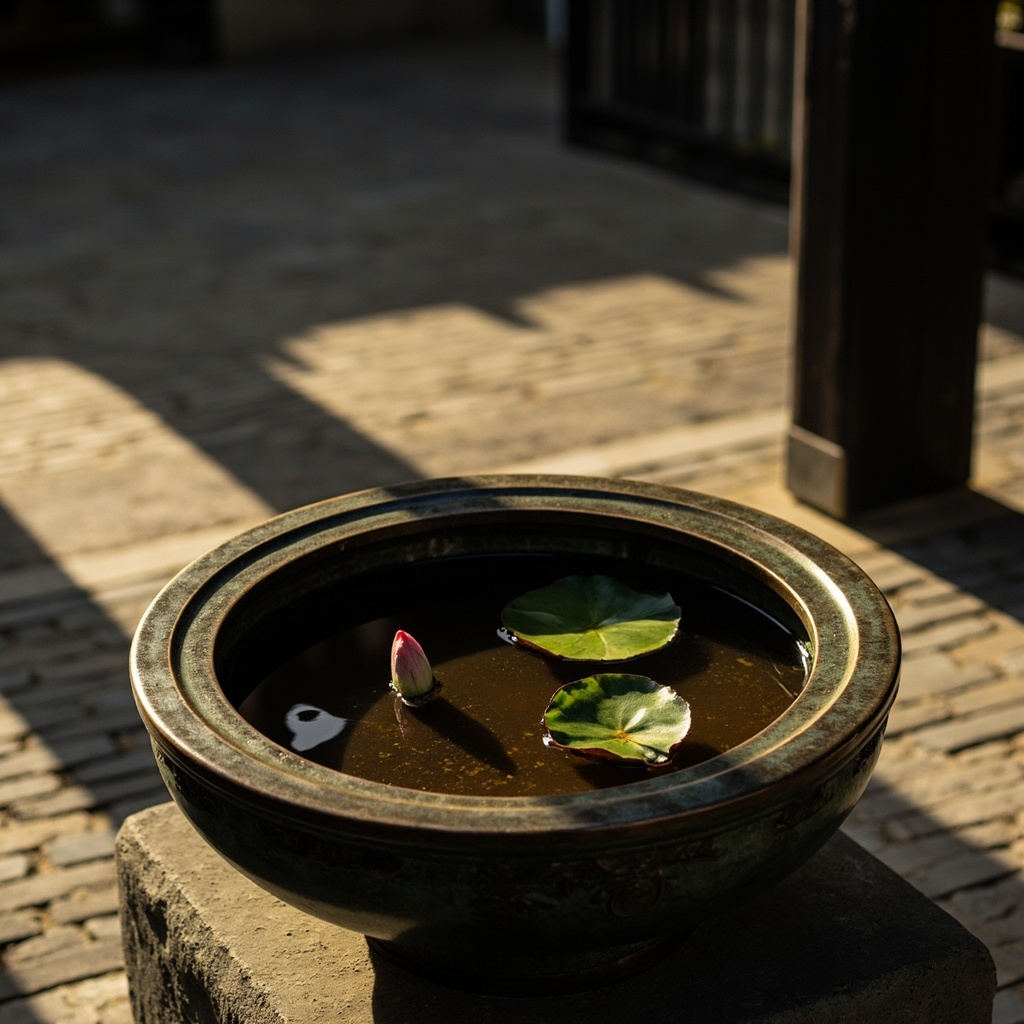
Walk through an old courtyard house in northern China and you will usually find one object that is not decorative, not devotional, and not for sale: a wide-mouthed basin of water standing off to one side of the paving. Visitors mistake it for a planter. It is not one. In the classical vocabulary of Chinese architecture it is a water vat, and the great ones set along the palace routes were called men hai, a sea in front of the gate. Nearly everything interesting about it follows from what it was built to do.
What a Courtyard Water Vat Actually Was
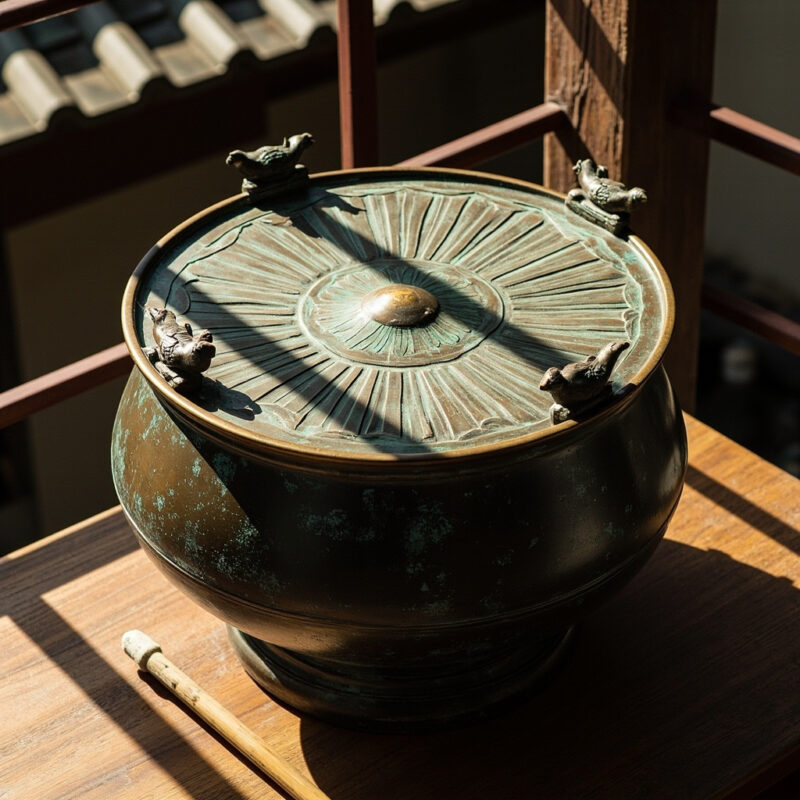
These vessels were made in bronze, riveted iron, carved stone, and heavy glazed ceramic. A household vat might be wide enough for a child to lean into; the largest held several tonnes, filled by carriers hauling from wells outside the walls. Construction was deliberately brutal: the object had to survive frost, ash-laden water, and direct contact with burning timber. The palace courtyards kept roughly three hundred of them at intervals along the processional routes, most in plain bronze gone green, a few gilded. They were not arranged as ornament. They were arranged as coverage.
Fire Came First, and Meaning Followed
An old Chinese house is a stack of dry timber, paper, hemp, and thatch under a single roof line, and a courtyard is exactly the dense, warm space where a cooking fire becomes a street fire. Water therefore had to be at the point of use; a bucket chain from a distant well arrives after the roof has gone. So the vat is, before anything else, a piece of fire engineering: capacity placed within running distance of the rooms it protects.
Only once that was solved did the feng shui reading attach. A house that cannot burn is a house that keeps its fortune. The symbolism is downstream of the plumbing, and that order matters when you decide whether to buy one.
Why a Jar Is Given the Name Sea
Men hai is not a description. A vessel holding perhaps two cubic metres is not a sea, and no one who named it thought otherwise. Traditional building vocabulary names an object for what it must be equal to rather than for what it is; a small pond becomes a sea. The overstatement is an instruction. A jar told it is a sea must never go dry. The name sets a maintenance standard and places the obligation on the household, not the vessel.
Reserve Rather Than Flow
This is where the vat parts company with every other water object in the house. A fountain circulates: a pump lifts, the water falls, the surface breaks, and the value is kinetic and audible. A vat does nothing visible. It holds. Its value is potential: volume available at a moment that may never arrive.
Classical feng shui is suspicious of standing water, which collects silt and is read as qi that has stalled. The vat is the sanctioned exception because storage is the whole function. The exception stays legitimate only if the water is maintained: skim it, top it up, change it fully in warm weather, and give it a living index such as a lotus or two small fish. Stagnation here is a maintenance failure, never a design flaw.
Round Mouth, Square Base, Bronze or Stone
The familiar profile is a round mouth over a square or octagonal footing, heaven above and earth below, the vessel mediating between them. Material carries as much information as shape. Cast bronze takes a patina, holds a chill, and was the classical choice for anyone who could afford it. Stone insulates well in hard frost. Glazed ceramic is the modern option, and the glaze should follow the element: deep blue, near-black, or grey. A strong red body sets water and fire in the same object. Bare iron rusts and stains paving for years.
Where It Stands on a Property
Placement in the old courtyards followed three rules that still translate to modern lots.
- In the courtyard, before the principal hall, offset from the central axis so the eye passes it rather than stopping.
- Within reach of the rooms it protects; a vat at the far gate does nothing for a kitchen fire at the back.
- Away from the mouth of the door: not facing the entrance, not in the straight line between gate and hall, and not beneath a bedroom window, where night damp and reflected light work against sleep.
In a flat, the same logic means a filled vessel near the cooking area or on the balcony behind it, never in the entrance.
Keeping the Water Alive
A vat is a commitment disguised as furniture. In warm months, top up in dry weather, skim weekly, and change the water every few weeks; a lotus or two goldfish serve as a living index, and fish gasping at the surface mean the water has turned. Scrub the interior each spring with a stiff brush and no detergent. In cold climates drain the vessel before the first hard frost; a full vat splitting is a genuine annual event. And never leave it empty through the New Year; an empty vessel is the one condition the name forbids.
Reading the Vat as a Diagnostic
The vat is the cheapest instrument in a house for reading how much attention a household pays. Dry and packed with leaves suggests a family stretched thin. A crack mended with cement suggests something deferred. Used as a bin or an ashtray, it says the entry has been surrendered to convenience. Green water with a healthy lotus says someone walks out with a jug. This is not superstition; it is a maintenance record visible from the gate.
Three Water Vessels, Three Different Jobs
Most confusion around water in the home comes from treating every vessel as interchangeable.
- Fountain: movement. Reads as continuous activity, needs a pump, and earns its place wherever sound and falling water are wanted.
- Aquarium: living water. Reads as ongoing vitality, needs filtration and feeding, and belongs indoors where temperature is stable.
- Water vat: reserve. Reads as capacity, needs no power at all, and suits a courtyard, a balcony, or a dry climate where something should be kept in hand.
Choose by job rather than by size. Two vats in a small courtyard is clutter; one is enough.
A Small Practice for a Modern Home
Without a courtyard, a stoneware jar on a balcony carries the whole idea. Fill it, float a lily or a mat of small leaves to slow evaporation, and check it weekly. The check is the practice. Once a week you walk out with a jug and top up a vessel kept for an event you hope never arrives, and in that gesture the teaching of men hai is complete: a household holding something in reserve is not living at the edge of its own luck.