Scholar Rock Feng Shui: The Viewing Stone That Lets Qi Pass Through
Most feng shui objects are asked to hold something back. Mirrors deflect, screens slow a draught, heavy furniture anchors a corner. A scholar rock does the opposite. It is a piece of raw stone, often barely a forearm tall, drilled by centuries of water into a lace of holes; its purpose in a room is to let energy travel through it rather than around it. Nothing about it is fixed or finished. Collectors have paid more for one unworked stone than for a courtyard of carved jade.
What a Scholar Rock Actually Is
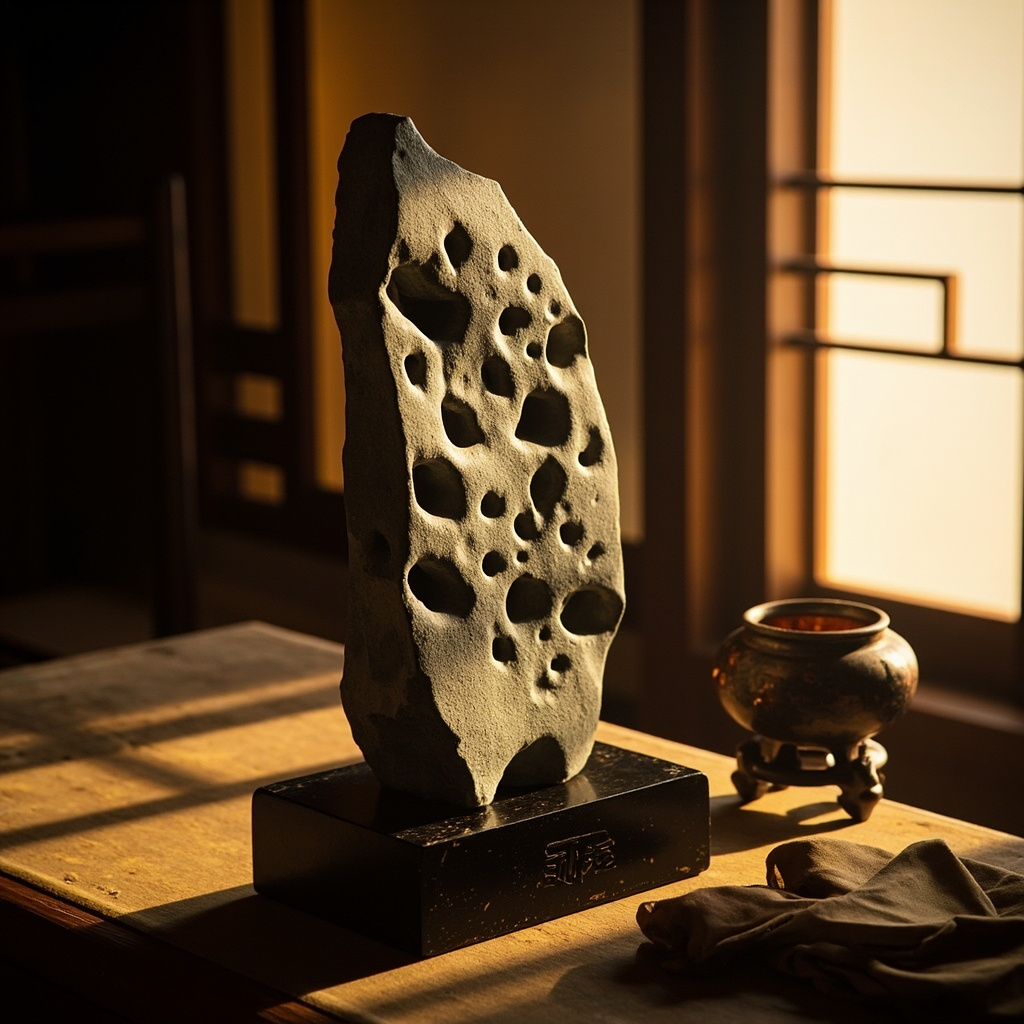
A scholar rock, called gongshi in Chinese, is a naturally formed stone valued for shape rather than mineral content. The best known are limestones eroded in lake beds and river courses, where water has spent centuries removing everything soft. What remains is a pierced, overhanging, often absurdly top-heavy silhouette that looks less like a rock than like a portrait of one. It sits on a custom wooden stand, at eye level or slightly below, and it is viewed the way a painting is: slowly, from several positions, in changing light. It is neither a paperweight nor a crystal. It is a landscape compressed until it fits on a desk.
Why the Stone Is Never Carved
This is the first thing Western collectors get wrong. A scholar rock that shows a chisel mark is worth a fraction of one that does not. In the classical valuation, human work subtracts. The stone earns its standing because nothing was done to it: water did the carving, the collector only chose. Feng shui reads that restraint as a quality in itself. A room full of objects that assert their maker stays tense. A single object that refuses to is oddly calming, and that calm is the practical mechanism, not a metaphor. The discipline of not improving a thing is what feng shui asks of a room.
The Four Classical Tests
Traditional appraisal reduces to four qualities, and they double as the questions to ask before you buy:
- Thinness (shou): the stone should look too slender to stand, a wafer of rock with almost no mass.
- Openness (tou): you should be able to see daylight through the body, not just past its edge.
- Piercing (lou): the holes should connect, forming channels rather than decorative dimples.
- Wrinkling (zhou): the surface should fold and crease like cloth, so the eye never finds a flat run.
A stone meeting three of the four is a good rock. One meeting all four is why people collect at all.
The Hole Is the Point
In feng shui terms, a solid boulder in a room is a small obstruction. A pierced stone is a filter. Air moving past it is broken into thin streams, so attention travels through the object rather than stopping at it. This is why a heavily perforated rock can sit in a tight hallway where a vase of the same size would feel like a blockage. It does not occupy the space so much as complicate it. The classical phrase is turning stagnation into movement; the plain one is that a hole gives energy somewhere to go.
A Mountain You Can Put on a Desk
Feng shui treats the mountain behind a seat as support; most homes cannot supply one, so screens, tall cabinets and headboards get drafted into the role. A scholar rock offers the smallest version of the same idea, with one important difference: a screen stands behind you and a rock faces you. Support is what protects your back. A rock is what you look at while you work, and its job is not protection but perspective. Placed on a desk it puts a landscape in the line of sight, and a landscape at eye level reminds a seated person the room is not the whole world. That is psychological, and it is real.
Where a Scholar Rock Belongs
Three positions work reliably.
- On a study desk to the side of the working hand, where it is seen but not handled.
- On a low console in an entry, where a visitor pauses, because a strange stone gives the eye a reason to slow.
- In a corner that has become visually dead, where a vertical, twisted form restores a little height.
In all three cases the stone wants a wall behind it and clear space in front, the same arrangement a painting needs. It rewards a spot you pass daily at slightly different angles; a rock that never changes is a rock you stop seeing.
Where a Rock Works Against You
Sharp, spiky stones belong outdoors. Indoors, a silhouette of points and blades reads as sha chi, the abrasive energy feng shui removes rather than adds, worst in a bedroom or anywhere you sit with your back to it. Avoid placing a rock directly opposite a mirror, where the reflection doubles the form and flattens the depth that makes it worth having. Skip the bedroom entirely: stone is a cold, still material and does not help a room meant for rest. And do not group four or five rocks on one shelf: a single stone reads as a landscape, five as inventory.
The Base Decides the Reading
The stand is not accessory. A stone tilted three degrees forward looks about to fall, which is dramatic but restless; set level, the same stone looks ancient and settled. Traditional stands are cut to the stone, with carved feet and a shallow cradle that holds without gripping, and the wood is usually dark and matte so the stone stays the brightest thing in the pairing. If you inherit a rock without a base, have one made rather than propping it on a book. The angle of the base is the difference between a specimen and an object.
Materials, Colour, and Weight
Grey limestone is the classic and the easiest to live with, because a neutral stone does not argue with anything else in the room. Dark stones read as water and suit north-facing spaces that get little light. Pale, thin, high-holed stones are collector grade and should be backlit, since transmitted light is half their value. Weight matters: a top-heavy stone needs a stand with a wide footprint and a spot away from doorways. Never oil or seal a scholar rock. The dust that settles in its creases is part of what you are looking at.
Common Mistakes and a Parting Note
The recurring errors are simple ones: buying a carved reproduction and calling it a rock, mistaking size for quality when thinness is the rarer virtue, and treating the stone as decor to be matched to a sofa. A scholar rock is closer to a pet than to a cushion. It has one job: to give the eye a place to travel and the mind a reason to slow. It does that best when it is the strangest thing in the room and the least explained. Stand one where you will pass it, leave it alone, and let the holes do the work.