Chinese Bamboo Steamer Feng Shui Meaning: The Zheng and the Rising Steam
The bamboo steamer is the quietest feng shui object in the Chinese kitchen, and one of the most legible. A stack of woven tiers, a domed lid, a curl of white vapour: nothing about it announces a remedy, yet generations of households have treated it as a working instrument of balance. To read it properly you need three layers of meaning: the material it is made from, the shape it takes, and the process it performs.
What the Bamboo Steamer Actually Is
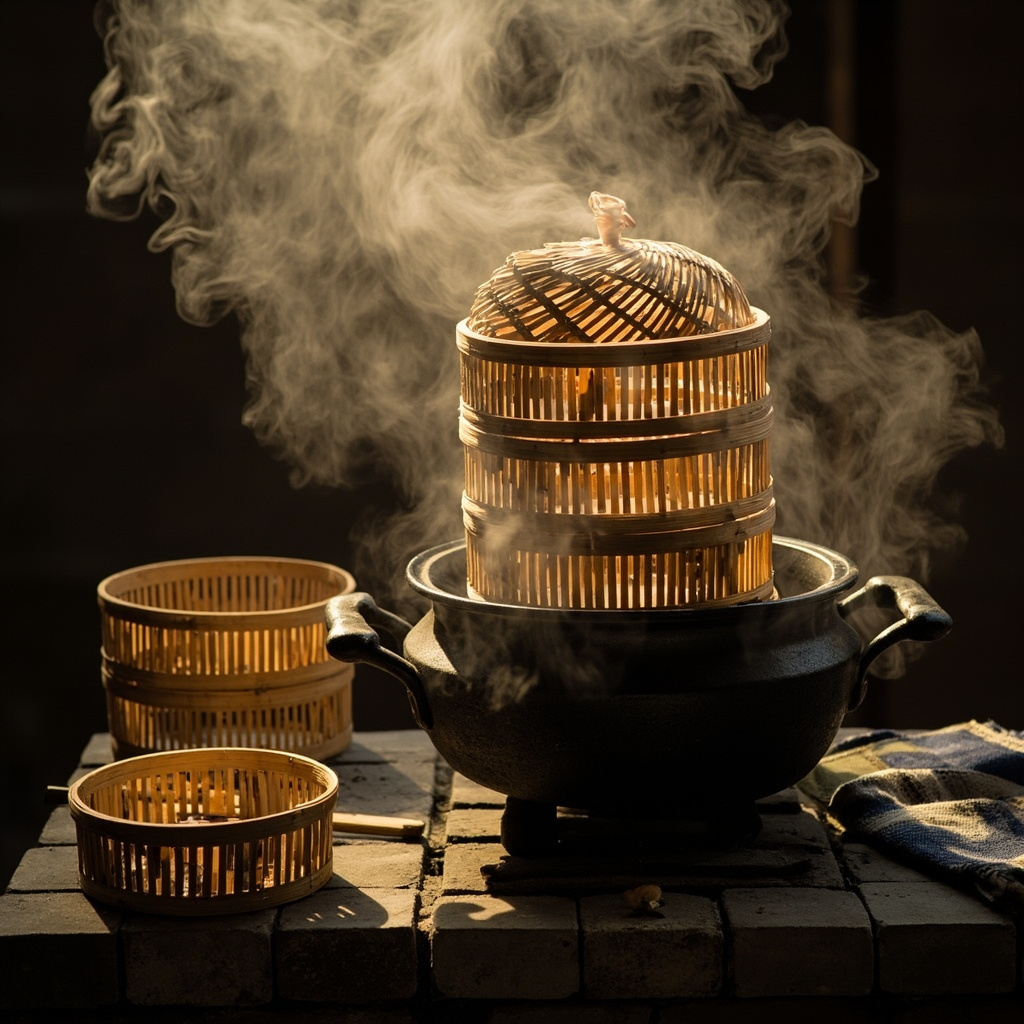
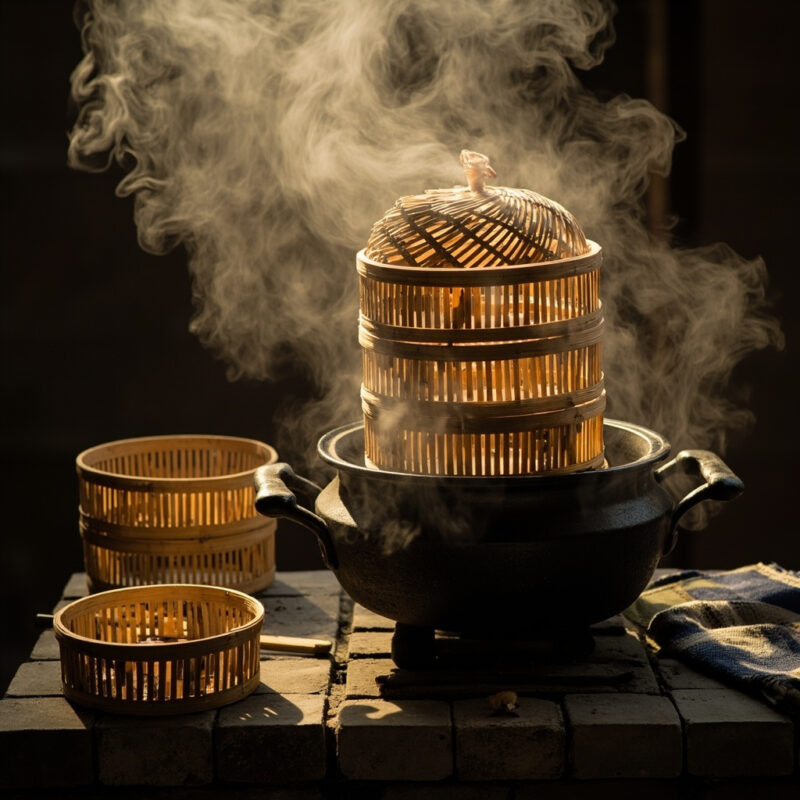
The steamer, known in Mandarin as a zheng, is a nest of round bamboo baskets, each with a perforated floor, stacked on top of a pot of boiling water and capped with a woven dome. In southern kitchens one, two and three tiers are common, the upper ones holding fish, buns or dim sum while the lowest holds the water itself. It took its mature form during the Song period, refined in the trading kitchens of the Huizhou region and carried south with the tea caravans. The English word steamer hides the point: it describes a function, not a form, and the form is modular, tiered and circular.
Why Bamboo, and Why Hollow
Bamboo was chosen for reasons that read cleanly in five-phase terms. It is a wood element object, fast growing, straight, hollow and light. The hollow quality matters more than the colour. Feng shui and Taoist practice both prize the empty receptacle: a hollow vessel receives, a solid block only repels. A bamboo tube is an ideal receiving form because its cavity is grown rather than carved, and its wall keeps everything inside it without hardening it. Empty receptacles kept in a room are treated as intake points for qi.
The Lid and the Rising Steam
Watch a steamer for a minute and one pattern dominates: vapour lifting. The steam is the visible form of qi in motion, rising from the heated water, passing through the perforated bamboo floors, filling the chambers and escaping at the rim of the lid. In feng shui terms the object performs an ascent in miniature. It draws energy from the source below and delivers it upward and outward, which is why the steamer has always been treated as a supporting object rather than a container. The lid completes the circuit, holding the warmth in.
Five Phases in a Single Pot
Open the account and the steamer speaks all five phases at once. Bamboo is wood, the structure that grows and bends. The water below is water, the phase of flow and softening. The heat that turns water into vapour is fire, the phase of transformation. The grain, the fish and the greens carried in the baskets are earth, the phase of nourishment and yield. The iron rim of the cooking pot is metal, the phase of refinement. Most household objects speak two or three phases at a time; a working steamer speaks all five.
Round Heaven, Square Earth
The steamer is built in circles and the cooking pot in squares, and this is not an accident of craft but a piece of classical cosmology made daily. Heaven is round and earth is square. The round forms above, the square forms below, and the two together make a complete axis rather than a lopsided one. The round lid has no corner to gather a sharp, obstructive angle, and no edge for conflict to catch on. Circular form is considered the most forgiving shape to keep in a busy part of a home, because it releases pressure evenly instead of pushing it against a wall.
The Woven Lid as a Pattern of Even Qi
Traditional Chinese weaving is a practical form of spatial design, and the steamer lid is a fine example. The strips are split bamboo laid over and under one another at an even spacing, producing a mesh solid enough to hold heat yet open enough to let vapour pass and escape. The working principle is the same one that gives the woven bamboo screen and the lattice window their place in the house: an even, permeable barrier that divides space without blocking it. Qi is described as liking to move through openings rather than around solid mass.
Where the Steamer Belongs in the House
Position is where the object earns its keep. The steamer belongs above the stove, in the working triangle of the kitchen where heat, water and food already converge, and it should sit on a raised surface rather than the floor. It should not stand directly over the sink, where vapour meets water and the moisture balance of the room is disturbed in the opposite direction, and it should not be pushed into a dark corner where nothing circulates. Because it gathers and lifts rather than blocks, keep it at eye level and bring it out during cooking.
The Steamer as a Social Object
Steam in a Chinese kitchen has always meant company. Dim sum arrives in bamboo baskets that are stacked, carried and re-used through the whole service, and a meal for several people is measured in baskets. Festival cooking puts the steamer at the centre of the table, lifting buns and fish and greens at once so that the dish arrives hot, fragrant and shared. The basket carried out to the table carries the household’s sense of hospitality with it. Where most remedies are personal tuning tools, the steamer is a communal instrument.
Craft, Character, and Care
The quality of a steamer is legible in its making. The best work is split rather than sawn, with the culm opened into long flat strips and the joints cut to fit without nails or glue, so the stack nests tightly and the steam travels upward without leaking sideways. The lid is woven from the same material in a fine even mesh. Seasoned wood will not mildew and keeps a clean flavour for years, while green bamboo that has not been cured will sour the food it touches.
When choosing, look at four things:
- Closed, gapless joints that nest the tiers tightly.
- Even perforation across every tier floor.
- A flat, well-woven lid that seats without warping.
- Seasoned bamboo with a clean, faintly sweet scent.
Handle it gently, keep it out of standing damp, and let it breathe between uses. Replace it when the material has genuinely tired rather than keeping it for sentiment.
A Quiet Instrument of Balance
Taken together, the bamboo steamer is a small, exacting lesson in feng shui thinking. It gathers, it lifts, it releases, and it does so while feeding a family. Wood frame, water below, fire beneath, earth within, metal at the rim. A round heaven over a square earth. A woven lid that holds warmth and still lets the rising qi go. It is not a talisman, and it does not need to be. It is an object that performs its function so completely that the function itself becomes the auspicious quality.