Chinese Stone Chime Feng Shui Meaning: The Qing and the Ritual Voice of Stone
Among Chinese ritual instruments is one Western visitors rarely meet, and it is not a bell. The Chinese stone chime, flat L-shaped stones of graduated size hung in a wooden frame and struck with a mallet, closes a ceremony rather than opening it. Chinese stone chime feng shui meaning therefore has little in common with the familiar story of bells that announce and ward, and much to do with completion and settling.
What the Stone Chime Actually Is
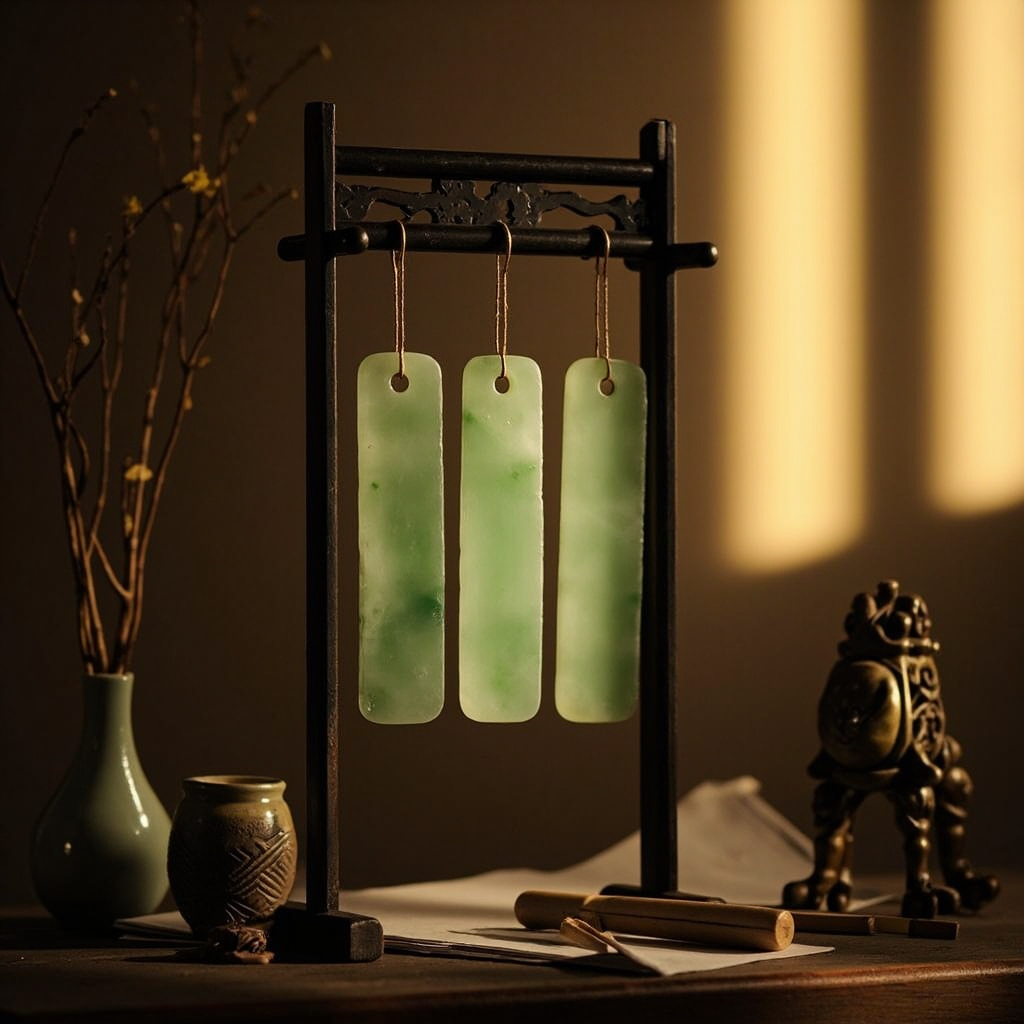
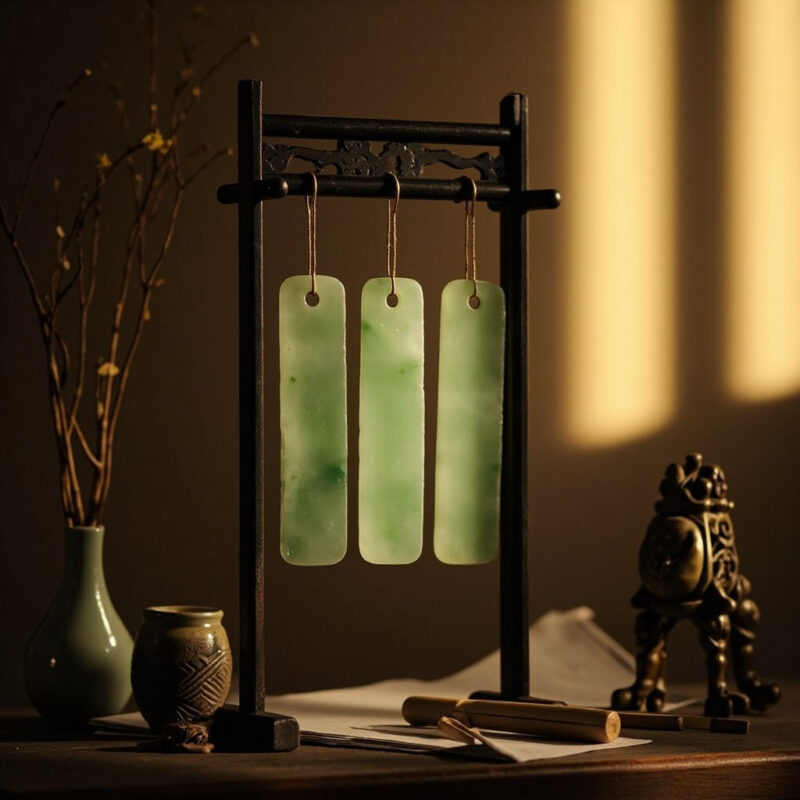
The individual stone is called a qing, and a graded set of them a bianqing. Each stone is worked into a blunt, obtuse L shape and drilled with a single hole near one end so it can be hung from a frame, and the set is arranged so the notes run in sequence, not in size alone. A standard set holds sixteen stones in two tiers of eight; a smaller twelve-stone set was also recognised. Materials run from black limestone and marble through to nephrite and jade, and the sound is always produced by a wooden mallet, never the wind.
Why the Chime Sounds at the End
Chinese ritual music runs on a division of labour between two families of instruments. The bronze bells open: the player strikes an individual bell to set the pitch and mark the start of a melody. The chime closes, and the pairing is obligatory. Where a stone chime is used a bell chime is required, the bell sounding while the chime answers. Mencius made that pairing the figure for a finished person, calling Confucius the grand synthesizer: the golden sound that begins, the jade resonance that concludes.
The classical record puts the chime early and high. When the music master Kui served the emperor Shun, he said he struck the stone and tapped the stone, and the hundred animals led one another in dance. The stone could make a disorderly population move together.
The Eight Sounds and the Stone Category
The classification of Chinese instruments by material is called the eight sounds, dividing them into metal, stone, silk, bamboo, gourd, clay, skin and wood. Bells occupy the metal class and the chime the stone class, and these two head the list because the ancient court considered struck metals and sonorous stones the foundation of ordered music, everything after them being colour. A chime is therefore not an ornament added to a ceremony, but one of the two things that make a ceremony legible.
The Stone Decides Its Own Note
Craftsmen did not cut a chime to a scale. The stone was chosen for the note it already held and trimmed around it, which is why two sets of similar material can sound different and a set is graded by pitch, not appearance. Inscribed stones record their own history: a Qianlong-period jade chime carries the name of its tone on one narrow side and the reign year on another, so the object carries its own date and authorship.
The Five Element Reading: Earth with a Metal Disposition
In the eight sounds the chime is stone. In the five element scheme the same object reads as earth, and carries a metal disposition besides, because the note it produces is bright and cutting rather than dull. Earth in feng shui is the centre, the slow digestion of what is taken in, the settling of things into place. Metal is clarity and the removal of what does not belong. A stone chime is therefore a settling instrument that also tidies: it ends a phase of activity and leaves the space cleaner than it found it.
Where the Chime Belongs in a Home
Placement follows the meaning, and the meaning here is closure. A chime at the front door announces arrivals and does the work of a bell instead. A chime belongs where something comes to an end: the far end of the movement through a house, the desk where the day’s work is finished, the counter where trading stops, a corridor where the day is closed. It is a bookend to a space, not a marker at its threshold.
- Keep it out of the bedroom. A chime struck at intervals above a sleeper works against rest.
- Do not hang it where it blocks daylight or interrupts movement through a room.
- Set it so the sound falls where people sit and work, not out toward the street.
- One large stone is enough at home. A set of sixteen is a temple instrument.
The Frame Is Half the Object
A chime without its frame is an ornament, and the frames carry their own iconography. The tiered wooden uprights set the order of the notes, and they were where the meaning was placed. A lacquered frame from the Qing period carries a gilded dragon for imperial authority and a pair of mandarin ducks below the uprights, the birds that always move together standing for faithfulness. Temple and court fittings were never neutral decoration, and a modern chime reproducing the dragon and the ducks is reproducing a statement about whom the music speaks for.
The Lineage and the Revival
The chime travelled with Chinese ritual music into the courts of Korea and Vietnam, where it is still played: in Korea a set of sixteen stones in Confucian ritual music is called pyeongyeong, in Vietnam the instrument is called bien khanh. In China the tradition narrowed after the Qing and the bianqing largely went out of use, returning in the twentieth century as a concert instrument and a collector’s object. The antique, the faithful reproduction and the modern decorative chime now sit beside one another in the market, so the terms of the old literature are worth learning before buying.
Choosing a Chime and Keeping It
A chime can be bought as a slab of stone with a hole in it, and here the difference matters more than for almost any other object in the tradition: the frame, the grading and the material are the instrument.
- Listen before buying. A good stone rings with a clear tone that carries after the strike; a resin casting sounds flat and short.
- Check for crack lines, the commonest fault, which a lacquered frame can hide from a casual look.
- Confirm the set is graded by pitch, not merely arranged for looks.
- Keep it dry and off the floor. Stone is durable, but the frame, the cord and the hanging pins are not.
- Ask for tone names if the stones are inscribed, since an inscribed chime has usually passed through real hands.
The stone chime is easy to misread as a decorative oddity, because it does not look like an instrument and does not behave like one. It sits quietly until struck, sounds once, and then is finished, which is the whole of its character. In the ritual hall it closed what the bell had opened, and in feng shui terms it describes a household that knows how to end things: work finished, guests received, the day closed, the space returned to stillness. Read Chinese stone chime feng shui meaning as a description of closure, and of the stone that makes closure audible.