Chinese Jade Cong Feng Shui Meaning: The Liangzhu Tube Bored From Both Ends
Most feng shui objects announce themselves. A mirror deflects, a bell disperses. The Chinese jade cong does almost none of that. It is a squared tube of green stone with a circular channel through it, worked in the Neolithic period and buried with the dead. Its feng shui meaning is not a function but a construction: it was bored from both ends, and where the two attempts meet is still legible inside.
What a Jade Cong Actually Is
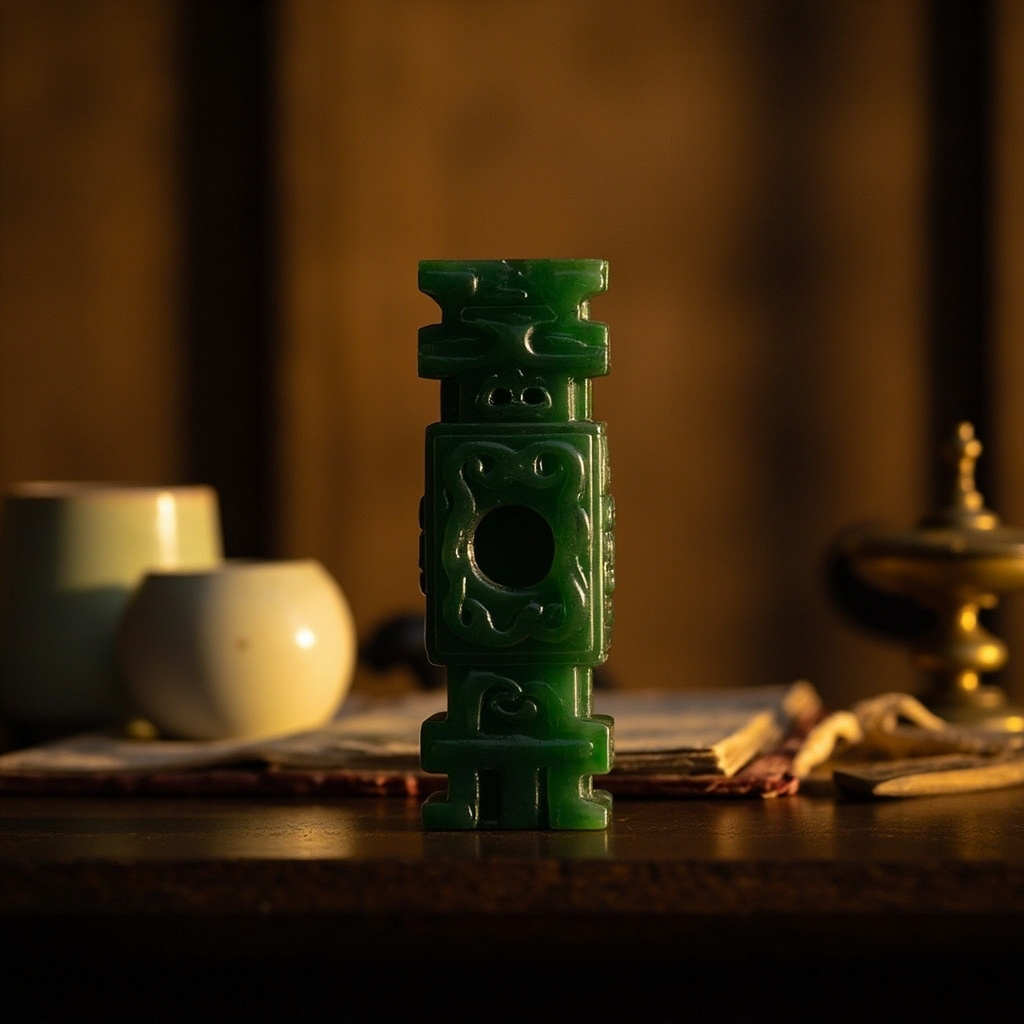
A cong is a tube with a square outer wall and a circular inner bore, its corners raised into blocks that carry a carved mask. The form belongs to the Liangzhu culture of the lower Yangtze delta, roughly 3200 to 2000 BCE, and was cut from dark nephrite. Most examples are short and plain. Larger pieces stack their registers vertically, five or six sections with a face at each corner.
- A square outer prism tapering from top to base
- A circular bore worked inward from both faces
- A low collar at each end where the tube emerges
- Carved masks at the corners, with round eyes and a nose bar
The Bore That Was Drilled Twice
Nephrite cannot be split or cleaved along a line. It has to be ground away with a hard abrasive, and a hole through the centre of a block this shape could not be worked in one run. The maker set to it from both ends, cutting two channels toward each other and finishing the tube where they met.
That method left a record. Where the two channels join, the interior shows a faint step where the bores did not meet flush. On the largest known example, 8.9 cm tall with a rim over 17 cm across, the round channel measures only 3.8 cm. The working of the tool stayed on the object long after the tool was gone.
A Square Tube With a Round Middle
A long-standing reading pairs the two great Liangzhu ritual jades: the flat disc called a bi stands for heaven, the squared tube for earth. Watch what the cong does with that pairing. The round part is hidden inside the square body, the square part outside where visitors see it. The two forms meet only in a thin slice at the rim. Heaven is not above earth. It is threaded through it.
The burial record supports that arrangement. Discs were laid on and under the body with cong tubes set around it, so a passage could run through a ring of square tubes. One excavated tomb held 25 discs and 33 cong. Whatever it did, it was done in company.
The Faces That Watch the Corners
The decoration is not applied ornament. On the larger cong, shallow relief masks rise at each corner of each stacked register, with concentric circles for eyes and a raised bar for a nose. Four corners, four faces, repeated up the height. The masks sit outside and turn toward the four directions of the room, while the channel they enclose runs quietly through the middle.
The object keeps its attention outward and its passage inward: a container that never opens toward you, working parts hidden, readable face turned out.
What the Object Was For
Honesty comes first. The function of the cong is not settled. Museums that hold them describe the meaning and purpose of cong and disc alike as unresolved, and the theories range from ritual implements to objects of rank. What is not in doubt is the effort: a cong had to be ground with abrasive sand, and a tall piece took longer than a life.
For a feng shui reader this is the important part. A tradition that kept honouring a form whose use is lost tells you the value was never only functional.
The Cong in a Modern Home
Read as a threshold object, the cong does not belong to any compass sector, and should not be placed like a talisman or a bowl of coins. Its logic is spatial rather than directional. The corner faces guard, the channel carries. That makes the right position wherever a passage enters, or where two parts of a home meet.
- Set it on a console near the door you use most
- Place it where a corridor opens into a room
- Keep the bore clear, with air around all four sides
- Give it a plain surface rather than a crowded altar
- Light it from one side so the corners read as faces
Where the Cong Does Not Belong
Three misreadings are worth naming. First, the cong is not a water vessel, and filling the bore breaks the feature that defines it. Second, it is not a wealth emblem; discs and coin strings carry that work, and a cong in a business setting reads as a paperweight. Third, it does not emit, deflect or purify anything. The cong is inert by design, and its contribution is the relationship it holds, not an effect it produces.
Reading the Stone and the Craft
Look at the bore first, because that is where the honesty lives. Hold the piece against a light and turn it slowly. You want the interior to run true, with a visible line where the two channels met rather than a modern tunnel.
Three marks of age
Fine relief on a four-thousand-year-old cong has softened until the eyes and nose bar need good light to appear, and that softness is a good sign. Colour runs from dark green through olive celadon to a cloudy cream, often with white veining. Old surfaces carry a low polish from handling, fresh cutting leaves edges still sharp. A cong whose carvings look crisp and machine-regular was made recently, whatever the label says.
Choosing and Caring for a Cong
Be clear about what a household piece is. Neolithic congs are archaeological objects held in museums. What circulates in the market is either a later revival from the Shang or Western Zhou, when the archaic shape was repeated, or a small decorative cong made as a bead. A large finely carved cong with museum documentation is not something you find in a shop.
For care, keep it simple. Wipe with a soft damp cloth, rinse briefly in lukewarm water, and dry immediately. No chemical cleaners and no ultrasonic machines, which dull a polish and reach old cracks. Keep it away from knocks, heat and prolonged sun.
A Passage Built From Two Directions
The cong is easy to dismiss as a museum piece, a square block with a hole that looks more like plumbing than philosophy. It is worth keeping in a home for the opposite reason: it is an object whose maker had to enter from two sides and could not hide the seam.
That is the lesson of the cong in feng shui terms. Flow in a space is assembled from more than one direction, the joins are where the work is hardest, and a passage need not be perfectly straight to carry something. Light it from the side, keep the bore open, and let the object hold two shapes in one structure without pretending the fit is seamless.