Chinese Ink Line Feng Shui Meaning: The Carpenter’s Mo Dou and the First True Line
Feng shui is usually described as a way of reading a place: where the door faces, where the mountain sits, where the water runs. Less is said about the instruments that made a building measurable at all. Before a house could be read it had to be set out, and that required one straight line on raw timber. In China the line came from the mo dou, the carpenter’s ink line: a wooden box, a spool of cord, and a chamber of ink-soaked cotton. It is the humblest tool in the tradition and the most consequential, since every square corner descends from it.
What a Chinese Ink Line Actually Is
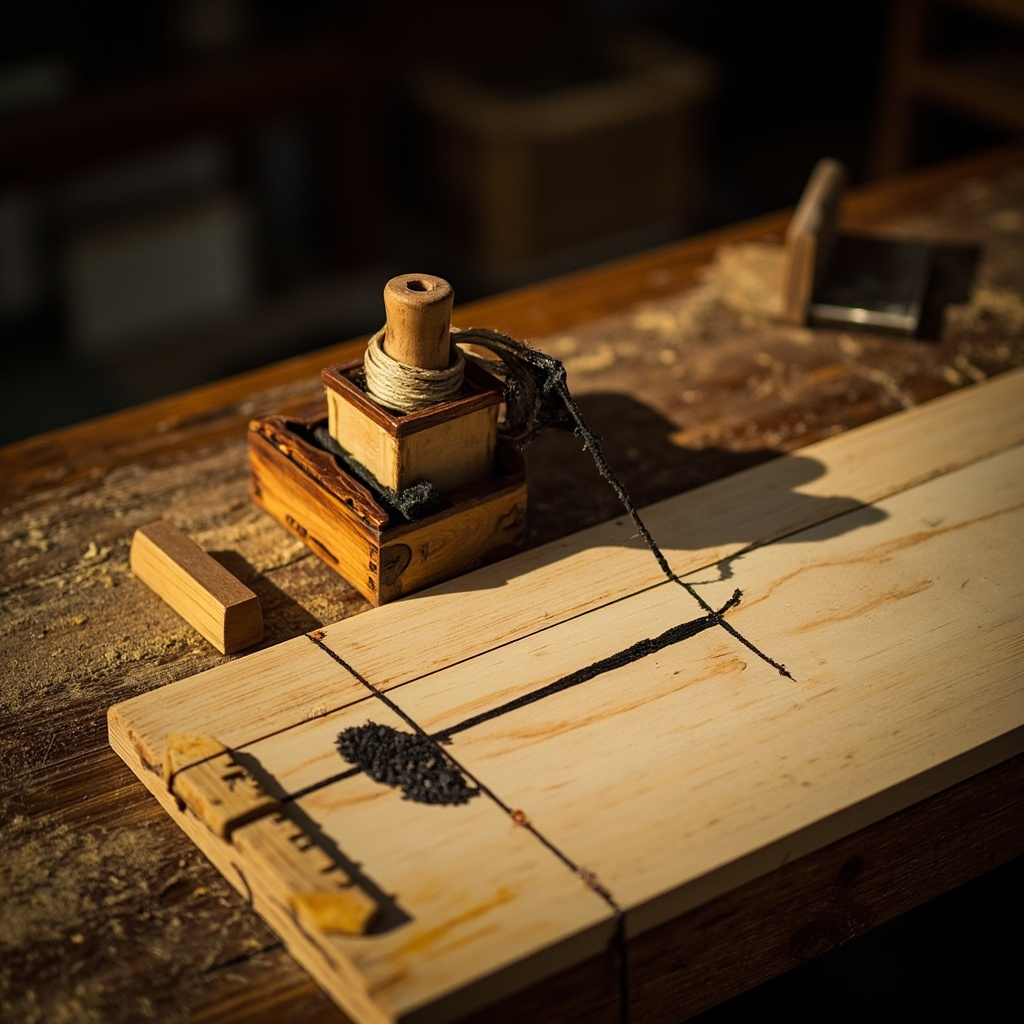
An ink line is not a pen and it does not draw. It transfers a line. A wooden body holds a spool of tightly wound cord and a chamber packed with ink-soaked fibre. One end of the cord carries a pin hooked into the timber; the other runs through the box to the craftsman’s hand. He walks the cord to the far pin, pulls it taut, lifts the middle and lets go. The cord strikes the wood and leaves a thin black line along a path that is straight by physics, not by skill.
Why the Mark Is Meant to Disappear
The most respected instrument in Chinese carpentry produces a mark designed to be consumed. You cut against the ink line, then plane it away or bury it under plaster. This is the opposite of a stele rubbing or a printed seal, where the whole point is to keep the impression. The ink line asks you to trust a mark that will not exist later. Its authority comes from the moment of transfer, not from what it leaves behind, which is why an old ink line on a shelf is a tool waiting for work rather than a relic.
Lifting the Cord: Straightness From Stored Tension
Beginners pull the cord flat against the board and drag it, smearing a grey shadow instead of marking a line. The technique is the reverse. Hold the cord clear of the surface, stretch it until it hums, lift it a hand’s width, and release. The lift stores energy; the release spends it in one instant of impact. Straightness arrives from a controlled discharge, not from steady pressure along the length. Anyone who has tried to correct a house by pressing on it slowly will recognise the distinction: continuous force rarely straightens anything, while one brief, well-aimed correction does.
Two Pairs of Hands and One Agreement
An ink line cannot be snapped alone. One person pins the far end; the other holds the box and releases the cord. Between them they must agree which corner is the reference, because each is looking at a different end of the same question. The snap witnesses that agreement. A household is not aligned by one person auditing the others. It is aligned by two people measurably agreeing where the straight edge runs before anything moves, and accepting the mark as arbiter once work begins.
The Reference Edge and the Cost of One Wrong Line
Everything downstream inherits the first line. Frame, doors, floorboards and window reveals are squared against it, so a line taken from a bowed wall produces a building that is uniformly wrong. The failure is dangerous because it is consistent: every corner is genuinely square to every other, and the assembly looks correct while sitting on a bad axis. Feng shui has the same trap. A facing direction measured from the wrong wall gives a confident, well-argued, entirely incorrect reading, and no careful analysis afterwards will reveal it.
Ink, Damp, and the Rhythm of Upkeep
Ink is the only permanently wet thing on a building site, and it will not stay wet by itself. The chamber is repacked with fibre, charged with fresh ink, and the cord reeled through until the whole length is evenly dark. Left too long, the cord dries pale and marks weakly; overfilled, it drips and blots the timber. So the tool carries its own maintenance interval, counted in days of use. The lesson transfers: some corrections are structural and permanent, while others are reservoirs that must be recharged or they quietly stop working.
Taking the First Line in a House
To read your own home the way a builder sets it out, establish the reference deliberately rather than assuming it. The order matters more than the method:
- Start with the longest uninterrupted exterior wall. That is the line the structure was set out from, and the one least distorted by later partitions.
- Next, measure the wall carrying the main entrance, because approach and facing are read from it. If the two lines disagree, the disagreement is the finding.
- On a renovation, take the floor plane before the walls. A level surface corrects much of what looks like a directional problem.
Never take the first line from a wall you intend to move, or from one visibly patched; both hand you the error you are trying to detect.
Where an Ink Line Belongs Today
As an object, the ink line belongs where work happens: a bench, a shed, a studio shelf within reach of a saw. It is not a display piece, and it looks wrong in a glass cabinet, because a tool retired from use has lost the only quality it had. Hung beside a square and a folding rule it reads as a working object and carries an authority no ornamental copy imitates. Keep it dry, keep it charged, and use it occasionally on something real.
Reading a Room by Its Lines
Most homes contain lines that reveal how the space was assembled, as opposed to how it was drawn on the plan. Four are worth checking with a straight edge and a level:
- The junction where the floor meets the longest wall. A gap that widens along its length means the wall is bowed, not the floor.
- The reveal of the main door. Uneven depth between the two sides shows the frame was set against a wall that was never true.
- The ceiling line above the window. A steady taper is settlement; a sudden step is a later alteration.
- The run of a tiled floor toward a drain. Water tells you where the plane falls, whatever the tiles suggest.
What the Tool Teaches About Correction
The ink line offers an unusually honest model of correction. The mark is temporary; the agreement behind it is not. The act is brief and decisive rather than continuous and gentle. It requires a second person holding the far end, and a reference both accepted before work began. Read that way, feng shui remedies stop looking like decoration added to a finished room and start looking like a measurement taken before anything is placed.